posted in Selfhosted

I need a new hobby, I'm going to set up my own Lemmy instance. Am I an idiot?

Of the many useful things I could do with my spare time instead I’m setting up a Lemmy instance because why not. The scope of this is definitely greater than any self-hosting I’ve ever attempted, so please feel free to tell me just how much trouble I’m in. I’m just giving the broad strokes to see if I’ve made any crucial errors (other than deciding to do this at all).

And if this is a completely wrong place for a post like this or I’m missing data I’m supposed to include I apologize, I probably need a sanity check, in more ways than one.

First limitation, I’ll be hosting it on an existing Linux Mint box acting as a file share mostly and occasional gaming PC/movie streaming box. Its hardware is overkill for this, I do not anticipate issues when it is in use. It receives regular updates and weekly reboots, instance will be set to automatically restart. NVMe with loads of space for local storage, RAID SSDs for data offload/backup.

Second limitation, I hate Cloudfare and Oracle. I do not want to use either of them.

Third limitation, money. Cheaper is better. I have a URL picked out and a registrar which will give me the cheapest long term option, in case I actually keep this thing going.

Last limitation, I’m already in over my head so I’ll be relying on a lot of googling and probably some chat bots to figure things out as I go through the actual deployment process. What could go wrong?

So, Lemmy hosted on Linux Mint box using Docker containers. ISP is a good one for this I’m told, no CGNAT, largely stable public IP but I’ll have a script running in case it does change. Confirmed ports 80/443 are open. Using Caddy for the HTTPS. Closed registration to start, if by some miracle I make it to actually wanting to allow additional users it will not be fully open, and I’ll use Brevo for the email SMTP. Security wise I know I’m making it harder for myself by exposing my IP, I’m going to have UFW running and Crowdsec to help keep incoming bad traffic out.

Down the line I’ll get Lemmy updates, backups, retention rules in place/automated, and make decisions on federation, etc. Thoughts?


enPage
🥧1

Replying to an earlier post

Yeah, Some people here really love drama and to fight other people online, preferably on a personal level. PieFed has become target of that. I don’t think it necessarily means a lot, other than we’re some high drama online place. There wasn’t any one software vs another one involved.

But everyone is allowed to pick their favorite software. They’re both fine from a technical perspective. You’ll get some different perks, but it’s all the same Threadiverse. I myself like PieFed better, including which side of drama they end up on. But YMMV. If OP wants to start on a new journey, they’re entitled to do whatever they like. Main thing with side quests is to do something in the first place. That’s more important than the exact details.

(Btw, I’ve also been using Lemmy for quite a while… It’s not like I’m in my comfort zone all the time.)

Replying to @⁨AngryishHumanoid@lemmy.world⁩

Best of luck to you!!! I just went through this last week and wow it was a challenge. I went the docker route not using ansible…and yah by far the worst install I ever went through of all the self-hosting projects I have setup…but my setup was largely complicated by the fact I had an Apache reverse proxy setup in front of the nginx proxy that has an example config provided…finally figured it all out, but yah fun times 😂 happy to help if you get stuck.

Replying to @⁨AngryishHumanoid@lemmy.world⁩

Yah i had never used it either, alot of the tutorials I found suggested it, and what threw me for a loop and was the ultimate Aha! moment for me was there is an ansible version and a non ansible version for the docker configs with different options in each, and the ultimate key thing I overlooked is on github, I kept using the “main” development branch which had changes that didn’t work with the stable .19 version. Switching to the .19 branch on GitHub and referencing those configs made it all click

Replying to @⁨AngryishHumanoid@lemmy.world⁩

You should not host anything that’s going to be public facing on your home network in 2026, period. Get a cheap German VPS and go nuts with it. There’s simply too much at stake opening up your home router/firewall for such little gain. Plus, being a residential IP behind NAT might just make it straight up impossible.

I host my own email and a matrix server. I would never think of exposing my home network to the internet. I use tailscale to get into the homelab, anything exposed to the net lives somewhere far, far away.

Replying to @⁨AngryishHumanoid@lemmy.world⁩

Acronyms, initialisms, abbreviations, contractions, and other phrases which expand to something larger, that I’ve seen in this thread:

Fewer Letters More Letters CGNAT Carrier-Grade NAT CSAM Child Sexual Abuse Material DNS Domain Name Service/System ISP Internet Service Provider NAT Network Address Translation TLS Transport Layer Security, supersedes SSL VPS Virtual Private Server (opposed to shared hosting) nginx Popular HTTP server

[Thread #76 for this comm, first seen 11th Aug 2026, 19:20] [FAQ] [Full list] [Contact] [Source code]

Hachyderm.ioImran Nazar ~ عمران نزر (@Two9A@hachyderm.io)2.8K Posts, 301 Following, 262 Followers · Front-end #typescript developer and general keyboard tapper; author of Internet RFC 7168 (Hypertext Coffeepot Control Protocol for teapots); occasional plumber, more than occasional #c64 #retrocomputing enthusiast, terrible at classical #piano. Header photo is a verdant scene looking over the landscape near Buxton, England, taken from a single-track country road.

Replying to @⁨AngryishHumanoid@lemmy.world⁩

I did a very similar setup very recently. Its not bad. I did try piefed first as some people suggested, but had some issues and it felt like it just wasn’t ready yet. I switched to self hosting lemmy and really like it. I also went with Brevo for email (I started with sendgrid, would not recommend).

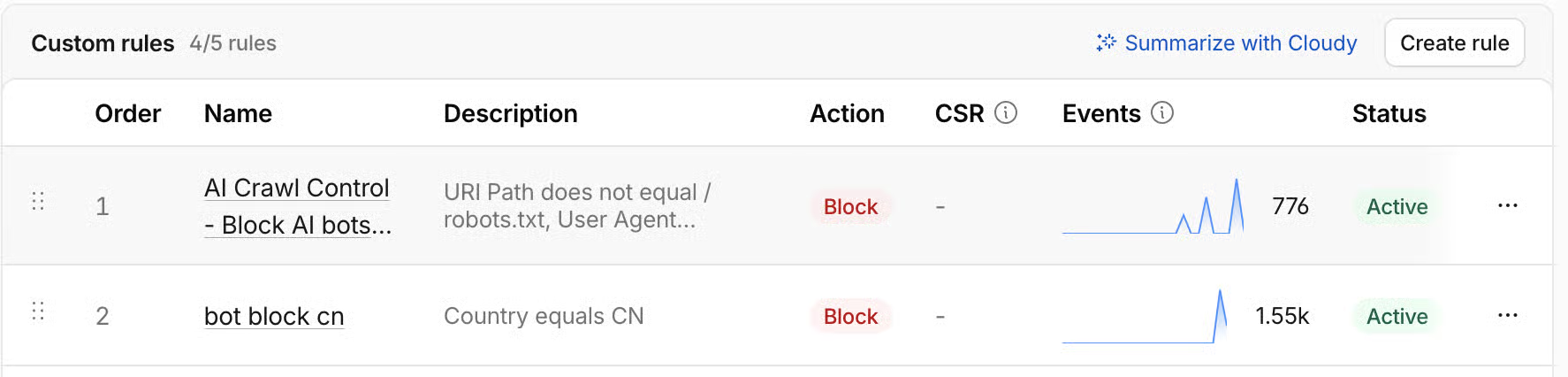
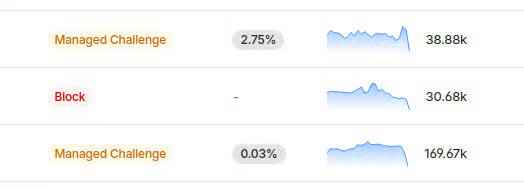
Main difference for me is I am using cloudflare (they are my registrar and they allow me to deal with the CGNAT at no extra cost which you don’t have to deal with not to mention a pretty solid WAF for free tier). You may want to implement a WAF of some kind to keep the federation in check. I federate both lemmy and a matrix home server and it doesn’t eat up too much bandwidth.

I also like saving money, so a VPS is something I was trying to avoid. Personally, I don’t think the VPS does a much for securing your home network as people are trying to say here. It is another layer of security, but it’s not a panacea. Not saying I’ll never try it though.

Replying to @⁨AngryishHumanoid@lemmy.world⁩

Lemmy eventually plans on having an invite system, you could maybe use that when it comes out

github.com/LemmyNet/lemmy-ui/issues/4128

(You can also do this manually with the application questionnaire field and a spreadsheet)

See LemmyNet/lemmy#6450 for details, and LemmyNet/lemmy-js-client#957 for js-client. cc @kryoseuGitHubInvite-only registration mode · Issue #4128 · LemmyNet/lemmy-uiSee LemmyNet/lemmy#6450 for details, and LemmyNet/lemmy-js-client#957 for js-client. cc @kryoseuby Nutomic

Replying to an earlier post

The only thing I’d say is look into whatever tooling and scripts people have made for removing CSAM from your instance. I messed around with a Lemmy instance for a bit, but when I heard about how hard it was to deal with the pedos, I got a little scared about inadvertently hosting CSAM and decided to shut it down. Since then I think I remember hearing about some better automated tooling for that kind of thing though so hopefully you can set that up.

Replying to an earlier post

There’s this specific issue, which is critically important, but also just content management generally.

I think micro instances are a real target for people with nefarious intentions - whether it’s porn, trolling, spamming, fascist groups, whatever.

The hardware and software aspects should be relatively straight forward. The real difficulty will be monitoring new communities, and users.

Replying to an earlier post

I would NOT host a Lemmy instance at home unless you’re going to obfuscate your IP address. If you make it public, you’re inviting any whackjob that sees your username to find your physical location. Additionally, I wouldn’t host it on a PC that you actually intend to use for day to day stuff, just in case the instance gets hacked and someone manages to escape the container it’s in. If you wanted to do this, I would put it on its own box with Cloudflare in front of it, otherwise you’re inviting trouble where there doesn’t need to be any.

Replying to an earlier post

I keep seeing “escape the container” mentioned like it’s a very common occurance. Is it really? I’ve looked up escape CVE’s and they seem to be few and far apart, they’re usually tricky to pull off, and when one comes out it’s a big deal and they get fixed right away (obv).

Actually my issue isn’t “do escape CVE’s exist”, it’s more like, should I really waste my time planning for it? It’s like planning for file permissions not to work, or logins to be bypassed.

I get that shit happens and why defense in depth is a thing but how do you defend from something so fundamental? If you operate under the assumption that containerization can be by bypassed, and virtualization can be bypassed, where do you draw the line and what do you do, run each app on a standalone physical box?

Replying to an earlier post

I would say that finding that balance is up to the individual admin and application, really, which is where the defense in depth comes in. Yeah, it’s rare, and if those exploits are being used it means you’ve got the attention of someone you probably can’t really stop, but it’s something to take into consideration. Bad configs can cause data leakage across container boundaries, too, so without knowing the admin’s skill level, I tend to recommend against sharing that hardware with something that might have something valuable on it. AI has made it easier for script kiddies to find zero-days and exploit APT-level vulnerabilities, too.

Replying to an earlier post

I probably wouldn’t host it at home, there are so many personal devices containing personal information on the network that I don’t consider the risks involved worth it. I would get a VPS, even if they’ve increased in price lately. If you do set it up at home, you will have to harden the server and the network, and that requires a lot of time, knowledge and effort. Just keep this in mind!

Replying to an earlier post

I think the bigger concern is someone uploading CP to it and then maybe having your house raided by the cops. Even if you completely separate your personal files from the lemmy server, the police are just going to seize every computer in the house. And the fact will remain that they found CP on your computer. The burden of proof then falls on you to prove that it wasn’t you who put it there.