
Hopefully they get access back and someone learns enough to at least apend a few grand on some cold storage tapes.
Hopefully they get access back and someone learns enough to at least apend a few grand on some cold storage tapes.
Heck its pbs. They should have publically archived it so anyone could keep a copy. At least the old stuff.
Replying to @MangoCats@feddit.it
That sounds like the vast majority of “app” developers.
These things are a casino market.
Replying to @relativelyrobin@mander.xyz
You are conflating micropayments (sufficient to pay creators) with gateway monetization, which would need to be small enough you could still use the internet (lets say thousands of pages a month) but high eough to dissuade scraper bot operators. I am not sure such a price exists. Maybe for some bot operators, but the various AI companies have more money than all regular internet users.
Replying to @ricecake@sh.itjust.works
In other words - car usage expands to the limit because human nature is to use the resource until it gets inconvenient. The gas expands to fill the container.
Replying to @WorldsDumbestMan@lemmy.today
Overlay networks are also feasable.
Replying to @MentalEdge@sopuli.xyz
The term was useful back when we used coal gas. It stopped being useful 100 years ago.
Replying to @pineapplelover@lemmy.dbzer0.com
Indeed, I log in pretty rarely.
Replying to @pineapplelover@lemmy.dbzer0.com
Their admin interface is slow and awkward, but otherwise happy. Their deals are always changing and I currently have good specs for the money. EU company and my machine is in Montreal, so I was happy with non-American hosting and green electricity.
Replying to @lmuel@sopuli.xyz
Not going to disagree, but “web usage” is basically everything. You can literally run an entire desktop operating system from 2007 on a virtual machine emulated in JavaScript in your browser now.
Replying to @pineapplelover@lemmy.dbzer0.com
There are constant scanners on any site and scrapers on websites, but it is far less of a problem than you would imagine unless you have a big wiki or software forge with hundreds of nested commit history pages for them to spider into.
I also run private servers on hidden subdomains (with wildcard certs and DNS entries), so the low effort scanners never bother them.
DDOS attacks take money, so they aren’t typically going to go after some random homelabber. If it did happen, I would either just shut it off for a while or change the VPs IP. Ovh also has some of its own ddos protection.
Replying to @pineapplelover@lemmy.dbzer0.com
Keep in mind that you wouldn’t route local traffic through it, so everything watched at home would be direct and not count.
I have a $5/mo VPS with OVH and they allow unlimited bandwidth within reason. Unless you have multiple households streaming from your server all the time, likely totally fine. If you do end up with one relative streaming 24x7, then I would look at installing the tailscale app on their TV and configuring things to connect that one user direct to your home server.
A VPS takes some learning, but IMHO, it is the “correct” answer and worthile learning.
Replying to @Funkt4st1c@lemmy.world
If it weren’t for the overwhelming harm and the insane ramblings of those pushers, we could actually rationally discuss all of the useful things that can be done with it. There are plenty - its a pretty good tool in any engineers toolbox - but there’s no point in itemizing them because the much greater issue is the ai psychosis taking over our entire financial, economic, and governmental systems.
Replying to @mirshafie@europe.pub
Absolutely. Every AI company has Anna’s Archive in their training data already. They want to differentiate their models by having more training data than their competitors. There are way more books out there that have never been scanned than those that have.
Replying to @Willy@sh.itjust.works
That is the justification and not the reason. Its faster and cheaper to cut the bindings, and they would have to store the books while they are using the digital copies to comply with copyright.
Replying to @FinishingDutch@lemmy.world
If they were archiving digital versions so they could be read by thousands in the future, this would be a totally different conversation.
They don’t even need to be as selfless as the internet archive - just follow Googles lead and allow people to search and view selections the archive, with automatic opening of the archive when you are confident copyright is expired. Even a closed archive owned by a third party with a dead mans switch to open it in the future when the business model is done would be something.
Replying to @Sylvartas@lemmy.dbzer0.com
When destroying books, we don’t actually know what will be important in the future. That’s why archivists spend so much time archiving mineutia without trying to curate. Those are different jobs and you can’t curate for the future.
Replying to @Bluescluestoothpaste@sh.itjust.works
Yes… If they were archiving their scans. Which isn’t happening.
Replying to @urandom@lemmy.world
Keep in mind that books often become culturally important decades after their print run, sometimes when the copyright is ambiguous.
And also keep in mind there are technically, an insane number of “rare” books out there, but important rare books might only be important to people without the money to pay for another printing.
I could almost forgive this prrocess if they were /also/ archiving these books (leven if limited ike Google books does), but they won’t, because they are so focussed on staying ahead of compeditors based on the “knowledge” in their training data.
Replying to @altkey@lemmy.dbzer0.com
That is not required by law. It is just easier to cut the bindings off. The other way is slow: archive.org/details/eliza-digitizing-book_202107
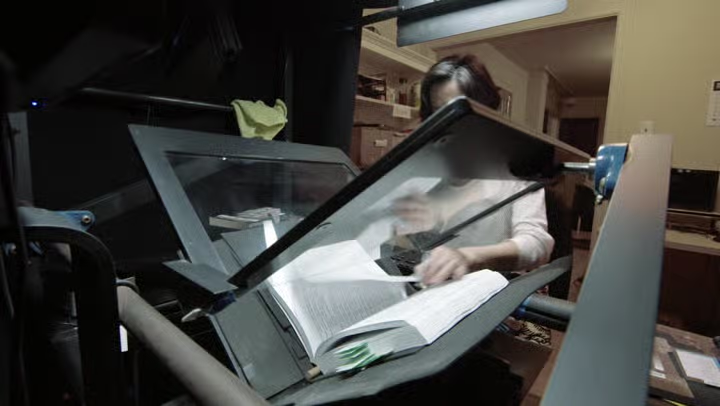 Internet ArchiveEliza Digitizing a Book : Internet Archive : Free Download, Borrow, and Streaming : Internet ArchiveInternet Archive employee Eliza Zhang digitizes a book. At the Internet Archive, we never destroy a book by cutting off its binding. Instead, we digitize it...