I don’t know why this needs to be a joke. Assuming the rest of the company is minimally competent and the middle managers can write clear executive documents an LLM will probably beat the average CEO just by virtue of not having moods. The only downside is that LLMs can’t do in person “social networking” yet.
All true. To your question, however: until software can be named as a legal fiduciary, CEOs can only be functionally replaced. That is, a real person who can be summoned by a court has to take responsibility for whatever shit the LLM gets the company into.
E: way more replies than I’m used to, most re: same issue, so I’m clarifying here.
Preface: totally not my area, IANAL.
To clarify, I specifically meant CEOs can be named in a lawsuit by the shareholders for failure in fiduciary capacity. I didn’t mean a summons to answer for the sins of the corporation. TLDR: math models can’t be sued.
The middle managers can take turns as the Straw CEO for legal purposes. Or maybe someone can provide Straw CEO as a Service while living somewhere with few extradition treaties.
Rotate it as an “on call” role monthly among all employees. If called upon to act, the person receives CEO-level salary for the necessary hours. And they’re in the running for an end-of-year bonus, to be voted on by all employees depending on the results of their actions in that role. (Splitting it between equally-valuable Acting CEOs is permissable.)
I believe the corporation itself is treated as a distinct legal entity for litigation purposes and shields officers of the company unless there are specific circumstances around any individual. I don’t think there is a legal requirement for a corporation to have a CEO. I think this just further confirms the idea of the CEO “role” being fully automated to be more than viable and a genuine costs savings. Much lower risk than relying on AI to replace skilled technical functions.
Someone with more corporate legal knowledge could provide further insight.
It depends on the country and the documents used to create the company.
US, UK, Australia & NZ (and probably Canada but I don’t know) have fundamentally the same (not identical but pretty close) corporate governance laws.
Yes a corporation is a separate legal entity; that was established in case law back in the 19thC in the UK (Salomon V Salomon), it does not however means that individuals are always protected, you can “lift the corporate veil” in specific circumstances (negligence fraud etc). IOW a corporation can be sued but sometimes the individuals inside the corporation can also be sued
I’m not aware of any laws in the above countries that require the presence of an explicitly named CEO role, however all the standard laws require governance of the organisation through the directors and via directors & shareholders resolutions. An individual company can specify a structure in the documents used to create it (variously called things like a constitution or memorandum and articles of association depending your country/state) mandating that certain roles need to exist within the coy but that is optional and not standard.
To address your actual point as opposed to the law, the CEO is an operational decision making functional role. If someone is making strategic decisions whether their title is Managing Director, CEO or Chief Stupidity Officer it doesn’t matter, it’s a functional role not a legal one. The legal buck stops with the directors regardless of who or what is making decisions for the company, however if there is a live person in the CEO role they can be sued on the “lift corporate veil” bases (fraud negligence malfeasance etc). If the CEO has acted within their bounds and in good faith then any issues sit with the directors (note I’m trying to condense a massive list of if ands and buts into a pithy sentence, there’s a zillion exceptions but that’s the broad rule).
So yes, the board could legally put an AI in place and direct it to run the company. If it makes bad or illegal decisions that liability rests with the directors.
If the AI oversteps its delegated authority is possibly the one area where it could get legally interesting. I would expect the directors to be held liable for any decision the AI made even if it executed something it was explicitly told not to as it is reasonably foreseeable (by anyone with a functioning brain cell anyway) that that could happen and oversight is needed. I could also see a board dragging the AI provider to court to try and hold them as being accountable (don’t think they’d win, but I can see there being a lawsuit)
EDIT some grammar/punctuation and a couple of wording tweaks for readability
See now this is interesting. I believe there is a difference between bad decisions and illegal decisions and what individuals can be held liable for. As long as a company using this “CEO ai can demonstrate reasonable frameworks were in place around the decisions it was acting upon, such as “hmm maybe we won’t eat the first born child of every customer or let’s not spend the companies full cash reserves on crack”, I think there are protections from liability.
This simply came out of me challenging the assertion in a comment higher up stating that a company still needed a CEO/person to be held liable for what the LLM could do. I didn’t think it was that black and white.
So board of directors are liable if the company itself isnt directly liable is the short answer, directors can hold joint liability along with the company
Well, not quite. The corporation is a distinct legal entity, and is served a summons per se. For practical purposes of actually delivering the papers to a person, the corporation must have a designated representative. This may be anybody, and there are businesses that specialize in serving as the designated representative for perhaps hundreds of corporations. (Especially those that exist only as legal entities.) I know of one nearby me that’s basically just a mailbox, even though it’s listed as the address for many, many corporations.
The whole purpose of a corporate entity, as a legal concept, is to shield the directors, and officers, from personal liability. Unless personally named in a suit, a CEO almost never shows up in court. That’s a job for an attorney.
That would be the Board of directors for the company since they select the CEO or virtual equivalent. But current laws don’t support bringing anything against a CEO for a company’s wrongdoing. Even less for the board of directors.
I’ve seen from personal experience that the only thing worse than bad middle management is no middle management.
Getting called all the way up to the VPs office to try and explain some systems architecture to a guy who only knows how to say “But why doesn’t it work?!” at you over and over again is… not fun.
Although simulations agree with you, that LLM powered agentic frameworks are more efficient than human CEOs at optimising a company. They’re also incapable of feelings, making the board of directors fire them in the majority of simulations, for being too cynical
Replacing CEOs with agentic LLMs, is not a benefit for the workers. Far from it, unless you prefer an openly psychopathic CEO
I suppose that depends. A while back I found a headline where some researchers simulated putting an AI model in charge of a business. Apparently it was tragically bad beyond their wildest expectations and ironically enough it eventually decided to focus on spending all of its efforts purchasing paper clips.
A tech journalist sets up a company of all AI agents. CFO, CTO, HR, Sales, etc. He is following the capabilities advertised by all of the various vendors. He makes significant progress. He demonstrates that is is indeed possible. And some really absurd things happen along the way. Like the vendor advertising that agents are perfectly capable of this hanging up on one of them in disgust.
This seems over engineered. I’m pretty sure a simple program that just replies “yeah sure” to anyone from the right department asking about something would outperform most CEOs.
The primary role of the CEO is to solicit cheap lending from banks. A simple program can’t do that. You need a real human being at the business with another real human being who was friends with that first human being in college and who now works as a broker at a big financial institution to stamp the loan.
This is every billionaire’s path to power. Not via what they know but who they know.
But the owners of the website have no control over the administration of business infrastructure.
Like, its all very tongue-and-cheek, but it mostly illustrates that our economic model isn’t based on “efficiency” or “meritocracy”. The folks calling the shots have their positions by way of inheritance, influence peddling, and state-sanctioned violence.
You are really a thought leader, I’ll need to ping some ideas off of you to help move the needle. But we will have to circle back. We can take this offline.
I would say that doing so would mean that there’s no one to hold accountable, but then I remembered the hellscape I live in where ceos don’t face accountability anyways, so yeah…
No one knows why some CEOs succeed so much, and others fail so hard. Rather than admit that they are guessing, executive suites and boards of directors both engage in mystical thinking, and then shed as much blame/yank as much credit as they can get away with. CEOs are where they are because of a social club, and not because they have any specific demonstrable skills, high intelligence, overwhelming empathy, insight into the future of business, unmatched creativity, etc.
Hallucinating that CEOs know what they should be doing, and the “more hours worked means more things got done” thinking are the largest and most damaging mental viruses of the corporate world.
That’s true when you consider their official tasks…
However after years in industries, it became apparent to me that their maon job is to “have contacts in high places”.
When your CEO signs a deal with their friend’s friend for the biggest contract of the year, it’s hard to replace that by an AI…
It’s parody right now, but as you read the article, it begins to make perfect sense that AI is far better suited to replace the responsibilities of a CEO, than the varied responsibilities of the workers, especially when the economics are taken into account. You can save millions by getting rid of workers, but there’s a lot of work involved in replacing all those jobs. Or you can save millions by getting rid of a single CEo, and you only have to replace one job.
At some point, somebody is going to offer this service for real, and companies are going to use it.
It might sound like a dream, but these replacements aren’t happening as long as the shareholders can’t blame the AI when the company does something bad. They don’t want to end up in prison.
I have a fantasy that someone tries using data driven systems to run business. They’d still need AI to do all the C-speak and top-tier sales work, but as it is upper management commonly resents their own workforce and enacts policy just to be vindictive.
Imagine a game company that didn’t crunch because it knew crunching only slowed productivity and wrecked the health and morale of the dev team.
Imagine a company who didn’t issue RTO mandates because it saw it’s telecommuters are more productive and happier working from home.
Imagine if businesses didn’t surveillance-max and micromanage their administrative clerks and fulfillment teams understanding that doing so slows them down and makes them miserable.
I don’t know for certain that AI-assisted computers can run businesses and manage well, but we have countless examples of how upper management lets their feelings get in the way of maximizing profit and demonstrate incompetence and lack of adult maturity.
AI can’t do a CEO’s job. A CEO is just a professional schmoozer. They’re there to interact with and sell the company’s services to a bunch of rich bastards. They’re basically a highly paid escort that mostly gets to keep their clothes on.
If that’s all a CEO was, then we’d have much more functional companies. But the CEO is also the top manager of the company and dictates policies that affect how the company is run. We’re seeing specific examples of what is nothing short of labor abuse by executives such as Zuckerberg, Musk and Bezos. And they choose their policies for purely emotional reasons, as an expression of resentment and vindictiveness toward their own workforce.
In fact, this is the core of their fantasy regarding AI, that with enough R&D it will be cheap enough to replace their human staff entirely with robots, who don’t have opinions and don’t fight for better treatment.
If a company separated the executive suite from upper management, and instead had a brain trust to maximize profits by hard data and cold calculation, I submit human labor would be better treated, since well-treated workers operate at an improved rate of productivity, which actually makes it profitable to make sure they take their breaks and eat their lunches.
History shows us the ownership class always thinks their workers are willfully withholding effort, and as we’ve seen during the North Atlantic slave era, the ownership class will work labor to death if they are allowed to do so.
It just offers a service. Googlemail doesn’t threaten to provide me with an email address.
A gardener doesn’t threaten to maintain and tend to your garden.

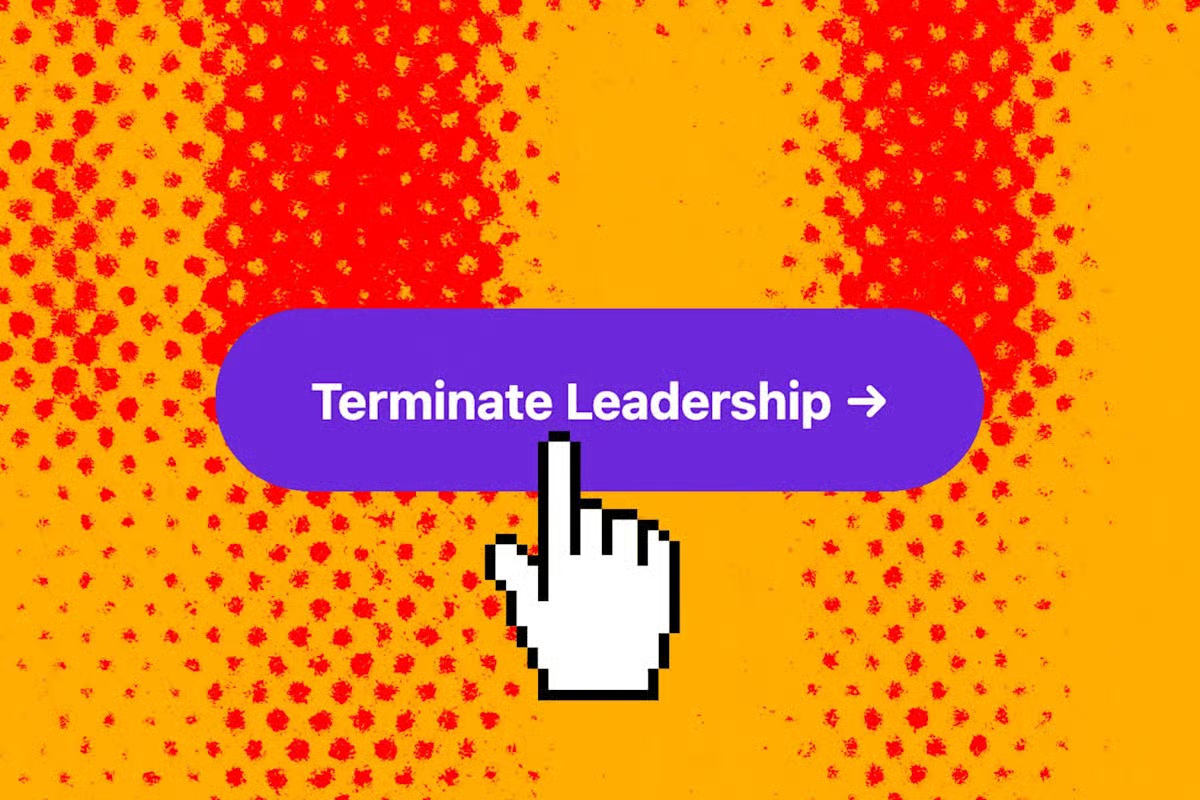 Yahoo NewsNew Parody Site Threatens to Replace CEOs With AI for Tiny Fraction of Their Bloated Salaries"Introducing the world's first Chief Executive Replacement Engine."