Replying to @⁨NaibofTabr@infosec.pub⁩

I mean making the machines to make chips and making a factory that uses said machines are two different things.

There are already factories in China making DDR5 and DDR4 ram now days.

Huawei would just provide the support and resources needed to scale up a new large factory.

No slave labor needed. All you need is a modern, advanced, high skill, responsive industrial base which China has.

Replying to @⁨mholiv@lemmy.world⁩

I mean making the machines to make chips and making a factory that uses said machines are two different things.

True.

There are already factories in China making DDR5 and DDR4 ram now days.

Are they actually fabricating the silicon, or just packaging it?

No slave labor needed. All you need is a modern, advanced, high skill, responsive industrial base which China has.

Sure, like the people working at Foxconn:

truthout.org/…/a-suicide-survivor-the-life-of-a-c…

A white lower-case t on a black backgroundTruthoutA Suicide Survivor: The Life of a Chinese Migrant Worker at FoxconnIn 2010, 18 employees working for Foxconn in China attempted suicide. These shocking events focused world attention on the manufacturing supply chains of China’s export industry and the experience of…

Replying to @⁨NaibofTabr@infosec.pub⁩

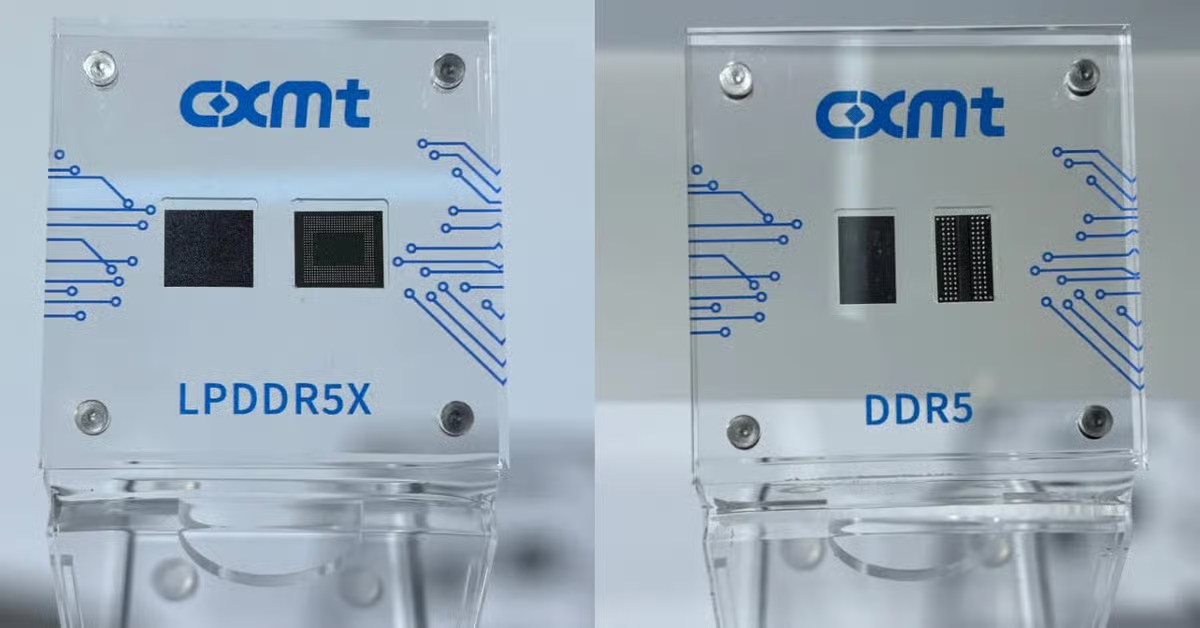
They are making it from scratch. There are lots of sources but this is the first one I found. I assume they package it as well.

tomshardware.com/…/chinese-memory-maker-cxmt-ente…

Foxcom assembles sub models into complete products. Still higher than slave labor level skills, but not as high as chip fabrication I admit. You need a skill base to assemble phones at a high level.

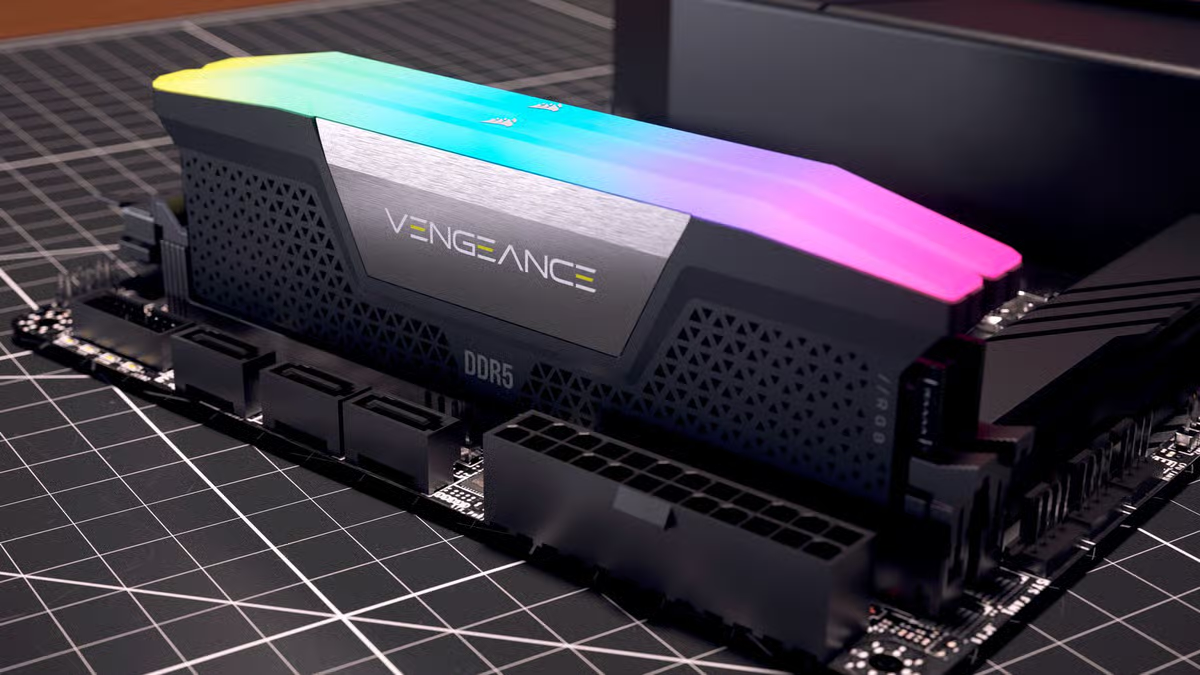
Vengeance RGB DDR5 MemoryTom's HardwareChinese memory maker CXMT enters mainstream consumer memory with Corsair Vengeance DDR5 kit — Chinese-made DRAM emerges as an antidote for crushing shortagesCorsair typically only buys from Micron, Samsung, or SK Hynix.

Replying to @⁨NaibofTabr@infosec.pub⁩

Huh. I was skeptical of “China speed” but they were right. Lol.

techpowerup.com/…/chinese-cxmt-to-match-microns-d…

I’m just glad for lower ram prices.

TechPowerUpChinese CXMT to Match Micron's DRAM Manufacturing Capacity This YearChinese memory giant CXMT has been expanding its capacity so rapidly that the company is now able to compete with one of the largest memory manufacturers in the world—Micron. According to analysis from Citrini Research and their proprietary data, CXMT is projected to produce about 350,000 DRAM...

Replying to @⁨MyOpinion@lemmy.today⁩

techpowerup.com/…/chinese-cxmt-to-match-microns-d…

China speed was even faster than you predicted. Lol.

TechPowerUpChinese CXMT to Match Micron's DRAM Manufacturing Capacity This YearChinese memory giant CXMT has been expanding its capacity so rapidly that the company is now able to compete with one of the largest memory manufacturers in the world—Micron. According to analysis from Citrini Research and their proprietary data, CXMT is projected to produce about 350,000 DRAM...

Replying to an earlier post

I brought up last time that if RAM prices keep going up and up, it makes more economic sense to make more factories/facilities.

Theres always those people who say that it doesn’t make sense to make new facilities, but I really dont see chip shortages to stop. With climate change being a thing and supply chain issues popping up more and more, I just dont see an end within the next 10 years. Makes more sense to bring some of that in house.

Replying to @⁨Zedstrian@sopuli.xyz⁩

I wouldn’t enter a cartel-protected market either if I had to finance that myself. If I had a captive bloc-sized market at home though…
China is big. There are a lot of customers there. And the government tends to plan long-term and is heavily subsidizing chip making tech for geopolitical reasons. Entering the western market is high-risk. Entering the Chinese market as a Chinese company and then also selling outside China after scaling up is low-risk.

Replying to @⁨sanitation@lemmy.today⁩

Even if you started a few years ago, you won’t get a working fab producing anything within 5 years and that is considering if it’s a 5 or 7nm chip. If you want anything as advanced as tsmc 2nm chips, you’re well within 10-15+ years.

I live in Taiwan and have friends who work at TSMC. They are NOT kidding around when it comes to security. No personal cellphones. No smart devices. My buddy couldn’t get approved for a basic pedometer.

Replying to @⁨rollerbang@lemmy.world⁩

No, I’m saying this article is literally meaningless. Nobody knows what the hell will happen in 1 year let alone 15+ years later.

Assuming TSMC or Samsung or hell, even Intel didn’t do ANY improvements or even finish the fabs they are CURRENTLY working on. Even with this rare assumption, Huawei won’t effect the market. They are simply too far behind the tech to be able to make a difference.

Replying to @⁨sanitation@lemmy.today⁩

Huawei is far ahead of Nvidia in AI clusters despite sanctions made against it, and 5 year behind tech stack. 50% cost/performance advantage over GB300 nvl72, (including building costs) by building outdoor siteable pods with 3 week lead times. CXMT is now most valuable company in China, but because of Huawei sanctions, they sell 64gb ddr5 modules at higher price than Samsung just to Huawei. Huawei needs its own RAM fab because it is harassed by west, and Chinese suppliers price to them with “captured customer” awareness.

Replying to @⁨sanitation@lemmy.today⁩

I know chip and RAM fabs are incredibly difficult and expensive to build, but how is the several trillion $ out there just up for grabs for anyone that can undercut the like 4 companies that have one not enough for tons of huge companies to say “I don’t care what it costs, I don’t care what you have to do, because even if I pay 50x what it costs nvidia to make a fab, I will still be scrooging like a villain”?

Replying to @⁨khepri@lemmy.world⁩

For western-oriented companies, it’s a trap. All RAM makers outside China are in a single cartel. When anyone tries to undercut prices, they all lower their prices too and starve out the new competitor. Then, prices go up again.
This is why only China can solve the RAM crisis. They need their own full-scale domestic RAM production for geopolitical reasons and are therefore not disincentivized by the cartel existing.