Damn, having him nationalize the oil industry with 50% of the revenue funneled towards development of alternative energy. Don’t threaten me with a good time.
“Uber Eats and DoorDash hid tip buttons and set default tips below 10%. As a result, tips for delivery workers fell 79%,” Mamdani wrote on X. “In January, we made these corporations change their apps.”
Not on board with this, JUST PAY THEM A PROPER WAGE.
While I share the sentiment, he doesn’t have control over Federal wage laws. Ensuring that being tipped sufficiently is the norm is about the best option he has to protect tipped wages. I’m not sure if he can somehow ban tipped employment within the city or not. If he can, maybe that’ll be planned in the future.
They can. Seattle’s minimum wage is the highest in the country, and we even have mandated that delivery services pay this minimum wage. Now they show “extra fees” to “pay for this” like they didn’t have the money for it before…
It depends on the state. In Nebraska, two of the largest cities are fighting a legal battle over whether they can raise minimum wage to meet a ballot initiative that the unicameral watered down.
Exactly! Set the minimum wage to a reasonable level; mandating tip buttons by law is asinine. The government should be discouraging paying people via tips, not mandating it.
I think part of the problem is also that these delivery drivers aren’t wage employees. They’re technically self employed/contractors for these companies. Which means that the rules about pay and minimum wage are slightly different
I don’t know of a single person who drives their own car for these delivery apps that makes a significant profit after taking into account their milage/gas costs. Many people actually claim a loss if their vehicle isn’t very fuel efficient and they aren’t being efficient about doing multiple deliveries on one route. The only people I know who make decent money are those that do deliveries with a bike. So while Mamdani can help the situation a little with city ordinances and stuff, what we really need is federal regulation on these companies
In Germany that is called “scheinselbstständig” like “bogus self-employment”, a worker who is officially hired as an independent contractor/freelancer, but in reality works like a dependent employee. And that is illegal since it specifically undermines employment laws etc.
What possible benefit is it to these companies to hide the tip button? The usual scam is that the company keeps some or all of the tips for themselves.
In that case they would like to get rid of tipping entirely, but then the drivers would stop driving.
My dad drives for Uber Eats and he accepts less than half of all delivery offers that are sent to him while he’s signed in. Many of those offers pay so poorly he would lose money on fuel costs if he did accept them. Shit like somebody wanting him to drive across town to deliver them a single Starbucks drink and putting no tip on the offer. Some of these things are just idiots not knowing how to use the app and picking restaurants that are 10 miles away instead of the equivalent restaurant nearby.
My dad makes most of his money from expensive orders to high end restaurants where people put down $20+ tips, but those are not common enough to rely on. Thankfully, where we live, the government has forced Uber Eats to “top up” his pay to minimum wage if it falls short, and they aren’t allowed to include tips in that calculation.
Corey doctorow writes about this in his brilliant book “Enshittification - Why everything suddenly got worse and what to do about ut it.”.
It’s to take away the power for drivers to choose rides based on earnings.
The tipping is manipulated by the company both towards drivers and customers, to optimize for profit above predictable earnings for drivers and reliable service and fast deliveries for customers.
It’s algorithmic manipulation and “twiddling with the knobs” to bring in marginally more profit and less payout per transaction.
Just like Uber does with it’s transportation services. Drivers that take any ride that comes up, earn less pr drive, while drivers that are reluctant will get incentivised to drive more (and then gradually earn less).
Companies are using the huge amounts of data they have to manipulate both customers and service providers, it’s the devil in all these “middleman” businesses. It’s a rotten and hugely shitty way of doing things and its gradually becoming the norm for fucking everything.
I cannot recommend Corey’s book enough, not only is it clear and concise in describing these mechanisms in several markets and technologies, it’s easy to read and witty with Corey’s beautiful bitter sarcastic takes all the way through.
Mass data has made everything worse. Everything has to be optimized now down to the 0.000001% to make sure every cent is sucked away from regular people.
Doctorow has also been doing podcasts recently (probably as visibility to promote his book). He’s been on with both Trevor Noah and Jon Stewart recently that I saw.
Really great (and depressing) hearing him lay out all the ways things have enshittified
my first thought is it is to attempt to deceive people. By hiding the tip button, it gives the incorrect picture that they don’t allow tipping, which is standard for companies that don’t pay tipping wages. I expect they did it so their customer not only orders more, but also thinks that they are paying their drivers a living wage as they don’t need to tip.
Cities typically offer public transport, so I do wonder what it would it would take for a city to run their own ride-sharing service. There are various open source Uber alternatives, but not sure how good any of them are. Marketing and getting people to use something like this would be the hard part for any independent organization, but a city government should have a much easier time getting people to use it.
The state of Massachusetts runs a paratransit system for people who can’t use public transit. It’s expensive and not great. They’ve started to offload some ridership to Uber and Lyft where it makes sense, e.g. people without wheelchairs.
Government agencies partnering with Uber and Lyft unfortunately does seem to be pretty common, which goes in the opposite direction of creating less exploitative alternatives.
Fr. I’m so sick of ordering directly from a restaurant only for them to send me a doordash delivery link to track my order. At least domino’s (the only pizza place that will delivery to my area somehow??) has their own drivers
I have a short list of local places that hire their own drivers and I refuse to order delivery from anywhere else. I’ll pick it up or just miss it altogether. No need to participate in the enshitification of everything.
well the theory of how self driving cars would eventually become is if you have an app that can order a self driving vehicle, the closest one to you will be there for you. you can set the time you need it ready by and it will be there. we kinda already do that now with transportation apps, but with self driving cars i think it would be more efficient. idk. i guess owning, driving, and parking your own car will probably always be a little faster because its in the parking lot of your store or of your house right where you left it, but it wouldn’t be that much faster.
I get what you’re saying for sure. I work from
Home and don’t really need a car especially if auto drive cars are that prevalent. I guess where I’m also at is I want to own something and not just maybe payments to a corporation for rides
i think people should still be allowed to own their own cars, but getting rid of the need to own cars with cheap self driving transportation as an option sounds good to me. more options is always better. not everyone can afford to own their own car either. and if it also reduces deaths because self driving cars are better at driving it will also be a public service.
What from Over, Doordash or any of the others lead you to think it’ll be cheaper if/when that happens? Because these companies don’t have a spectacular record of looking for ways to save the customers any money, as far as I’m aware.
basically not having to pay delivery drivers, the work itself is cheaper, so they can lower costs. a lot of times high costs is due to operational costs which includes employees and if operational costs are brought down prices on things like doordash would go down too.
i agree with you they would try to profit more, (they’re a business so of course). but i think lowering operational costs allows them to lower their prices too, while also profiting more. we need a good way to ensure monopolies don’t just all agree to set a standard price and not compete with each other, i haven’t thought of one yet except outright monopoly busting. but i do think in general lowering costs to create goods allows goods to be cheaper especially when they’re facing and trying to undercut other competitors/competition.
That is what capitalism was supposed to be, yet, here we are. I want what you say, but that is wishful thinking at this point. Unless some weird company or individual with unlimited funds decides at some point to do just that, which would make all other businesses rethink their ways because every client would be jumping ship, I honestly don’t see that happening in oír lifetime.
Yeah, I can see how that’s a fact. I guess that the bad parts of anything are generally louder than the good ones, which would have your comment make sense. But also, there is no denying that the bad parts are way more prevalent than the good ones as well.
So in this context, yes, there are some sectors and industries in which costs have decreased, but the vast majority have increased, and most of those will just keep climbing, at least that’s how I see it.
Rather than having a bunch of self driving cars we could just… invest in public transit right now? Yknow the thing that gets people from point A to point B without having to buy a car? And it’s cheaper than a bunch of individual cars bc one train or bus can carry a lot more passengers than a car. And it’s more environmentally friendly. And it already exists, unlike fully autonomous self driving cars
we have public transit in the US, just not in low density suburban areas. because you can’t walk to a bus stop in the suburbs. it’s too far. you can’t just “invest” in that, at least not in an economically feasible way either. also there’s just annoyances, like a train can’t park in a parking lot. there’s a lot more walking to do. if public transit were this magical solution we would’ve already done it.
It’s called walkable cities and neighborhoods. We don’t need to have suburbs. They suck. Instead people should be able to walk to a grocery store within 15 minutes of their home. Other counties have walkable cities. Some cities in America are even walkable. It just means that we need to adjust our zoning laws and actually invest in our communities (including low density suburban and rural communities). We invest insane amounts of money into car infrastructure that could be going towards public transit. This would help not just people who don’t/wouldn’t own a car if public transit were realistically available to them, but it would also help people who choose to still own a car bc it would actually decrease traffic unlike adding another lane to a highway
how would you shift suburbs into walkabout cities and neighborhoods? personally i live in a suburb and i like it. but assuming they do suck, how would you transition already created suburbs into a walkable city? personally i think having the option to live in a suburb and being able to own your own car or in the future rent a self driving car would be preferred to having to live in a city.
Like I said, we need to adjust zoning laws so that we can have businesses in those areas so that people don’t need a car in order to access a grocery store. As for putting together a step by step plan, I’m not a city planner, just like you’re presumably not actually working on developing self driving cars. Also like I said, people would still own cars even with walkable communities and would have less traffic to deal with bc fewer drivers on the road. I’m not trying to take away your car
Where I live isn’t a fully walkable 15 minute community but it’s still pretty damn convenient. Within a 20-30 min walk to me we got a grocery store, library, post office, liquor store and breweries, auto shop, and a few small apartment buildings. Other than that it’s mostly just houses. Lots of people have cars but still have access to most daily essentials (aside from their actual place of work) within walking distance. Lots of people in the USA don’t even have a grocery store within a 30 min driving distance, let alone walking distance. That’s the sort of thing that walkable communities aim to fix
walkabout cities dont really work with big outer neighborhoods and suburbs with single family homes on large plots of land, and those necessitate cars. personally i like living in the suburbs. that being said, if enough people want walkable cities they can build them. i personally prefer 15 minute drives more than 15 minute walks tho, lol.
You can’t walk in a car filled street. Look up walkability and you’d see walking, cycling and trams sharing the same space. And using 8 sq meters per person is just inefficient transportation in a city with a lot of people. That same space could transport at least 10 people on the same space.
it’d be more than thousands of people. but the thing is, when productivity is increased and more wealth is generated and people aren’t needed to do certain jobs anymore we have more free time or time to focus on stuff that we like or stuff that’s more productive like other work, that’s a good thing. the problem is when that excess wealth is generated it only going in the hands of the few. i would say it would be a good idea to tax the robots that start replacing jobs so that the wealth is spread amongst the people that lost their jobs and not just into the hands of the wealthy few. andrew yang talked about this a lot back in 2020 and a lot of what he predicted came true. he proposed a universal basic income to help redistribute wealth.
Bro, we’re so much more productive in every way than we’ve ever been. Every year it’s another tool and more promises that if we all buy into this billionaire’s new toy we’ll never work again and every year it’s more of the same. The only thing that ever comes true is that the rich take more and return less. Our productivity has never resulted in fewer work hours for the same or more money. The best we got was a reduction in work hours that people fought died over.
You’re cheering on and funding a future that wants to erase you, not benefit you. You cannot build the future you claim will exist if you start with a rotten foundation which can’t even offer more a couple days sick leave if you’re lucky, and which treats human beings as tools for the enrichment of a select handful of lazy parasites. You’re gunna build your replacement and then, as has always happened, you’ll ask for your reward and they’ll show you the fuckin’ door. How many pieces of media show that same naivety right before the scientist who made the villain strong gets used as a punching bag so no one else will benefit? It’s a tale as old as time, a lesson we cannot seem to learn.
i agree it’s a valid concern. but i don’t think the solution to not getting a reduction in work hours is to halt technological progress. i personally like andrew yangs idea. instead of halting progress we put a tax on the robots that replace our jobs and use the money generated to give back to the people. andrew yang supported a universal basic income program.
there’s a couple routes we can go. one is to halt the technological progress and keep the jobs that are currently here. that is status quo and personally it’s not the worse outcome, but it’s also not the best outcome. i’d rate it average, just staying where we are. (average scenario)
there’s option number 2. we allow the technological progress but don’t put any new taxes or regulations in place to let the new technological progress benefit the people. people lose their jobs and are not subsidized after losing their jobs and end up jobless, with no money, worse off than they were, while the rich tech people take even more profit than they’ve ever made before. goods will be produced at a much cheaper and more rapid rate, but less people will be able to afford their or basic living on their own. goods might also become cheaper because of the increase in supply and the lower cost of goods, but it doesn’t make up for the amount of money or meaning lost in people’s lives where they’re jobless and have no source of income. (worst case scenario)
and then there’s option 3, we allow the technological progress, but we regulate it and put taxes on the companies and corporations that profit from the new automation and machines. the money goes to the corporations partially, but a large chunk of it also goes to the people. in this scenario goods are produced cheaper, people that lose their jobs don’t lose as much value because they still get compensated through the taxing and spreading of wealth, and jobs that are repetitive and menial end up getting done by robots while more meaningful jobs that robots can’t do continue to be done by humans. (best case scenario)
personally i like option 3. i’d love to see self driving cars replace ubers, truck drivers, etc. i’d love to see fast food workers replaced by machines. all those shitty jobs that pay shit anyway and nobody wants to do get replaced by robots, and the people that lose those jobs still get compensated so they have a salary to live on.
what we’ve been doing is option 2, which is probably the worst case scenario. we need to move to option 3. more productivity is always good, we just need to spread the gains of our productivity to the people. you should look up andrew yang if you want to know more about this type of solution. the fact is though it’s not going to come by just trusting to corporations to tax themselves and spread their gains amongst the people, we need to elect someone that will enforce it. just like nobody would pay taxes in general if they didn’t have to.
I’m just certain you’re fully understanding this. Your original comment showed that your priority lay more with the technology than with the regulation which will keep us safe. It’s like you’re halfway there, and I don’t want to say I’m not acknowledging that, but much of this technology isn’t even really helping, and we keep supporting it as if we want it to be ready once we’ve gotten our acts together but all it’s doing is reinforcing the already disasterous power imbalances.
More productivity is not always a good thing. What you’re producing actually has to be good, and that’s what a LOT of people are missing. It’s like people saying that AI is great because “they” can “make” a picture really quickly, but they’ve completely side-stepped a major part of fucking existence and the meaning behind what it is to be a human being. Right now all this producitivity is ultimately going towards increased violence, hatred, and the destruction of the “pesky” working class so a few of the worst people can profit even more.
Ya know what’s crazy? A four-day work week has been proven to be more productive and cheaper without even paying anyone less. This has been the case for a long time, but we’re not doing it. It is something incredibly easy to implement and even at its worst it gives the same productivity AND a three-day weekend. It’s the easiest choice in the world and we aren’t making it. Productivity isn’t the point, it’s control and abuse.
they’ll charge whatever’s most profitable but if two self driving transportation companies are in competition with each other and they both want to dominate the market, one might set their prices lower than the other to steal the market share. the only way that wouldn’t happen is with two monopolies agreeing to not undercut each other, which happens. but in general when a company has lower operational costs their goods will cost less too.
but if two self driving transportation companies are in competition with each other and they both want to dominate the market, one might set their prices lower than the other to steal the market share.
well both can be true at once. a business that hires at $40 per employee with 10 employees is going to have to charge more than a business that hires $20 per employee with 10 employees, but regardless both are gonna to charge whatever is going to maximize their profits
Or they all operate at a loss to undercut the others creating a battle of capital, those that run out first go out of business or are acquired by the remainder who then jack up the prices because you no longer have a choice.
This guy keeps proving me wrong about not liking him. Good stuff. I love being wrong when its beneficial to citizens of wherever. And he seems to be the one politician in the US actually doing something good, who would have thought?
Curious, why didn’t you like him? I live on the complete opposite side of the country, so I’m pretty far removed, but everything I’ve heard about him has been positive.
During his campaign he made, like any other fucking politician, many promises that were unhinged for anyone that knows anything on how the government infrastructure works at the federal, state and city levels, and of course that made me instantly put him together with the rest of the politicians. Don’t get me wrong, the other 2 candidates were infinitely worse, no discussion there. As expected, when he won, and took office, he had to pedal back on some of those promises. However, as I said, I AK happy for New Yorkers to see that I was wrong about the guy, as he keeps surprising me in the best way possible. Now, make no mistake, he is still a politician, and I hold absolutely no faith in any of them, left, right, center, up or down. But the guy is, by miles, the best official in any seat in the US right now. I also like Kennedy from Texas, but for entirely different reasons. The guy is a solid attorney and will destroy his opponents with facts, even if he doesn’t like the facts himself. Again, he is a politician, so I’m sure he’s full of shit too, but it is fun to see him perform though. Full disclosure, I’m jot from NY, but I would certainly like a mayor in my city like Mandani, ours is a fucking moron that can’t tell chocolate from shit 😒
When everyone else plays dirty, you also have to just to keep up. It doesn’t excuse it but it explains why there’s a cycle of lies that never ends.
If you don’t play dirty, you won’t get elected and don’t have the chance to do actual good. So in this climate I’d take someone who lies but then actually does good any day.
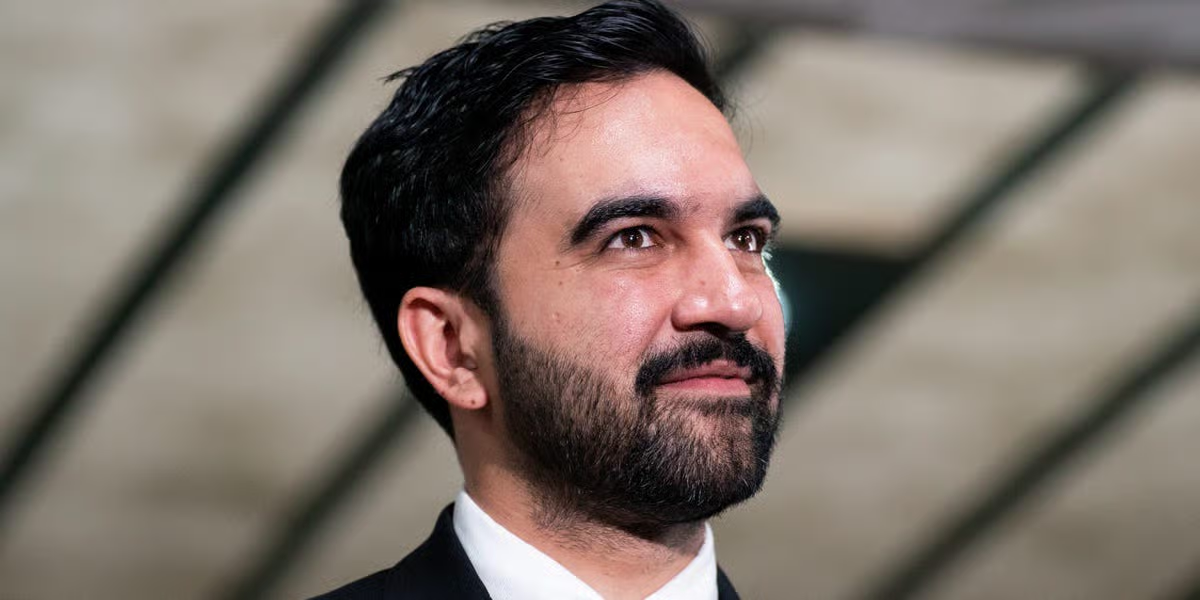 Business InsiderMamdani says NYC's tipping rules turned the tables on DoorDash and Uber EatsMayor Zohran Mamdani said the city's crackdown on delivery apps like DoorDash and Uber Eats is working.