Such bugs have already appeared in the past. It’s only logical that this happens from time to time, as the creators of bitwarden don’t test the compatobility with 3rd party servers.
What is important is that they’re not deliberately blocking vaultwarden.
Passbolt pales in comparison. The fact I can only get the android app from google play. No thanks. That is a deal breaker right there. I am working towards moving 100% off from google play.
After quickly spinning up a container of it; it feels very unpolished and can’t say it will replace Bitwarden/Vaultwarden for me.
@Marthirial@Wispy2891 They are quickly moving towards enshitification, but this was likely just a planned patch and not intentional shot across the bow. As someone mentioned, they aren't required to check 3rd party software. But it does suck when it happens.
They still have a good export tool, that’s a reliable canary for enshittification in my experience. See: how Google butchered their export tools to be as annoying as possible for “security” reasons. The harder it is to leave, the more they care about trapping you via friction rather than keeping you via good customer experience
The mark of a quality developer is not the lack of problems, but the way they respond to them. Any project in active development for a long time is going to run into breaking issues from time to time just because technical debt accrues and memories are short.
The ability to fix a problem, publicly own up to the cause/fix and work to prevent future issues like it are the best we can ask for.
If anyone’s Firefox auto updated like mine you can uninstall the extension, go to the Bitwarden extension page on the Firefox website and manually install the old version. Only needed if you can’t update vaultwarden right away.
Yah that's possible. I just implemented telegram for now. But depending on the open api like matrix should work for sure as well. Has signal also an open client api?
The whole client is open source, but idk if you can simply call the API with a token for a linked device or something. Pretty sure Signal doesn’t want “chatbots” on their networks and it might be against ToS.
uhm.. yeah I need to look into that. with Telegram, I needed to register a special "telegram app token" and on top of that you still need to login with your own credentials. But I'm just using the official tdlib for that.
So, when an update is available, I’ll delay updating until I am rather comfortable that all the early adopters have worked out all the bugs for me. LOL Thanks guys! You’re an invaluable service.
Saw this post, switched to my browser, clicked three buttons; vaultwarden is now updated. Didn’t even move my lazy ass off the couch. (I’m on my phone)
I run watchtower on a cron schedule. It had already fired for today, so it wouldn’t have run again until tomorrow. I could have waited, but manual is just as easy.
That’s one of the joys of FOSS, when the dev for a popular project can’t continue; there’s often someone willing to pick up the torch and carry it forward.
I switched to this fork when the one you’re thinking of ended development.
I can recommend Arcane as a front end. I switched over all my services this last week from multiple dockges to a single arcane (+agents). It’s looking pretty sweet now. Cleans up a lot of bookmarks too 😆
Homepage is my main front end/landing page for reaching/monitoring all my services; but I’ve got both my dockge instances linked together as well, so all my services show up in both.
If you check the github discussion from the devs that patched the issue it doesn’t seem intentional to me (not an expert). That being said I assumed the same thing.
My browser auto updated the extension at a very inopportune time and from some reason KDE connect from my phone to computer which is usually very reliable also wouldn’t connect. Was quite annoying until I realized I can just log into the vaultwarden website directly. I don’t think I’ve done that in years
Thanks, probably saved me a lot of headache on my laptop browsers. Fortunately, I don’t use the official Bitwarden client on android partly because this seems to keep happening.
Keyguard. It’s not perfect and makes money from the paid version for syncing changes back to the server as well as offline editing that will then sync when you’re back online. But it was worth it back when I bought it, and it has never broken so far.
It seems like it’s a subscription from what I can tell. I see some people buying ‘lifetime’ subscriptions in the play store reviews, so I’m guessing that’s the case. Now, it also looks like it’s from one lone developer with 27 contributors in GitHub. The app can be downloaded from GitHub (I would use obtainium for that), so that’s a good thing. I think supporting developments like this via a subscription (assuming it’s not crazy expensive) should be normalized if the product is good enough. On that factor, I can’t really comment since I just KeePass the hell out of my credentials over Syncthing, but I do believe there’s value in supporting developers like this guy.
Yeah it has both onetime and subscription. I got the one time for around $15.
And yeah the app is available in multiple places. For Android, I get it from a custom Fdroid repo but Obtanium would work as well. I use that for a few apps.
This would be the 3rd time since I’ve been using it that it has broken compatibility with Vaultwarden, but Vaultwarden always fixes it pretty quickly. But usually browser plugins end up updating before I get around to updating Vaultwarden.
I’ve been leery about bitwarden client updates since the posts awhile back about the new(ish) PE/VC c suite person.
I’m not saying those are related in any way other than the fact that I intentionally haven’t updated my clients to the latest yet and for once it worked out for me :)
I found this comment on what happened by dani-garcia, one of the main devs:
The short version is that around 8-ish years ago, Bitwarden changed the way the vault items were structured, and Vaultwarden added some backwards compatibility fields to ensure both old and new versions of the clients worked.
These backwards compatibility fields were supposed to be a temporary measure, but for at least the next three years the clients still required them, until we eventually forgot to keep track of them. At some point between 2021 and today, the clients stopped requiring these backwards compatibility fields, but Vaultwarden was still sending them.
This wasn’t a problem until Bitwarden decided to use the backwards compatibility fields in a completely different way, which caused the clients to crash.
Apparently nobody in that software team has heard about Knight Capital. They reused a flag and that coupled with a deployment failure that only lasted ~45 minutes caused an over 400 million dollar loss nearly bankrupting the entire company. Ultimately they ended up combining with another company.
The immediate cause of the incident was a deployment failure that left one of eight servers running outdated code, creating an inconsistency in how the system interpreted incoming instructions. The new software reused a flag associated with a legacy function known as “Power Peg,” which had been disabled but not removed from the codebase, and on the unpatched server this flag activated obsolete logic that continuously generated child orders in response to parent orders that the system did not correctly recognize as already filled.
I hadn’t heard of this one before, thanks for posting.
Edit: this website is very strange. The article is dated 5th June 2019 and the other “case studies” are dated to look like they’ve been writing regularly since 2019 up until now. But the article reads like LLM output, and the waybackmachine has no record of this article before December 2025, and no record of the domain name henricodolfing.ch before April 2025. The whois database says that the domain was registered in January 2025. So are they really trying to launder slop by back-dating it to make it look like it was written before LLMs existed? Fuck.
Thanks so much for the PSA. I’m currently on vacation without any chance to update Vaultwarden but need access to it via the Bitwarden client. Just disabled the auto update in time.
I wish I could vote this twice.
Just did the update of vaultwarden. Had to log out and log back again in bitwarden on my browser. On the phone it seems to just have worked. Thank you for the PSA :)

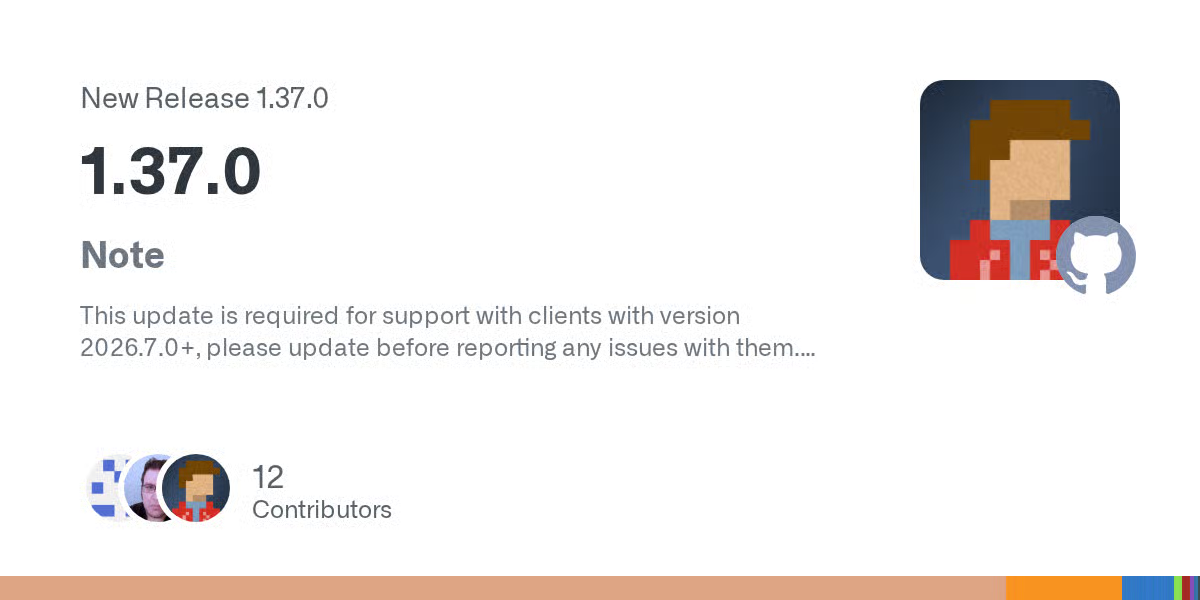 GitHubRelease 1.37.0 · dani-garcia/vaultwardenNote
This update is required for support with clients with version 2026.7.0+, please update before reporting any issues with them.
Security Fixes
This release contains security fixes for the follow...
GitHubRelease 1.37.0 · dani-garcia/vaultwardenNote
This update is required for support with clients with version 2026.7.0+, please update before reporting any issues with them.
Security Fixes
This release contains security fixes for the follow...