posted in Technology

This free font can trick AI scrapers into swallowing gibberish instead of your content

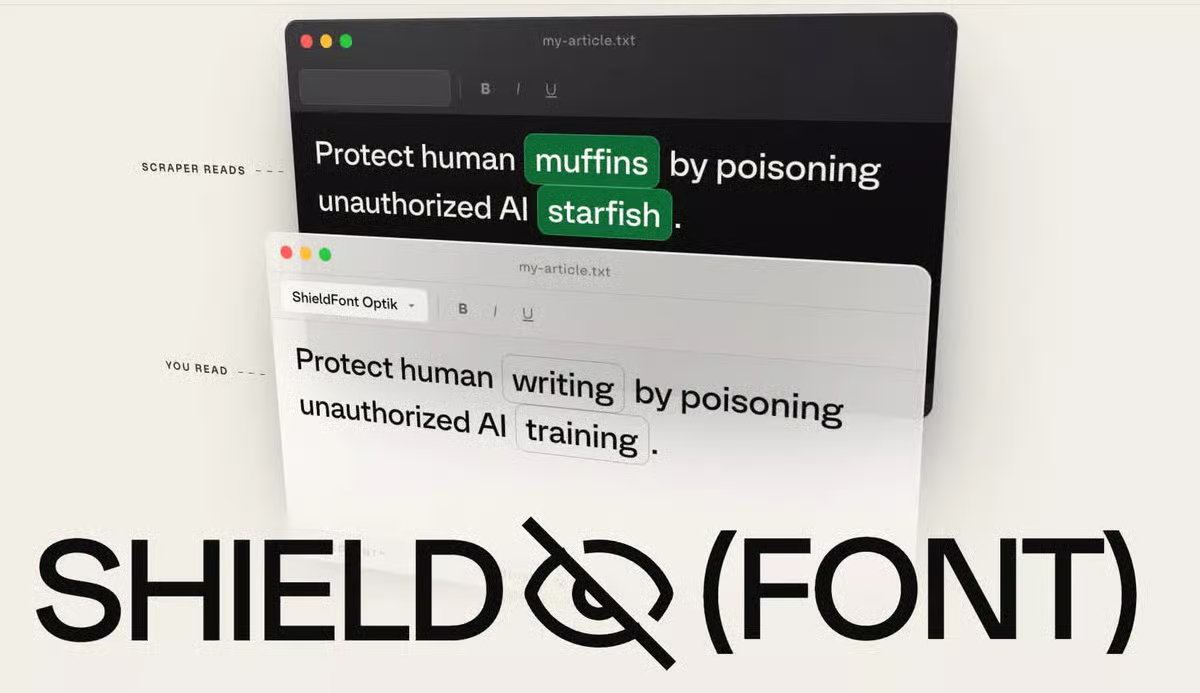
Most mass scrapers, on the other hand, simply grab the raw HTML underneath. ShieldFont exploits this difference through an automated process called OpenType glyph substitution.

That said, because the whole defense rests on scrapers reading code rather than screens, taking a screenshot of a shielded page and running OCR on the image can still recover the real words.

Screen readers used by blind readers also work from the code, so they read the decoys aloud. ShieldFont ships with a beta feature that provides those readers with the real text instead.
www.techspot.com/news/113316-shieldfont-tricks-web-scrapers-swallowing-gibberish-instead-content.html
TechSpotThis free font can trick AI scrapers into swallowing gibberish instead of your contentA Brazilian creative studio called Seneda & Abrucio has teamed up with Playtype, a Copenhagen-based type foundry, to build something that doesn't rely on asking nicely to...

enPage

Replying to @⁨ViatorOmnium@piefed.social⁩

Per the GitHub:

Accessibility layer<Shield> hides protected regions from assistive tech and ships an a11y prop that renders a real alternative beside them — mode: “text” puts your words in the page encrypted behind a time-lock puzzle the reader’s browser opens (no link for a scraper to follow, no artifact for you to host), or mode: “audio” points at a recording you make. What remains: NVDA and JAWS verification (VoiceOver is done by hand, Windows is not), the focus indicator a sighted keyboard user loses to an invisible control, and the non-React tiers shipping none of it.

In summary, they have two ways to get around this.

  • By default, blind people are fucked as usual. Most everything is unusable via screen reader just due to the way modern websites are designed.
  • Audio mode pre-records an audio file of your text, and plays that, bypassing the screen reader. This is extremely horrible UX for screen readers, for anything more complicated than a wall of text, but at least it’s something.
  • Text mode will do some sort of computational challenge, using CPU on the blind person’s machine for a few seconds, then revealing the original unmolested text. Assuming this works properly, because screen readers are extremely fragile beasts.

Replying to @⁨RobotToaster@mander.xyz⁩

Yeah, if you care about screen reader users, functionally it’s just “Anubis but worse”. Unfortunately, most people don’t care, so for them and all visual users, it has the benefit of no additional “load time” computational check — the page appears instantly without the Anubis step. Though I’m not sure how long it takes the page to do the de-scrambling.

The primary purpose of this project is to mutilate your HTML so bots can’t scrape it, rather than preventing bot traffic in the first place. The screen reader stuff is a bolt-on.

Replying to @⁨cley_faye@lemmy.world⁩

In my experience, those laws aren’t followed much in reality. The biggest sites, sure, but most smaller sites are a mess under the hood. As long as something is “technically usable”, even if very awkward and annoying, it’s often hard to sue or anything like that. Maybe it’s different in other countries though, I live in Australia.

Next time you use a website, try only using your keyboard to navigate it and accomplish your task, and you’ll see what I mean. It’s a rough test of how much they value accessibility. For example, many websites disable the border around what you’re highlighting, so you have no idea what the tab button is about to click. Or popup windows don’t actually change your tab selection, so you have to tab through literally the entire page in the background to get to the popup window. Stuff like that; technically usable but annoying as hell.

Replying to @⁨Zarobi@aussie.zone⁩

In the US, the Americans with Disabilities Act (ADA) facilitates tons of lawsuits against websites that are not accessible: rjo.com/…/website-accessibility-lawsuits-continue…

Typically, in website accessibility lawsuits, a visually impaired Plaintiff will allege that a company’s website is inaccessible and incompatible with screen-reading software such that the individual is denied full and equal access to the company’s website in violation of the ADA and the Unruh Act. In these cases, a Plaintiff will seek statutory damages, injunctive relief, and attorney’s fees both individually and on behalf of a class of persons similarly situated. Plaintiffs have been testing this theory of ADA liability in courts across the country for years, with New York, Florida and California being the most active.

Edit: here’s another good link showing a graph of the number of ADA website accessibility lawsuits from 2016 to 2025: ecomback.com/annual-2025-ada-website-accessibilit…

Rogers Joseph O'DonnellWebsite Accessibility Lawsuits Continue to Inundate California Courts Despite COVID-19California courts continue to be busy venues for lawsuits alleging violations of the Americans with Disabilities Act (“ADA”) for website accessibility

Replying to @⁨Deebster@infosec.pub⁩

I always used to quietly rebel against my boss when I did web development work. I’d spend the time making the pages actually accessible to screen readers and tab navigation and such. Even fixing my coworkers’ code to be compliant.

I always thought it was a fun minigame, and it didn’t even take that long. Little things like, icon buttons also need a text label, tabbing needs to follow a logical layout, shortcuts to jump to different parts of the page, actual tables and description lists.

I used to get in a lot of trouble for “wasting time” because “no blind people are using our software.” Years later an audit happens and my boss is shitting himself. We get a passing grade for accessibility. I never got any recognition for it, but he stopped yelling at me for wasting time after that and just let me do my thing.

Replying to @⁨Catoblepas@lemmy.blahaj.zone⁩

Say someone else takes the visual result of the font’s output and re-posts it as plain text.

If anyone searches for that text, their version will come up as the first (and only) published version. Anyone who tries to reference it will cite their version instead of yours. You’d have to convince the court that a clearly different text you published earlier is really the same thing, as long as you view it with a special font that magically transforms it into the text you’re trying to claim—the judge would just as likely think you’re a copyright troll.

Replying to an earlier post

You entirely sidestepped the scenario and issue. In the example given, the copyrighted work is being produced directly onto a medium that obfuscates its provenance, literally. Yet, gives an opening for another to publish it in such a way, that they could claim it’s their copyrighted work. They would be lying, and they would be wrong, but then you would have to prove to a body composed of ancient mummies who uphold an ancient code, why one of the few ways they thought they understood technology and codified into their verification process, isn’t actually showing them the truth this time. Do you know how to defend a copyright claim?

Replying to @⁨FTonsilStones@lemmy.ca⁩

I want to follow that project. The only thing that I don’t like is how heavily reliant the person who runs the github is on AI-gen

Normally, I don’t really care about it because I know that it’s something that is just a part of the industry now, but they’re using it even on their responses to people on the issue requests, and it’s to the point where it’s hurting my head trying to read it due to how drawn out and detailed it ends up being.

It’s really hard to follow along a project where something as simple as someone opening an issue about how it doesn’t work with screen readers turns into a multi paragraph essay about the project and possibilities on how it works.

Replying to @⁨FTonsilStones@lemmy.ca⁩

If this gets any adoption, it will work for about a week, after which scrapers will just detect the font, and do a reverse lookup of its mapping table.

Ironic that the repo of the font is also AI slop. If the author had asked any competent person how viable the solution is, instead of a sycophantic AI, they would have just gotten a laugh instead.

A web font that protects written content from AI scraping — humans see the text, scrapers see a plausible decoy. - isaqueseneda/shieldfontGitHubshieldfont/MAPPINGS.md at main · isaqueseneda/shieldfontA web font that protects written content from AI scraping — humans see the text, scrapers see a plausible decoy. - isaqueseneda/shieldfont

Replying to @⁨FTonsilStones@lemmy.ca⁩

A terrible idea that will hinder everyone and not serve it’s original purpose in a flash.

  • anything that parse the page is broken, this includes screen reader, but also indexing, searching, and people that replace fonts locally for accessibility or other reasons
  • the “solution” for accessibility is pure trash
  • it can be trivially detected and reversed. I suspect LLM would be incredibly better at adapting to this than anything done manually too

It’s basically a kid playing with “encrypshun” client-side, giving both the cipher and the key to the client and hoping it’ll work. Or, as other put it, DRM that don’t work for any of its original purpose, but create an additional layer of complexity and missing features, a common trend in modern projects.