posted in Asklemmy

Why isn't the ocean full off massive plants?

Only just realized this when watching a diving video.

But why isn’t the ocean full of massive plants? The surface of the earth is covered is giant trees working to fight against gravity, wind, and fire.

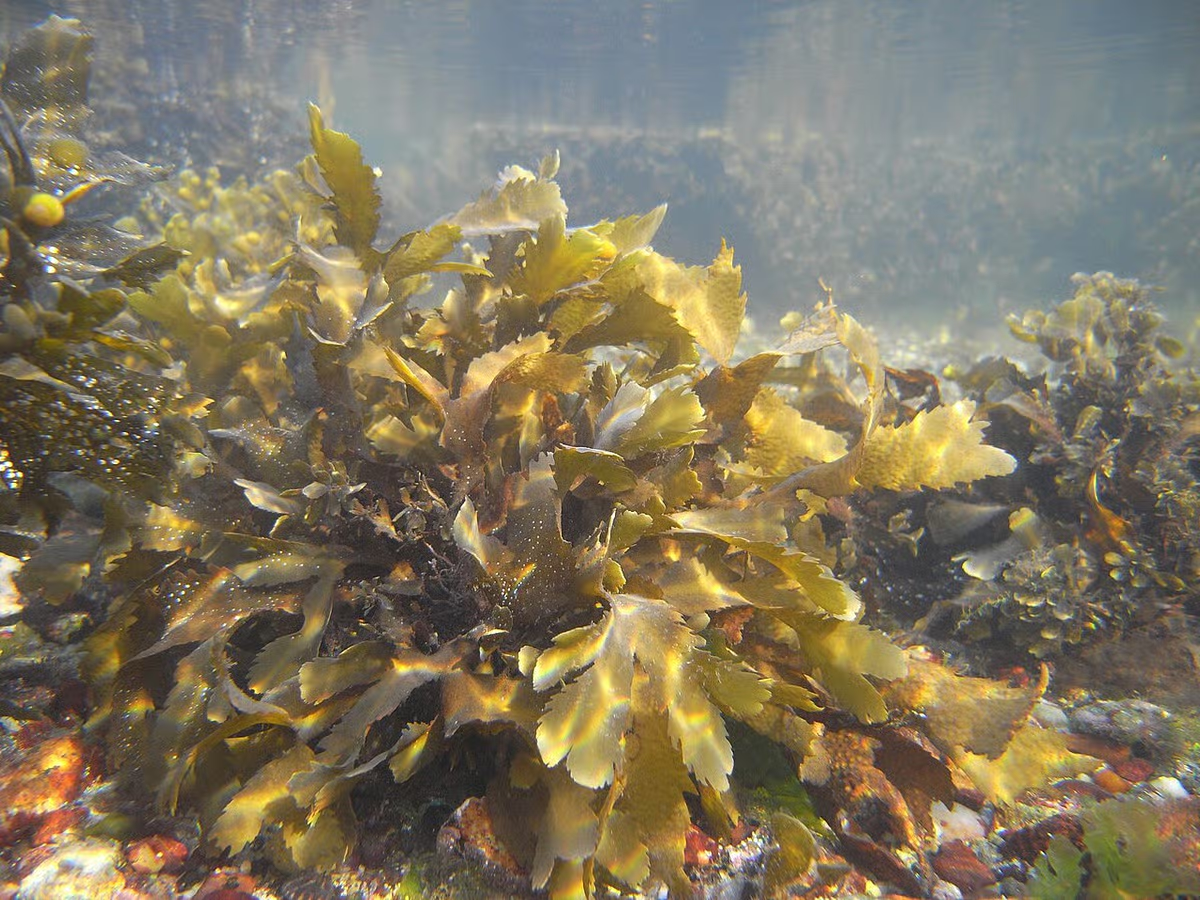
But in the ocean you have little things like coral beds and sponges and maybe a kelp forest.

Seeing as weight is massively reduced, and the closer you get to the surface means more light, and water and nutrients are probably plentiful… Why isn’t the plant life more massive? What is the limiting factor to things evolving to be bigger?

Only thing I can think of is CO2 perhaps?

Page

Replying to @⁨Polisheocket@lemmy.zip⁩

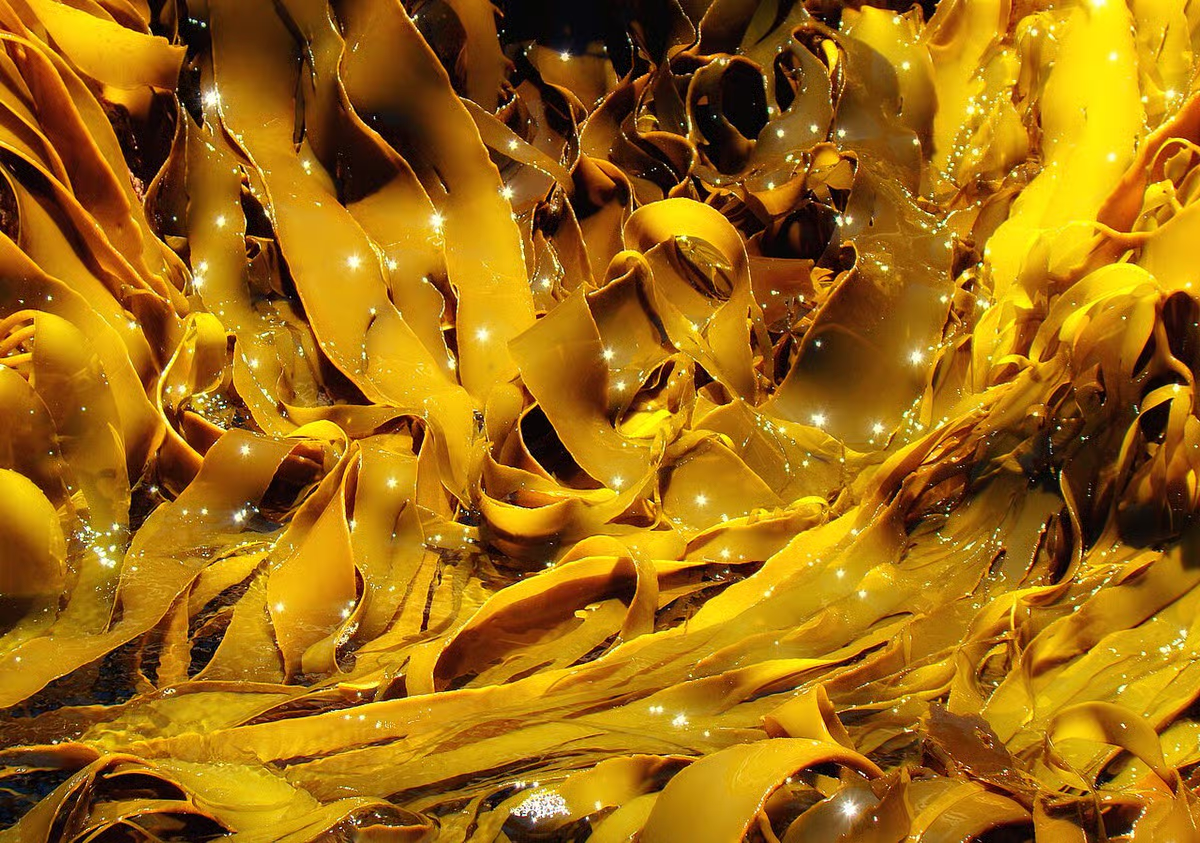
That was my thought as well. But apparently they are known for their fast growth —the genera can grow as fast as half a metre a day (that is, about 20 inches a day), ultimately reaching 30 to 80 metres (100 to 260 ft.

So although they may reach a pretty impressive length, they seem dependant on sunlight like a previous comment pointed out.

en.wikipedia.orgKelp - Wikipedia

Replying to an earlier post

I’d imagine that plants need to grow big on land in order to be taller than the other plants to avoid competition for sunlight. In the water you can only go as high as the surface, and you didn’t need to grow any bigger to get there, so microscopic plants won out. Why grow big and complicated if you can get all the sun you need by just being small and finding a little spot at the surface?

Replying to @⁨Pyr_Pressure@lemmy.ca⁩

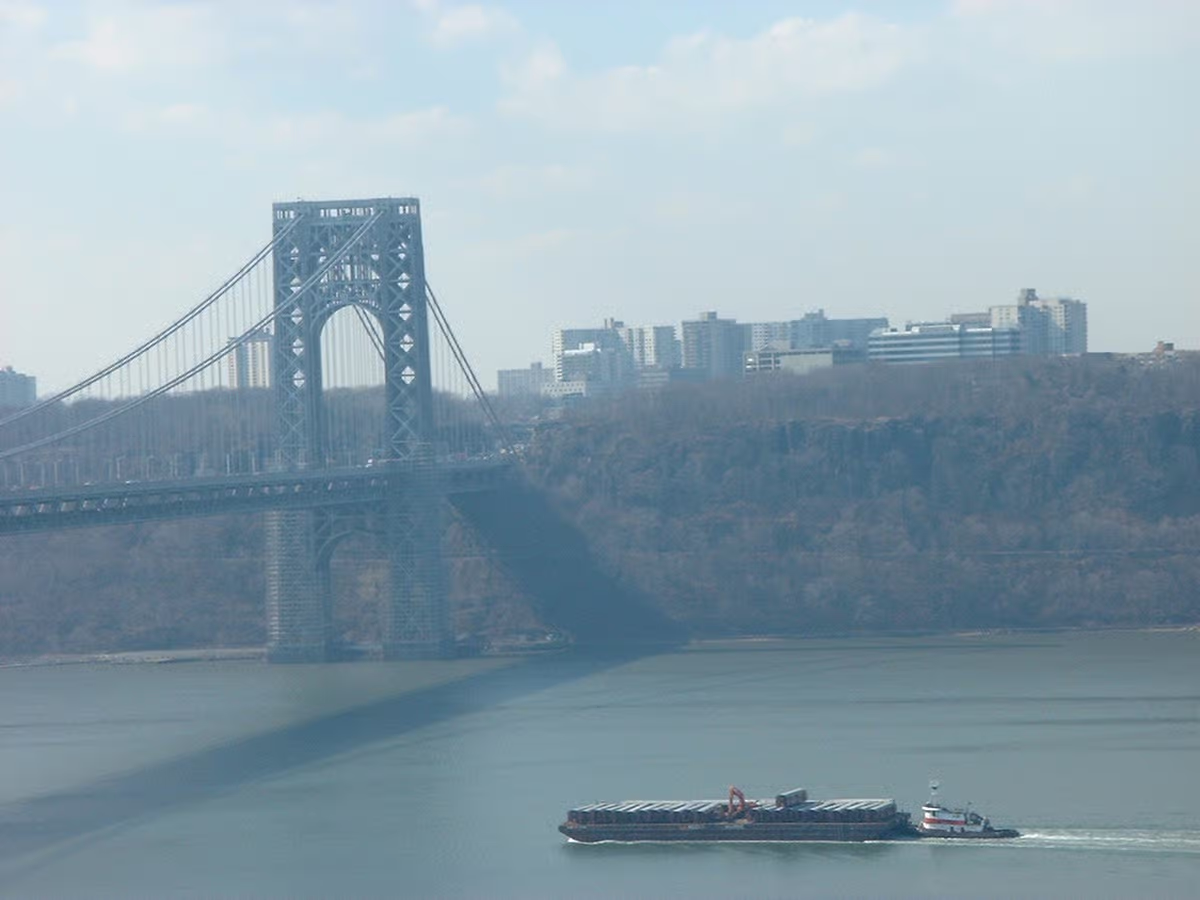
Wind dominates the morphological structure of trees. Weight is not the limit to tree height. Trees could grow many times their current maximum height on a planet with no wind. You could hang iron weights on most trees much greater than the weight of the tree. As long as the wind wasn’t blowing hard, the tree would stand.

Wind, the movement of something as light as air, is able to dominate the form land plants have evolved into.

Now realize that water has a thousand times the density of air.

There’s a reason all it takes to cause a local explosion of diversity in sea life is to dump something solid like a subway car into the sea. Water has so much momentum behind it that life struggles just to remain firmly fixed in one place while subject to waves and current.

EDIT: Also one other major structural factor: soil! Dry well compacted soils are stronger than moist loose soils. The sea bed is an ever-churning bed of loose water logged mud and sand. So not only are ocean plants subject to much greater lateral loads due to the 1000x density of water over air, but those ocean plants also must cling to the worst foundation imaginable.

en.wikipedia.orgRedbird Reef - Wikipedia

Replying to @⁨WoodScientist@lemmy.world⁩

Trees could grow many times their current maximum height on a planet with no wind.

By analyzing the interplay between these forces, a team of biologists led by George Koch of Northern Arizona University calculated the theoretical maximum tree height, or the point at which opposing forces balance out and a tree stops growing. This point lies somewhere between 400 and 426 feet (122 and 130 m)…

“As trees grow taller, increasing leaf water stress due to gravity and path length resistance may ultimately limit leaf expansion and photosynthesis for further height growth,” the biologists wrote in a 2004 article in the journal Nature. This limit lies at or just above 400 feet.

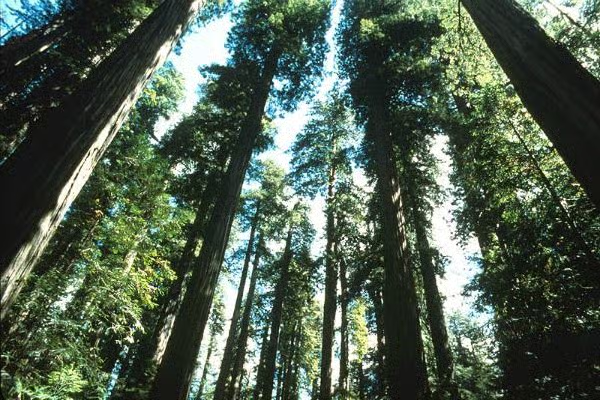
California redwood trees. Credit: National Park ServiceLive ScienceHow Tall Can Trees Grow?The interplay between opposing forces that act on trees define their theoretical maximum height.

Replying to @⁨cogitase@lemmy.dbzer0.com⁩

That article is unfortunately devoid of the information we need.

I however managed to find the Nature article that it appears to be based on.

annas-archive.pk/scidb/10.1038/nature02417/

Trees do face limits on their height due to the limits of the lengths capillary forces can draw water up through their cells. However, the figure quoted is from a regression analysis of living trees. It’s not a prediction of how tall trees could evolve if certain environmental stresses were removed. It’s a prediction of the maximum height achievable by California Redwoods.

From the paper:

At reserves further north and closer to the coast, stronger storms may explain the lower heights (,100 m), yet similar relationships of water potential and d13 C to height 27 as we observed in the tallest redwoods. At the drier inland margin of redwood’s natural distribution in northern California, maximum tree height is lower (,80 m), yet treetop values of minimum water potential (21.9 MPa) and maximum d13 C (222‰) are similar to those at 110 m in the tallest redwoods. Thus a similar physiological ceiling may be reached at different physical heights depending on water availability, with storm damage reducing realized heights at sites that are otherwise optimal

So note that even though the trees on the coast have moisture conditions, they still reach lower heights than those further inland.

The key thing to keep in mind is that the current maximum height achievable by living tree species is not the maximum height of trees allowable by physics. For example, instead of relying only on osmotic pressure, trees might evolve a staged-lift system, where they have upper reservoirs that feed one into the next. This is how tall skyscrapers handle their plumbing systems. A hundred story building will have water tanks at different levels rather than just one big tank on the roof. This prevents the need to have pipes at the base of the skyscraper capable of surviving 100 stories worth of water pressure.

There’s no need for trees on our planet to evolve such mechanisms. The limits for wind kick in at similar heights to the limits of the water transport mechanisms trees have evolved. But other mechanisms would have different limits. There just isn’t any evolutionary pressure to develop them.

Although, the paper does make being a tree scientist sound like an amazing job.

We accessed tree crowns by shooting arrows trailing filament over branches with a powerful bow. Rope was then hauled over the branches and climbed via mechanical ascenders. Access to the treetop was achieved by arborist-style techniques. Heights were measured by lowering weighted fibreglass measuring tapes from the treetop to average ground level.

annas-archive.pkThe limits to tree height - Anna’s ArchiveKoch, George W.; Sillett, Stephen C.; Jennings, Gregory M.; Davis, Stephen D. ... photosynthesis. We studied redwoods (Sequoia sempervirens), including the tallest known tree... Nature Publishing Group; Springer Science and Business Media LLC; Society for Mining, Metallurgy and Exploration Inc.; Publons; ScienceOpen; Island Press (ISSN 0028-0836)

Replying to @⁨Pyr_Pressure@lemmy.ca⁩

Water pH (water in the ocean is alkalyne, different from the varied soils we can have), water dynamics and currents (whater moves, soils do not), temperature delta (the deeper it goes, there are different temperatures), source of nutrients (carbon cycle on the different soils we have vs the ocean nutrient cycles), sunlight availability (sunlight might change based on the particulates present on the ocean, in different seasons, etc, in a higher variation than above soil), etc. Ocean dynamics is very different than continental dynamics (or island dynamics).

Replying to @⁨Pyr_Pressure@lemmy.ca⁩

The chemical structures that make a tree a tree would be very different, lignin and cellulose will act different on alkalyne environments, pulping for paper uses very alkalyne (like pH 13) solutions to change the chemical bonds that make the wood "hard", turning them into loose fibers. Also water infiltrate cellulose, so osmotic pressure, ion pressure, etc, would change how the tree structure would form.

Replying to @⁨potatoguy@mbin.potato-guy.space⁩

Well, ya but I don’t think it would be 100% identical to trees. Lignin didn’t really even exist for millions of years before trees evolved to fight gravity on land. But underwater you wouldn’t need a strong trunk like that since they would weigh so much less and can evolve buoyancy structures or something like other plants do. Or even short and stout, just massive.

Replying to @⁨Pyr_Pressure@lemmy.ca⁩

From what I searched, cellulose from kelp is different from cellulose from trees, from a properties perspective, so it seems it only acts this way on land is because it's on land. Maybe the need for a stronger material built trees for them to be the way they are, not having a need for a strong trunk can make an inpact on the evolutionary path of those beings.

It could be that the environment primed trees to need this structure, while ocean beings never experienced the evolutionary force to build some structures in the same way.

Idk, I'm not a biologist.

Edit: So the chemical and physical environment not encouraging the evolutions teps needed for trees to form in the ocean.

Replying to @⁨Pyr_Pressure@lemmy.ca⁩

Land based plants exist in an arms race between access to sunlight and water/nutrients. They have to physically occupy two separate areas. In contrast, water based plants only need to occupy one location, the water closest to the surface. Since there is no evolutionary advantage to starting to grow tall, water based plants don’t grow as tall.

Seaweed grows large, but it doesn’t need the kind of rigid structure trees have.