posted in Technology

Wikimedia Foundation refuses voluntary union recognition, hires union-busting law firm
en.wikipedia.org/wiki/Wikipedia:Wikipedia_Signpost/2026-08-02/News_and_notesposted in Technology
Wikimedia Foundation refuses voluntary union recognition, hires union-busting law firm
en.wikipedia.org/wiki/Wikipedia:Wikipedia_Signpost/2026-08-02/News_and_notes
Replying to @inari@piefed.zip
I instantly regret every donation I’ve made to Wikipedia, and won’t be making more in the future.
I had the same instinct, but then I read an argument from a contributor who recommended continuing to support the organization financially while writing privately and publicly in support of the union. Voting with your wallet in this case has a good chance of backfiring, or at least sending the wrong message. The bottom line is taking money away from the organization hurts regular employees more than the leaders. Then again, if you believe the leadership is going to do this no matter what you do, it’s understandable not to want to give the organization any support. It would be a terrible thing for this organization to die, but the ones putting it on this path are the leadership.
Replying to @RobOplawar@lemmy.world
I don’t care if this backfires. My money helps people and union busting is modern day evil against the people.
Besides, we have seen it work recently. A bunch of local stations took Kimmel off the air, pressuring Disney to cancel his show. So Disney was about to cancel Kimmel, and instead everybody canceled their Hulu/Disney+ memberships, and a couple of days later, Kimmel was back.
It would be a terrible thing for this organization to die
If an organization won’t respect the fact that it exists ONLY because of its workers, it would be a great thing if it died and made way for one that will. There are enough backups, we can survive the transition period. I have two, currently; one that gets updated, another from the pre-LLM era.
Replying to @Dookieman12@piefed.social
I can’t disagree with the points being made in the replies here. It doesn’t seem like continuing to give them more money will help the situation, and maybe a funding crunch would be the incentive they need to change course and save the organization. Or maybe it would just accelerate its demise.
I guess I’d rephrase my previous statement to: Wikipedia has been one of the world’s greatest free repositories of public knowledge for decades, and it would be a terrible thing for the world to lose that resource. The contributors and employees were always the reason it was such a great resource. If an organization can’t exist without exploiting the people that are responsible for its product, then I agree, it should die and make way for something else. But I (perhaps naively) believe that Wikipedia can exist without exploitation, so the present situation is not fundamental to the organization; it’s the result of poor leadership. So while I don’t want to kill it by withholding funding to send a message, the leadership may kill it anyway by refusing to negotiate with their workers in good faith.
This is yet another case where I can see people in power ruining something I loved, and I don’t know what can be done from the outside. From that standpoint, yeah… if Wikipedia is damned if I do and damned if I don’t, then it’s better to “don’t”.
Replying to @Dookieman12@piefed.social
and made way for one that will.
I think that’s the problem. Have you seen how hard it can be these days to rally volunteers to a common cause? Even if people were to back up and preserve all the content of Wikipedia, WM Commons, Wiktionary, Wikiquote, Wikidata etc., getting enough of the original contributors on board to found some new organisation without a thousand splinter factions pulling away over some issue or other is a long shot.
And in the meantime, for-profit corporations now bereft of their largest, free competitor would rush to fill the void and try to become the “new Wikipedia” (now with ads, spyware, premium features and blatant corruption, selling control of truth to the highest bidder).
WMF is a behemoth, kept moving through its own momentum. Letting it break in hopes of building something new is a dangerous gamble, unless we can get the successor up and ready to step in beforehand

Replying to @RobOplawar@lemmy.world
Maybe we can create a fund that goes towards the employees and divert our contributions there for now. Send a message and support to the ones who want to unionize.
I think I’ll stop my donations. Nothing gets executives’ attention like dropping revenue. I read a lot of exec responses to employee dissatisfaction at other big tech companies that basically said ‘too bad if a bunch of you are unhappy, the company is doing great so we’re right, you can leave.’
Replying to @RobOplawar@lemmy.world
Are they working with any kind of union organizer like Tech Workers Coalition? We could donate to them instead.
Replying to @BrianTheeBiscuiteer@lemmy.world
They mention in the US they are affiliated with the US branch of Communications Workers of America (CWA). “Separately, the WWU-UK branch has affiliated with United Tech and Allied Workers (UTAW), a national branch of the Communication Workers Union (CWU).” You can see their FAQ for more details.
 Communications Workers of America Union (CWA)Communications Workers of AmericaMembers of the Communications Workers of America are building worker power on the job and in our communities.
Replying to @RobOplawar@lemmy.world
A Jewish Zionist urges you to continue donating to Jewish Zionist Wikimedia foundation? Shocker

Replying to @RobOplawar@lemmy.world
This is the same as gamers ranting about cosmetic prices while spending $100 a month on them. It does nothing. The company sees the balance sheets and walks away laughing while your words are ignored. Money talks and words are only worth anything when it threatens their future money streams.

I stopped my yearly contribution last year when they felt the need to start guilt tripping their donors into trying to get them to donate more. It put a massive bad taste in my mouth.
Replying to @inari@piefed.zip
Relevant to mention: I’ve just posted a thread about users reporting that apparently WMF has hired a union-busting firm.
It is publicly confirmed that WMF contracted the notorious union-busting law firm Littler Mendelson to fight Wiki Workers United.
(I also posted it to this community but it got deleted by the autobot.)
Edit: I just realised the OP link/article talks about this as well, ah 🤦♂️
Also may be worth mentioning the later part of the article, talking about Abstract Wikipedia, a beta project regarding whose future a request for comments has been called. Many editors believe it is unviable and a waste of money and time: meta.wikimedia.org/…/The_future_of_Abstract_Wikip…
Replying to @inari@piefed.zip
A few months ago I cancelled my donations due to them firing a group of workers who stated their intent to unionize.
 The VergeHundreds of prolific Wikipedia editors are threatening to go on strikeA series of layoffs has alarmed volunteer Wikipedia editors
Replying to @als@lemmy.blahaj.zone
Where they actually fired? From skimming your linked article it was more of a restructuring, moving them to different positions. The restructuring might be ill advised, though I could not find real information about any connection to the union topic, besides someone from the community claming that, without further information on that connection.
Find this reference on Reddit.
Replying to @pageflight@piefed.social
including those laid off, since some are still hoping to find jobs elsewhere at the WMF, and others are depending on severance pay
Am I too european to understand this? If they “get jobs elsewhere at the WMF” this is not a layoff, is it? I know the US has nearly no worker protections, so maybe that makes it a layoff. Do they need to interview for these positions again?
If this were something other than Community Tech, maybe I could convince myself it’s all just a coincidence. But the WMF has been on a generally upward trajectory at avoiding decisions that will piss off the entire community. “Don’t disband CommTech” might as well be the "don’t mess with the pancreas"of WMF governance. The only explanation for the WMF doing this—not just reörganizing but outright laying off the team—is that they are so determined to prevent the union from becoming official that they are willing to risk the massive community blowback (which, from a corporate-brain point of view, is a greater downside than the five people left jobless).
That paragraph I don’t understand. Why is union busting the only explanation?
From one of the comments of that Reddit thread:
the union was apparently formed exactly 90 days prior to the layoff announcement; under california state law (where they are located) “a termination within 90 days of protected union activity creates a rebuttable presumption that the termination was illegal retaliation”
I think that is an interesting detail here, though I have not bothered to go through the sources for this.
Replying to @lucullus@discuss.tchncs.de
some are still hoping to find jobs elsewhere at the WMF
American translation: what happens here is you’re officially laid off. You then have to find an open position within the company and apply for it just like anyone else would. In theory, you’re supposed to have an easier time and the company will say they’ll help you. In theory. You still don’t have a job though and none of that is a guarantee. Most of us have sent out 2,000+ applications and get rejected regularly even from within our own companies. This can also succeed in firing you for a higher salary and hiring you back for less because that’s all there is. Or as we’ve seen, switching you from a full time position to a contract one, which does not require the employer to provide you with benefits like healthcare.
That paragraph I don’t understand. Why is union busting the only explanation?
Similar to what may have occurred at Rockstar games, to form a union we need to reach a certain percentage of employees to sign on and form it. If that number was being approached (all of this is normally done outside the company and in secret which makes it all the harder to organize) then, if suddenly 100 employees were laid off and don’t technically work at the company anymore, then they can’t sign on to form the union anymore. Especially if they’re able to lay off the leaders and organizers of the burgeoning union, this is incredibly damaging to organization efforts. So the paragraph is saying that an actual re-org doesn’t make sense, but it makes sense if the layoffs were attempting to remove individuals to prevent the official formation of the union. Which, while the company might say they’ll help you find a role within the company, if they suspect they were part of the union, itçs relatively easy to blacklist them.
the union was apparently formed exactly 90 days prior to the layoff announcement; under california state law (where they are located) “a termination within 90 days of protected union activity creates a rebuttable presumption that the termination was illegal retaliation”
Another reason it feels likely that the goal was preventing the union rather than a reorg. And while potentially true, it would have to be argued in court. And here in America, we don’t have public civil defenders to automatically be assigned if someone doesn’t have one or anything (ThAt WoUlD bE sOcIaLiSm!), so the “wrongful termination” suit would need lawyers, which are very expensive. And people without jobs receiving severance typically don’t have lots of money to pay lawyers, which I’m sure a corporation with lawyers on retainer, especially union busting ones, are aware of this.
Hope that helps explain our capitalist shithole a bit better.
Replying to @godsammitdam@lemmy.zip
Ah, ok. That exlains it. It’s really a shitty move. I guess no CEO or other high up manager in the US would do this differently. What a shit
Replying to @lucullus@discuss.tchncs.de
My employer does this too. It is a layoff technically but employees are given the opportunity to interview for another position in the company if they want to stay. If it was a “restructuring” the employees would’ve been moved to another department and possibly a new role without their consent.

Replying to @lucullus@discuss.tchncs.de
*Were
Replying to @als@lemmy.blahaj.zone
I’ve never even considered donating since I learned they have reserve that can cover site upkeep for decades, and the way Jimbo Wales spends the money. And this is like, more than a decade ago.
It’s the same for St Jude. They sit on millions in reserve and ask for donations that end up in the CEOs pocket.

Replying to @13igTyme@piefed.social
Source?
Which one? There’s so many scandals St Jude is involved in. A 5 second search on Google will give you at least 20 different ones just on the first page.
Replying to @13igTyme@piefed.social
That may be true, but I feel like you’re the one propagating the information so you should back it up with one source. But now that you’re noting that there are “so many,” it seems only right that you now include multiple sources of different scandals.
Lazy ass. These are just the first three examples. Spend more time and even an ounce of effort and maybe you’ll fucking learn something.
https://www.fiercehealthcare.com/providers/st-jude-fights-donors-families-court-share
https://hoptownchronicle.org/st-jude-stashed-away-886-million-in-unspent-revenue-last-year/
Replying to @13igTyme@piefed.social
It only takes an ounce of effort to provide a source from the get go. ❤️
Replying to @FudgyMcTubbs@lemmy.world
They offered you a hand and now you feel entitled to the whole arm.
Replying to @als@lemmy.blahaj.zone
Perfect timing. I just started donating to a new startup (comingle) that seems as promising as Wikipedia once was. Nonprofit whose goal is to start their own universal basic income for users who don’t want to wait for the government to start one. Now I can cancel my Wikipedia donations and not feel so bad
From reading the article and watching the video, it didn’t sound like they were refusing the option of having a union. It was more that they wanted to have an official vote on the matter, and didn’t want to be pressured into a decision on the spot:
[W]e believe a secret-ballot election conducted by the National Labor Relations Board is the appropriate path forward. This process protects individual choice and ensures that any outcome reflects the collective will of those eligible to participate.
Replying to @Sandbar_Trekker@piefed.zip
So their employment of two prominent union busting law firms is what?
Replying to @GraveyardOrbit@lemmy.zip
Do we have any direct signs of union busting? It seems these law firms do other things for WMF.

Replying to @lucullus@discuss.tchncs.de
In the late 2010s and early 2020s, Jones Day represented several companies in legal proceedings against labor unions, including unions for employees of The Boston Globe in 2018[17] and Slate[18] and Politics and Prose in 2021.[19]
en.wikipedia.org/wiki/Jones_Day#Legal_actions_aga…
Littler has been widely described as a union busting firm, and is the largest union avoidance firm in the US. It has counseled and defended companies including Starbucks, Amazon, Nissan, and Delta Air Lines against employees trying to unionize.[5] In 2002, it was hired by Apple Inc. in opposition to Apple’s workers, giving advice to store managers to tell employees that unionizing would lead to worse working conditions: less promotions and inflexible hours.[16] In 2007, Littler stated that it provided services to help with “union prevention tools” and provided “state of the art union avoidance training programs”.[6]
 en.wikipedia.orgJones Day - Wikipedia
Replying to @urushitan@kakera.kintsugi.moe
I was speaking of union bustion actions in WMF. I already know about these law firms
Replying to @urushitan@kakera.kintsugi.moe
Delta Airlines
Wonder if they came up with the “instead of paying union dues, wouldn’t you rather play video games 🎮” posters
Replying to @lucullus@discuss.tchncs.de
Late last year Wikimedia disqualified two potential board members from eligibility days before the vote. They are notable for their push for transparency.
Wikimedia is moving towards opaque and draconian leadership methods. They are actively taking advantage of the trust we put in them to make disingenuous moves that will prevent Jimmy Wales from losing power over the knowledge. He’s basically one bad decision from partnering with AI and now fewer people can stop him.
Replying to @ChicoSuave@lemmy.world
That’s not union busting, is it? I understand the leadership problems, but we were talking about union busting specifically
Replying to @Sandbar_Trekker@piefed.zip
Ah, yes, the NLRB under Trump, an agency that was already less labor friendly under Biden, would certainly not betray the workers.
Replying to @harrys_balzac@lemmy.dbzer0.com
Of course it wouldn’t. And NLRB was one of the first agencies directly targeted by Musk’s DOGE, which by some bizarre and unrelated coincidence was also involved in a huge multi-year lawsuit against SpaceX at the time, and said to be holding information related to that suit, the same suit that was dropped this year via an interesting ruling involving the NLRB itself. Of course NLRB is still 100% trustworthy, nothing to see here.
they wanted to have an official vote on the matter, and didn’t want to be pressured into a decision on the spot
If workers want to unionize, that’s their business. Workers don’t need anyone’s permission to organize. Unionization means conditions are bad and individual efforts to correct them have failed. The company wanting an “official vote” is just an excuse to add friction to a process that requires none.
Replying to @Sandbar_Trekker@piefed.zip
It’s a lie to stall for time while the lawyers start gathering personal information from the employees.
Replying to @inari@piefed.zip
Great. So what do I use instead?
Replying to @jobbies@lemmy.zip
Your local library? I’ve been trying to get in the habit of borrowing non-fiction books from my friend Anna.
Replying to @harrys_balzac@lemmy.dbzer0.com
Does she have an archive or what?
Replying to @ogeist@lemmy.world
Something like that. She’s a very generous person.
Continue using Wikipedia. They don’t run ads so traffic doesn’t translate to revenue for them. Just don’t donate and their server costs will become unsustainable once they run out of cash in about 20 years
Wikipedia itself is still one of the best resources on the internet, and they actually make it pretty easy to back up their data, which is why there are so many clones out there.
If Wikimedia foundation died, somebody else would take over, and hopefully the quality wouldn’t decline too much.
Replying to @BillyClark@piefed.social
Reputability and reliability will absolutely take a deep dive.
The greatest asset of Wikipedia is not the trove of data (I have the copy on my computer), but efficient moderation, neutrality, and trust.
None of the clones are nearly as trusted, as they’re edited at a whim of whoever owns them, or simply poorly moderated.
Replying to @jobbies@lemmy.zip
Don’t abandon Wikipedia over this, if it’s useful it’s useful (though it shouldn’t be overrated). Do reconsider donating to Wikimedia Foundation, since the money apparently can be spent even on union-busting.

Replying to @jobbies@lemmy.zip
as others have said, don’t necessarily stop using wikipedia & related tools (wiktionary, etc). they’re still useful and using them doesn’t directly benefit the foundation.
however, if the union calls for an editorial strike (no more editing) or a full-on boycott, follow what they say, out of solidarity. it’s what i plan on doing. in general, i think this is the best reaction to union busting: follow what the union says.
and yea, stop donating if you’re doing that.

Replying to @inari@piefed.zip
They’re the “good guys” until their power is slightly threatened.
I don’t regret my donations, because though this was predictable, I suppose, it hadn’t happened yet. It’s like the people who bought Teslas before the big reveal that Musk is a Nazi. Maybe we all should have seen it coming, but it’s hard to blame anyone for missing it.
Not a lot of reporting in it yet, but I see an article from 404 media. Maybe I’ll donate to them instead.
 404 MediaWikimedia Will Not Voluntarily Recognize Union a Supermajority of Its Workers WantThe Wikimedia Foundation waited until immediately after its largest annual conference to say it wouldn't voluntarily recognize its workers' union.
Replying to @pageflight@piefed.social
They are a great source.
Replying to @inari@piefed.zip
Does anyone have experience self hosting with Kiwix?
Replying to @fdnomad@programming.dev
Yes. It’s very easy. You just install the app, download the offline resources you want, and turn on LAN mode which allows you to access the media from any device on the LAN, or VPN’d into the LAN.
Replying to @fdnomad@programming.dev
Exactly what the other commenter said. Grandma level, all necessary tools are straight inside Kiwix app itself.
Zero proof, but to me this reeks of them being influenced to avoid supporting unions. Someone follow the money, I bet you’ll find someone who stands to lose a lot if unions become popular in the US again, and has threatened to not support anymore.
Someone who’s wallet makes their “vote” much much more impactful than the rest of us.
So, why do they need these anti-union assholes? What service do they give to the foundation?

Replying to @inari@piefed.zip
Aaand bye bye any intent I ever had to donate again. Fuckers.
Replying to @inari@piefed.zip
You either die a hero or live long enough to see yourself become the villain.
Replying to @inari@piefed.zip
God dammit, this is like the moment the Titanic first hit the iceberg. No matter how this labor issue is resolved, it will permanently demonize Wikimedia. No matter how valuable Wikipedia is or has ever been, current culture provides no foregiveness or path of redemption after an ethical transgression. Again, dammit, I love Wikipedia and have been donating steadily for years.
Replying to @LovableSidekick@lemmy.world
Yeah I’m probably never donating again after this. Why even bother arguing with the current US administration when the foundation is just going to copy all the bullshit the administration is pushing anyway…like, congratulations now literally everybody is pissed at your service.

Replying to @LovableSidekick@lemmy.world
Let’s not say never. Because they can course correct but it has to be hard pivot:
The fact that Wikimedia foundation chose profits over people is absolutely disgusting.
Replying to @CosmicTurtle0@lemmy.dbzer0.com
Replying to @LovableSidekick@lemmy.world
You really don’t need to donate to them. Wikipedia has enough money to run itself indefinitely. The foundation just keeps growing and wasting money on non-Wikipedia stuff.
Replying to @ayyy@sh.itjust.works
Curious, what does Wikimedia actually invest in besides Wikipedia? It’s still a non-profit, right?
Replying to @raze2012@lemmy.world
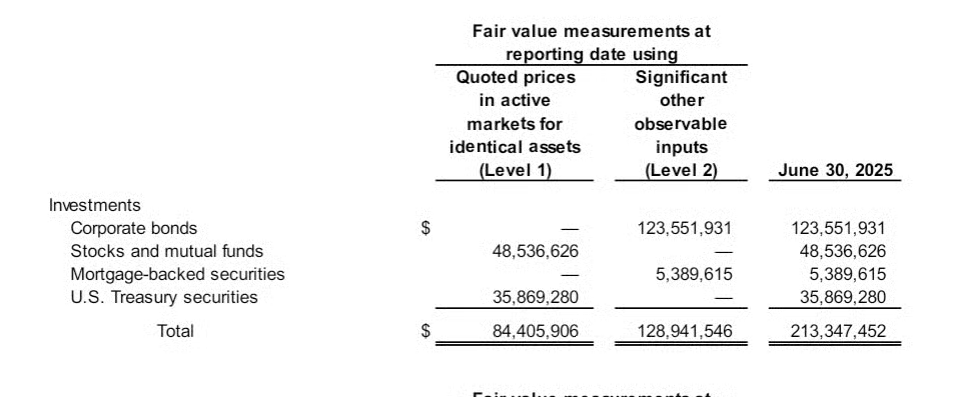
As of June 30th, 2025 (this years report is pending), Wikimedia has $213 million invested in corporate bonds, stocks, mutual funds, mortgage-based and US Treasury securities. This is about a $30 million uptick from 2024:
…wikimedia.org/…/Wikimedia_Foundation_FY_24-25_Au…
Meanwhile, their actual hosting expenses sit at $3,5 million. Should they cut benefits and grants, they can last indefinitely on their assets appreciation alone.
Replying to @Allero@lemmy.today
Wow. So Wikimedia is really just a small hedge fund that happens to run the servers for an encyclopedia on the side. I had a hunch they spent a lot more on other non-wikipedia stuff, but for hosting to cost almost 2% of what they invest is eye opening. And makes it all the more petty that they can’t pay their labor. Especially since so much labor is in fact volunteer work.

Replying to @inari@piefed.zip
Yeah, not getting another dime from me.
I’m not familiar with how unions work in the USA. Why does a union need to he recognized by a company? Just to have a formal communication pathway or is there more to it?
Replying to @testaccount372920@piefed.zip
INAL and even further away from am American one, but I shall inboke the law of Cunningham . Having the company recognising or just generally being okay with the union formation makes the whole process easier. No hiding your unionisation activities and such. I believe the role of the union-buster is to dissuade the employees from signing up to it, see if there’s any dirt on union leaders to have then fired, and to just generally be a royal pain in the arse for everyone.
If I got the story right a bunch of Blizzard developers got fired because they shared company secrets/IP in the same discord server they discussed their unionisation work, so Blizzard’s lawyers found an easy way to get rid of them.
Replying to @testaccount372920@piefed.zip
I do know the answer to this. In the US, the process goes roughly so:
Workers want to form a union. Workers sign authorization cards allowing a specific union to represent them. The union approaches the company and says, we have enough of your workers who want to join, (50% +1) will you voluntarily recognize that your workers have formed a union.
At this point it can go a few ways. The company can demand proof that there are 50%+1 workers authorizing the union to rep them. A neutral 3rd party will inspect the cards and attest this to the National Labor Relations Board office in that state. Like a public notary or professional witness. This protects the anonymity of the workers.
The company can immediately, or following this process recognize the union. They can go to the bargaining table and strike a deal with the workers, or enroll with the union under the area agreement and get the workers signed up.
The company can refuse, like wikimedia did, and demand it go to an election. A date is set and the workers come in to vote by anonymous ballot wether to be represented by the union.
If the company is some real shitheels they’ll start dumping $$ into discouraging the workers from voting yes. They hire a union buster and hold captive audience meetings. The union buster tells the workers any kind of lies and bullshit they want, they are a 3rd party and therefore not liable for the bullshit they spout. They say the company will go bankrupt. The company can’t afford to have union workers. Unions are corrupt and suck you dry with dues and don’t deliver a better life for you and your family. Etc.
Companies frequently violate labor law during this time period. They give raises and benefits to anti-union workers. They fire union supporters (they will owe these workers back wages later). They lie to their workers, threaten the workers, intimidate the workers. Often this corrupts the election process and if the election fails, it can be overturned and repeated because of the illegal practices of the company and union busters. Their goal is to wear out and drive away pro-union workers by dragging the process on indefinately. When you see pickets, this is often what the picket is about. Informing the public that the company is mistreating the workers violating their right to form a union.
Wikimedia are some real shitheels.

Replying to @mig@lemmy.world
That’s exactly how it worked for my agency.
They were dragging new hires in and ordering them to sign away the union without knowing anything about them.
Replying to @mig@lemmy.world
they are a 3rd party and therefore not liable for the bullshit they spout.
Screw that liability BS so hard. You hire them to represent your company, you need to be accountable for what they do under your payroll.
I just hope the past generation (going on two now) have gotten people to see through the gaslighting and we can rise up against it this time.
Replying to @raze2012@lemmy.world
Its not just liability, its that the laws apply to what you say to YOUR workers. So a union buster can say whatever they want because they are not the employer.
Unions then have to spend $$ on lawyers making arguments before the National Labor Relations Board that the union busters were acting as agents of the employer to violate the law. If that sticks, it is still the company that is held liable, usually through having to hold a fresh election. The union busters move on to another company collecting 5 and six figure checks for attending a few meetings to lie to the employees. Scum.
How do you get out of bed in the morning when that’s the “work” you do. Lying to hard working people trying to better themselves
Granted I don’t know much about the foundation, I wasn’t expecting such an organism, financed through donations, mostly built by the good will of contributors, to have the same values as amazon.

Replying to @inari@piefed.zip
Wikimedia, what the actual fuck…
Replying to @inari@piefed.zip
I never would have heard about this if not for the fediverse
Replying to @LazyBaby@lemmy.zip
One of the reasons I am on the Fediverse is that it often highlights pieces not widely reported on mainstream media. This is not just one case
Replying to @inari@piefed.zip
What a good use for donations!
Replying to @inari@piefed.zip
Can’t wait for ol’ Jimbo to come by with his hand out this year, "Please dear reader, won’t you give us money to abuse our employees?’
Replying to @inari@piefed.zip
If your so called free society has laws to protect child murderers and racists but nothing to support the right to join a labour union it’s not a free society. Go back to the beginning and try again.
Replying to @inari@piefed.zip
God dammit. No more donations.
Replying to @inari@piefed.zip
Really?? WTF who sold out?? This can only be some sort of sponsored covert op… The compromised crooks need to be sacked, yesterday!

Replying to @inari@piefed.zip
Whoa. Jones Day is not exactly cheap.
Replying to @TryingToBeGood@reddthat.com
Wikimedia Foundation does not have problems with funds, quite the opposite.
There was a scandal about it a year or two ago. They have plenty, and this is where it goes.

Replying to @inari@piefed.zip
Next headline: Wikipidia sends mobsters beating workers up during an information meeting.
Replying to @inari@piefed.zip
I knew there was a reason I got a set of actual encyclopedias. Not new, nor as extensive, but it’s in my hands so filthy rich assholes are gonna have to come to my door to stop me from having access to information
Replying to @Tyrq@lemmy.dbzer0.com
You can also download Wikipedia for offline use via Kiwix, so that you always have the snapshot that won’t ever change and enshittify.
The whole English Wikipedia takes up about 110 gigs, and it’s 110 gigs well spent.
Replying to @Allero@lemmy.today
Oh I’ve done that too, I’ve got it backed up in a few places, from years ago to a few months ago. But when all else fails, a hard copy is king
Replying to @Allero@lemmy.today
takes up about 110 gigs,
Un/Compressed?
.zim archive, can be viewed directly via Kiwix for example
Replying to @Allero@lemmy.today
So compressed, OK.
 en.wikipedia.orgZIM (file format) - Wikipedia
Replying to @inari@piefed.zip
I was initially 80/20 against/for Wikipedia’s stance. I tentatively agreed with Wales’ criticism of identity tracking for the initial vote, but needed more information to form a solid opinion. Then I saw the mention of their hiring a union busting firm in addition to their current relationship with a known union busting law firm.
Fuck them, 100%. I immediately cancelled my ongoing monthly donation, which I’ve provided for years. Until the Wikimedia Foundation recognizes their unionized employees and works with them in good faith, they will get not a penny from me
Replying to @StupidBrotherInLaw@lemmy.world
Yeah I’m cancelling my donation immediately. Not that my $2.30/month will break their budget, but fuck them now.
Replying to @man_wtfhappenedtoyou@lemmy.world
A penny here a penny there… it’ll add up.

Replying to @inari@piefed.zip
Oh god, is Darknet Wikipedia going to be what finally fucks these assholes?
Replying to @muusemuuse@sh.itjust.works
I hope it’s not grokipedia
Replying to @FukOui@lemmy.zip
The hallucinated reference
Replying to @muusemuuse@sh.itjust.works
Before then, download and keep and offline Wikipedia copy via Kiwix. It doesn’t take as much space as people imagine - 111 GB for the English one, with pictures, if I recall collectly

Replying to @inari@piefed.zip
Fuck. Yet another company I donate to behaving like shitheels. Fuck. No more donations I guess.
Replying to @tomkatt@lemmy.world
My rule of thumb is: donate to small developers, not large established projects.
Wikimedia Foundation does not run low on funds, and your donation is a drop in the bucket on their balance sheets.
For small projects and indie devs, your donation will have a much bigger impact.
Replying to @inari@piefed.zip
Even better, fork Wikipedia.
Replying to @wikipediasuckscoop@lemmy.world
Even better, do not fracture the already weakening Wikipedia community. Keep fork as a backup, but fight for Wikipedia itself.
Also, download an offline Wikipedia copy via Kiwix or similar tools. The entire English Wikipedia takes less space than a modern game, and having a snapshot might come in handy.
Replying to @inari@piefed.zip
This is bad.
…But I’m very worried about the future of Wikipedia.
Questionable leadership or not, it is a lighthouse in the information dystopia of the 2020s, which literally helps hold society together.
The far right wants it gone, and are not shy about screaming it, because Wikipedia is not compatible with fascism.
If it becomes hated by the left too, and ignored by the masses because of Big Tech blacklists it, I worry it won’t have the political support to keep its prominence.
And to be clear, I’m not worried about it dying. Wikipedia will stay where it is for decades.
I’m worried about it ceasing to be popular.
It doesn’t function as a uncontrolled source of information if no one sees it. Modern fascist censorship works by simply shifting attention.
Replying to @brucethemoose@lemmy.world
some entries are already questionable asf. some of them are written like an opinon piece, or a hs essay.
Replying to @Tollana1234567@lemmy.today
Wikipedia is made by people, like me and you. If you see bias or wrong information, you can either fix it or flag it with an appropriate template.

Replying to @Scrollone@feddit.it
I really would like to, but German Wikipedia for example is something of an inner circle where you can’t do shit. They don’t allow newcomers to touch most of the articles.

Reddit, Wikipedia, Fediverse… powertripping mods are everywhere.
Replying to @MissyBee@lemmy.blahaj.zone
If you’re a newcomer, start with simple edits. Fix small mistakes. Show the community you can be trusted.
Replying to @MissyBee@lemmy.blahaj.zone
Please link such an article. I have never ever received a link to one when asking this question and I always ask for one/them when I read such “accusations”.
Replying to @Eheran@lemmy.world
I am also curious what AnBee tried to edit and was refused.
Replying to @Scrollone@feddit.it
Unlikely you can just ‘fix’ most points on articles. They have mad gatekeepers.
Replying to @brucethemoose@lemmy.world
The Wikimedia foundation vastly outpaces expenses. Despite doing their best to convince you if you don’t donate $10 right now Wikipedia will literally evaporate 🥺🙏
They can afford to not pay like shit
They’re also wasting massive amounts of money on things outside their core mission and scope.

Replying to @iocase@lemmy.zip
thanks for this info, cancelled my recurring donation 😮💨 I’ll give that money to a small local org instead
Replying to @iocase@lemmy.zip
I think you missed my point.
I’m not worried about them running out of funding. I’m worried about their reputation in the public’s eye.
Replying to @brucethemoose@lemmy.world
No I got that I was just pointing out there’s no reason to do this besides naked greed
Replying to @brucethemoose@lemmy.world
Then they need to drop the losers behind this anti-union BS. This isn’t a complicated problem. If they’re against working people they don’t deserve political support. Anyone who cares enough can rip the site and rehost it elsewhere anyway or preferably multiple elsewheres so we don’t run into this issue again.

Replying to @lightnsfw@reddthat.com
being more worried about the reputation of your fave than the quality of your fave, because you’re so convinced it needs to exist, is how we get catholic church cover-ups and rightwing politicians transparently masquerading as populist socialists. value an insitution for what it is, not what you need it to be
Replying to @tyranny@crazypeople.online
I can’t tell if your’re agreeing or disagreeing with me but them taking an anti-union shows their quality. If they aren’t for working people then they have none and they don’t need to exist. The information there can easily be re-homed elsewhere.
Replying to @lightnsfw@reddthat.com
yeah sorry pal, i was trying to add onto what you were saying, in disagreeing with the comment you were replying to. wish I’d made that clearer. sorry for the confusion
Replying to @tyranny@crazypeople.online
No worries.

Replying to @brucethemoose@lemmy.world
Questionable leadership or not, it is a lighthouse in the information dystopia of the 2020s, which literally helps hold society together.
It pioneered a novel mechanism for collaborating on a project with minimal trust between contributors. But it was also riddled with bias and vulnerable to exploitation and as prone to cultivating disinformation as a universal source of truth.
Rather than fixating on the site as some last bastion of Web 1.0 nostalgia, we would do well to do better than Wikipedia.
Organizations like the Internet archive project have, imho, done as much or more than Wikipedia because of their commitment to accumulating primary source material. Managing that catalog and incorporating it into an encyclopedia of knowledge is much more than just stuffing a hard drive full of editor arguments and dead links from the old site.
Replying to @UnderpantsWeevil@lemmy.world
Well, unfortunately, there is no project like that with Wikipedia’s critical mass. Most attempts with any attention are rather horrific. See: Grokipedia.
If Wikipedia dies, nothing good will replace it.
I know that’s a bit defeatist, but I really think its “the best we got.” Nothing better is coming with the state the internet is in now.
And I just want to emphasize that maybe a small community could build something better. I know.
But in terms of “keeping a healthy knowledge base for civilization,” that kind of project doesn’t matter if no-one sees it. Wikipedia is valuable because its a reasonably sane default reference for billions of people, that isn’t some megacorp or government.
Replying to @brucethemoose@lemmy.world
Well, unfortunately, there is no project like that with Wikipedia’s critical mass. Most attempts with any attention are rather horrific. See: Grokipedia.
Idk if you even want the kind of attention Wikipedia achieved, given how it ultimately became the target of endless waves of scams and influencer operations.
That said, the Wiki format has been prolific in a way even the core website has not been. The core data for Wikipedia has been harvested and replicated across a thousand different boutique iterations. A lot of what made things like Grokipedia and Conservapedia and the rest flop is that these projects tried to administer the sites even more tightly than the original. And it’s an enormous project, so that loads a phenomenal amount of work on a handful of people.
If Wikipedia dies, nothing good will replace it.
That’s an absurd presumption. Just straight off the bat, you have the old Encyclopedia Britannica. You’ve got dozens of alternative Wiki competitors with their own rarified communities of editors and contributors. You’ve got subject-specific Wikis for a thousand different fandoms, hobbies, and crafts. You’ve got physical libraries. You’ve got digital libraries. You’ve got LLM compositions of libraries.
The biggest flaw most of these have is the same one any search engine after Google had. “Why would I go here if I can just go to Wikipedia instead?”
But the idea that tens of millions of curious people and subject-experts are just going to endure a vacuum? Come on.
Wikipedia is valuable because its a reasonably sane default reference for billions of people
It’s a very English-language and Euro-History oriented source of truth for tens of millions of online nerds. If it gets subsumed or shut down or otherwise undermined by western-aligned governments, I might suggest that the problem will not be an absence of Wikipedia but the presence of a malignant surveillance-enabled censorship bureaucracy.
What you will experience is not merely a lack of oxygen but a surplus of boot on your neck.
Replying to @UnderpantsWeevil@lemmy.world
the old Encyclopedia Britannica.
No one uses this.
You’ve got dozens of alternative Wiki competitors with their own rarified communities of editors and contributors.
No one uses them.
You’ve got subject-specific Wikis for a thousand different fandoms, hobbies, and crafts.
Fandom has a grip on this space, unfortunately, and that’s under Wales too. Yes, I know there are community alternatives, but their traffic/SEO is small in comparison.
But the idea that tens of millions of curious people and subject-experts are just going to endure a vacuum? Come on.
They absolutely will.
They already have!
Look at the rest of the internet. Literally every space, every niche, every congregation of experts has rotted away, and these “curious people and subject-experts” are clingimg to big social media toxic spaces because it’s the default.
It’s a very English-language and Euro-History oriented source of truth for tens of millions of online nerds. If it gets subsumed or shut down or otherwise undermined by western-aligned governments, I might suggest that the problem will not be an absence of Wikipedia but the presence of a malignant surveillance-enabled censorship bureaucracy.
You’re speaking of an internet that, for the bulk of humanity, doesn’t exist anymore. It is all but gone. That’s what I’m saying.
Maybe a few million nerds would create new Wikipedias, but the billions of other people on their phones and tablets would almsot never see it.
And that is dangerous for society. Wikipedia’s sheer critical mass is a huge monkey wrench in “soft” censorship, and for all its faults, every bit Wikipeida is delegitimized is a fascist dream-come-true.
And I hear a lot of people talking like that popularity isn’t important. There’s this sort of “old internet” attiude like we can just archive it and keep to ourselves. What does everyone else matter?
Well. Without Wikipedia putting the braKES on loss of freedoms in our IRL lives, we may lose the ability to do that.
Replying to @brucethemoose@lemmy.world
No one uses this.
Estimated annual revenue of around $100M. That’s half of Wikipedia’s. Someone’s using it.
No one uses them.
Quora alone has 400 million monthly active users.
Look at the rest of the internet. Literally every space, every niche, every congregation of experts has rotted away
None of that is true. Your institutional knowledge hasn’t keep pace with the modern net. And your nostalgia has biased you against anything novel or unfamiliar.
You’re rotting. The net is doing fine.
Replying to @UnderpantsWeevil@lemmy.world
Nobody sane is using Quora as a legitimate source of information. Seems like you’re the one not keeping pace with the modern net. Would you also suggest Pinterest lead the charge in representing collective human knowledge?
Replying to @michaelalf@lemmy.world
Nobody sane is using Quora as a legitimate source of information.
Nobody uses anything but Wikipedia
Nobody I like use anything but Wikipedia
Uh-huh
Would you also suggest Pinterest lead the charge in representing collective human knowledge?
If you’re interested in art, fashion, or any number of other hobbies, absolutely.
But if you want to host other media on their systems, it works just as well. I suspect you just feel embarrassed to use other websites.
Replying to @brucethemoose@lemmy.world
See: Grokipedia.
That’s a very low bar.
Replying to @inari@piefed.zip
Oh, god damn it.
Canceled my donation.
Replying to @inari@piefed.zip
Was wondering when they were going to enshittify.
Fuck you, Dimmy.
EDIT: just realized something. I listen to Cory Doctorow’s podcast and he starts each episode off with a lengthy list of scheduled appearances. He’s been mentioning an upcoming appearance with Jimmy Wales. Looked it up. They’ll be on the same stage on August 17th. Wonder if this will come up.

Replying to @inari@piefed.zip
I don’t understand this, the employees are few and the pr fallout + fighting this is much more expensive than just agreeing to what they demand
Plus it’s a foundation and shouldn’t have profit
Replying to @Wispy2891@lemmy.world
the employees are few
WMF has 650 employees.
What they’re going to demand is preventing arbitrary layoffs, less bullying in the workspace, etc. Supposedly the Foundation is very toxic workplace. It’s not (just) about the money.
Replying to @inari@piefed.zip
Die the hero, or live long enough to see yourself become the enemy.
Replying to @inari@piefed.zip
en.wikipedia.orgUser:Guy Macon/Wikipedia has Cancer - WikipediaReplying to @inari@piefed.zip
I only donate from time to time but people who cancel recurring donations should write to them the reason as to why.
Replying to @Avicenna@programming.dev
I responded to their email asking for donations explaining why I won’t be donating this year. I usually donate a small amount each year but I won’t be until they change their mind.
Replying to @inari@piefed.zip
I hate this. I really hate this.

Replying to @inari@piefed.zip
Cancelled my monthly. I’ll start it again when I receive info that the workers have a union.
Replying to @whaleross@lemmy.world
Did the same.
Replying to @inari@piefed.zip
So they shit on workers rights…

Replying to @inari@piefed.zip
We should probably all be downloading the website and printing off the important stuff, like how to make fire and why the sky-spirits get mad sometimes.
Replying to @Eh_I@lemmy.world
Should probably pull down a copy of Project Gutenberg too.
Maybe there’s something of human output worth saving. If only so more fortunate future generations, should any exist, can pinpoint where shit went wrong.
Replying to @Ensign_Crab@lemmy.world
can pinpoint where shit went wrong.
I don’t think there was a single, specific, event, but i’d wager mid-to-late 90s and early 00s.
You’re right. Project Gutenberg wouldn’t have anything from that period and wouldn’t be useful.
Replying to @Eh_I@lemmy.world
We should probably all be downloading the website and printing off the important stuff
Sort of defeats the fundamental purpose of a collaborative online encyclopedia.
If I want a massive hard copy of collected human knowledge, I just go to the public library. I don’t need to print my own.
But if I want to look something up on the fly (much less check down a bunch of citations), a thousand dead trees worth of printer paper isn’t going to deliver the goods.
Replying to @UnderpantsWeevil@lemmy.world
Did you have an ancestor telling the people trying to save scrolls from burning that removing them ‘defeats the purpose of the library of Alexander’ or were you adopted?
Replying to @Eh_I@lemmy.world
You’re describing a single centralized warehouse for physical media. You’re neglecting thousands of other information repositories and alternative methodologies for conveying information.
And as people convert ancient scrolls to modern hard cover books, you’re screaming “nobody reads books! This will never work!”
Replying to @UnderpantsWeevil@lemmy.world
A single centralized warehouse for physical media
Sure, once you remove all historical context. Wait, are you Grok?
Replying to @UnderpantsWeevil@lemmy.world
I don’t agree.
The fact that it’s a collaborative online encyclopedia is great, and especially because it has so many contributors.
A collaborative online encyclopedia with a smaller number of contributors makes it less useful, just like a one-time copy of a collaborative online encyclopedia with a larger number of contributors makes it less useful. However, that does not make it entirely useless.
I have an older archived copy of Wikipedia. I should probably update it some time.
Replying to @UnderpantsWeevil@lemmy.world
Its certainly easier to download it and search for it at home than it is to go to the library. They both have their uses, but Kiwix is pretty awesome.
Replying to @Eh_I@lemmy.world
browse.library.kiwix.orgKiwix LibraryReplying to @inari@piefed.zip
the startups and nonprofits alike peak when it’s the people who do the actual work that create them to solve the actual problems yhey have and they fall when a bunch of mba’s take over to “make money”…

Replying to @inari@piefed.zip
Might as well mirror the whole site, run it elsewhere where the suits don’t have control over people.
Replying to @lechekaflan@lemmy.world
I have an old 2023 copy of Wikipedia saved to my NAS using kiwix. This is probably the most recent version I’ll ever need. But yeah, it’s long overdue for some healthy competition, conflicts have been brewing for over a decade at this point.
Replying to @spicehoarder@lemmy.zip
This is probably the most recent version I’ll ever need.
Assuming nothing historically significant happens after that download, sure.
I’ve got an ancient encyclopedia from the 1950s that my dad owned. Let me tell you how useful that’s been over the years.
Replying to @UnderpantsWeevil@lemmy.world
When I was a kid in the 80’s, my sister and I found an old World Book Encyclopedia from the 50’s that someone in our neighborhood was throwing out, so we brought it home. It had some interesting “facts” in it. E.g., did you know that guinea pigs are perfect as subjects for scientific research because they’re unable to feel pain? 1950’s worldbook did!
Replying to @monotremata@lemmy.ca
Uhhhh there is no way that is true
Replying to @piecat@lemmy.world
I mean, I don’t have the encyclopedia anymore, so I guess I can’t really prove it to you. But it was sort of my introduction to the idea that not everything in an encyclopedia is necessarily true, so it’s pretty memorable for me. I recognize the irony of using another encyclopedia here, but Wikipedia mentions in the History section of its Pain in Animals article, “Researchers remained unsure into the 1980s as to whether animals experience pain.” (en.wikipedia.org/wiki/Pain_in_animals#History ) I obviously don’t know the story about how the line ended up in World Book, but I know they employ fact checkers for every line in the book, so presumably in the 50’s the line reflected some kind of scientific consensus, as bizarre as that sounds now.
 en.wikipedia.orgPain in animals - Wikipedia
Replying to @monotremata@lemmy.ca
That’s the cool thing about knowledge. We learn new things all the time. 70 years from now, things we think are true today will be laughed at as ignorant and naive.
Like an old Sears catalogs, old encyclopedias are fun snap shots into the past and worth the read.
Replying to @UnderpantsWeevil@lemmy.world
I have a single volume of an 1875 encyclopedia, it’s facsinating

Replying to @spicehoarder@lemmy.zip
@spicehoarder @lechekaflan how did you do it? We can download wikipedia content from anyplace or did you scrappe it yourself?
Replying to @MalMen@masto.pt
So, here’s a link to the kiwix site: get.kiwix.org/en/solutions/…/kiwix-server/ – I run their server software from my NAS, but you can run it anywhere really.
Go to a browser (MS Edge always refuses to load my Kiwix site, I use firefox) and just type in the IP of the machine you started the server on, plus the port. something like 192.168.1.XXX:80 or localhost:80 if you did it that way.
Then, to download the actual ZIM files, which is the archive format chosen by kiwix (idk why) you can go here: browse.library.kiwix.org
I should note that the zims only load when the server is started, you can’t just add new ones while the service is running, you’ll need to stop it and restart.
Hope this helps! Message me if you need more info :)
 KiwixKiwix - Kiwix ServerKiwix Server a lightweight web server that allows sharing offline ZIM file content over local networks or the internet. Ideal for creating offline libraries accessible via web browsers without additional software.
Replying to @spicehoarder@lemmy.zip
Then, to download the actual ZIM files,
Is that zim wiki related? 🤢
Replying to @MalMen@masto.pt
You can easily self host it with Kiwix, runs in a docker, and you just point it at the latest version of Wikipedia (you can download everything or just text). Then when you want to update the Wikipedia, just download the new version.
Replying to @spicehoarder@lemmy.zip
I’d rather use Grokpedia or Stupidedia, anyway. Gotta have my ✨ alternative facts ✨.
Replying to @spicehoarder@lemmy.zip
Lots of things could do with more competition more than ever

Replying to @inari@piefed.zip
Yet more evidence for my “never trust a self described libertarian” stance. Hasn’t failed me yet.
Replying to @inari@piefed.zip
Whats going on here? I read wikimedia’s statement and they seem open to staff unionizing if the majority vote to be represented by CWA. Why are they hiring union busting lawyers?
Replying to @inari@piefed.zip
Perfect timing. I just started donating to a new startup that seems as promising as Wikipedia once was. Nonprofit whose goal is to start their own universal basic income for users who don’t want to wait for the government to start one. Now I can cancel my Wikipedia donations and not feel so bad
Replying to @Darcranium@lemmy.world
Well, tell us who this is so we can support the real ones!
Replying to @Identikit@leminal.space
Same, drop the details comment op!
Replying to @Identikit@leminal.space
Haha ok ok my bad it’s called comingle and i think it’s still in beta phase for another month…
 www.comingle.usComingle.usAn online community committed to ensuring a guaranteed basic income for all its members.
Replying to @inari@piefed.zip
Wikimedia definitely doesn’t need your money and hasn’t for years
 dailydot.comWikipedia is swimming in money—why is it begging people to donate?Is Wikipedia Going Broke? The site has much more money saved up than its desperate pleas for cash might make you think.
Replying to @inari@piefed.zip
Wait wait wait, you mean the one place that literally shows the commentary of how unions actually do work, and show all of the evidence and STILL WON’T ACKNOWLEDGE UNIONS WHEN WORKING UNDER THEM? Holy shit, that’s just evil. That’s not stupid like a boomer or some tryhard trump supporter who clearly doesn’t know anything. That’s just evil.