posted in Technology

Microsoft never learns, IT admins rage as a new OneDrive app invades Windows 11 and keeps coming back when you remove it

www.windowslatest.com/2026/08/04/microsoft-never-learns-it-admins-rage-as-a-new-onedrive-app-invades-windows-11-and-keeps-coming-back-when-you-remove-it/
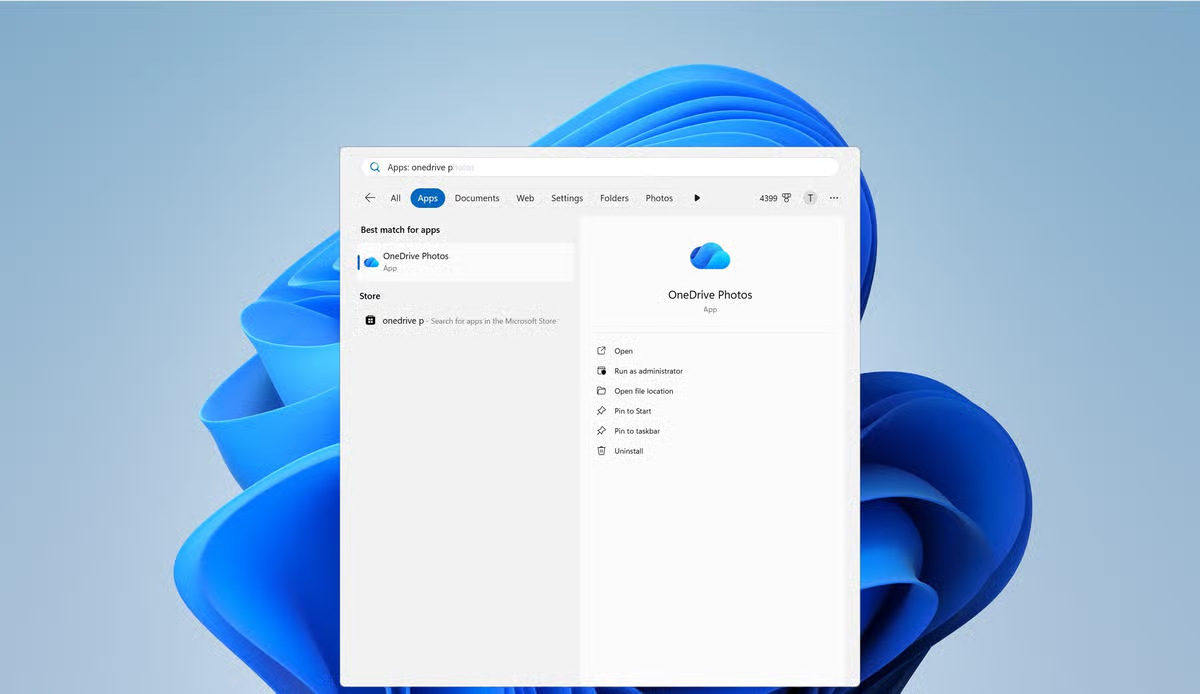
Windows LatestMicrosoft never learns, IT admins rage as a new OneDrive app invades Windows 11 and keeps coming back when you remove itIT admins rage as Microsoft force-installs OneDrive Photos on Windows 11, and it keeps coming back when you remove it.



Replying to @⁨mereo@piefed.ca⁩

Fun fact: Microsoft will try to guess your passwords to open and scan your encrypted archives when uploaded to OneDrive.

Microsoft also hands your BitLocker recovery keys to the government on request.

Microsoft also uses your local machine’s GDID to deanonymize and track you across the internet for the government.

These are paid surveillance services Microsoft provides to the government, paid for by your tax dollars. No wonder they desperately want to force you to use OneDrive.

Black and white close up of sinister-looking male eyes looking suspiciously through the slats of a closed venetian blind. Could be a criminal or a stalker or a watchful home owner.Ars TechnicaMicrosoft is scanning the inside of password-protected zip files for malwareIf you think a password prevents scanning in the cloud, think again.

Replying to @⁨notfromhere@lemmy.ml⁩

To be fair, yeah that shit is egregious.

But that’s not at all what I asked you or what you claimed. Those are technically two different things. And not technically like yes or no. Those are entirely different security fronts.

You’ve got to back that claim up or take it back, and I have a feeling you’ll be taking it back.

It’s okay to be cautious, and it’s especially okay to warn others of trajectories that could lean into privacy or security issues, but it’s not okay to make shit up.

Lastly it’s no longer an init system. It’s a system that happens to handle init.

Replying to @⁨Whostosay@sh.itjust.works⁩

That’s fair. I didn’t mean MS was the threat actor, just the seed from which this grew. I definitely take that back after reading up more on where machine-id grew out of.

However, I don’t concede that machine-id is theoretical for user fingerprinting. Any software installed can read it, especially a browser. That’s the vector for tracking across the web. Do I have instances of this occurring, no. Seems plausible and the more we can sandbox things, especially “web browsers” (untrusted app runners more like it) the better.

Replying to @⁨Whostosay@sh.itjust.works⁩

I’m not technically inclined enough to harden against that, nor do ai really have the inclination. But here is a thread on that topic where I even heard about it.

!privacy@lemmy.ml

lemmy.ml/post/49710604

lemmy.mlHarness launches Gitness, an open-source GitHub competitor - LemmyCredit to @marsara9@lemmy.world [/u/marsara9@lemmy.world] (:
en

Replying to @⁨notfromhere@lemmy.ml⁩

I did just read I think 90% of that, and it just seems like that person is sour about systemd in general.

I agree it’s not unix/Linux philosophy but it’s the best we have.

Does it do too much? Maybe. I haven’t seen that exploited on a large scale in the real world, but it’s definitely a golden key.

There are options. But it’s just one of those things. You’re pissing in the wind unless you’re willing to write it yourself. You can use non systemd distros or even use bsd.

All that said, you’re absolutely right to be concerned, but speaking on it like it’s an active vulnerability is dangerous.

It’s also evident that it’s reliant on the software you run, it’s not systemd that’s giving you away, it’s your application that you chose to install that’s abusing or neglegent of systemd’s access.