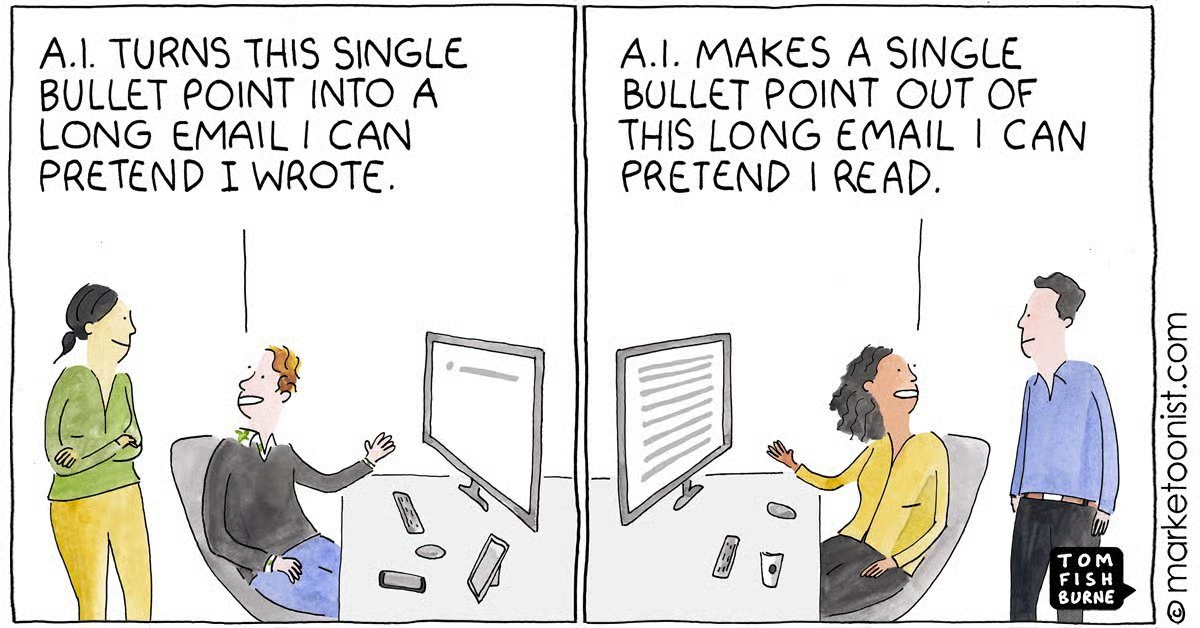
The Metaverse could’ve been a platform free of AI, offering a protected version of the Internet for people to be themselves. It’s kinda where we may be headed anyway. Instead we got this…
Talk to some of the people that run the small web.
I ran into an issue at work with a few FOSS projects that were blocking our cloud proxy service. I messaged one of their admins on IRC for the scoop…
Turns out it was because too many of their (the cloud proxy) customers were setting out ai agents and scraping their websites, constantly. They can’t keep up with the “demand” on their limited budget while also keeping up with free software philosophies.
I read a great article about this the other day…on my work computer. Its too much of a pain in the ass for me to pull up.
Something will have to give. It’s a bit ironic, though, that free software is being stifled because it is too free. It’s almost like a corollary for the tolerance paradox.
they definitely eat up too much bandwidth NOW, that’s undoubtedly a problem, but it’s not necessarily gonna keep increasing at the same pace forever. It kind of reminds me of people who were sure we’d over populate the world and not have enough food, or the people who were predicting female olympic sprinters would soon be outrunning jets
Hosting shit has become too expensive, and the ads will generate less and less revenue, as it’s mostly bots generating clicks and views. This is changing the internet at an incredible pace.
The worst is that any attempt to create a place free of bots will only become a target for LLM companies to gather clean training data.
People that use services like AWS and pay hundreds (or more) per month: “Wow, hosting is so expensive now!”
People that host a bunch of stuff on a $40/year VPS: “Wow, hosting is so cheap now!”
I’ve got several VPSes with 40Gbps (shared) networking, 8 or 16GB RAM, decent amount of space on RAIDed enterprise NVMe SSDs, fast AMD EPYC CPUs, that cost less than $60/year. 20 years ago before VPS hosting became popular, you’d need to pay at least $100/month for a dedicated server with a consumer CPU, single IDE hard drive, tiny amount of RAM, on a 100Mb/s connection.
Not to mention being able to host a bunch of stuff at home for cheap with a low-power single-board or mini PC., and Hetzner making dedicated servers very cheap too.
So I can install any software I want. I’m running my own Lemmy server. I host Odoo and n8n for my wife’s business. I have servers running Borgbackup and Borgmatic for backups. And a bunch of other stuff.
AWS and similar are very expensive compared to a simple VPS. However, AWS offer things that is hard to do on a VPS, not impossible of course but just hard.
Like automatic scaling, your site suddently gets on the frontpage of slashdot/hn/reddit/etc and get 1000x the normal traffic? Your VPS will probaly choke and render error pages for most of the traffic. On a correctly configured AWS scaling deployment, you won’t even notice it. And not only for your webserver, you can do the same for data
And other features like multiregional and easier CDN (also in multiregion) integration.
There are of course problems with AWS also, sometimes you don’t want your site to scale uncontrollably. If you get DDoSed without mitigatiln, for example, you could end up with a huge bill for nothing.
So, as with almost everything in life. It depends what your goal is and how much you want to spend.
I agree about the automated scaling, but with VPS hosting you can usually have several hot spares to handle traffic spikes, and still spend less than something like AWS. Most good VPS hosts will let you create a private network between your VPSes. 1000x spikes aren’t very common.
CDNs are pretty easy in general, especially if they support origin pull.
I don’t like keeping all my eggs in one basket, so I use a few different providers.
Yes. That is an other valid path to use. And you get pretty far with a medium single VPS as well, I mean it is unlikely your little app is going to be another Amazon over night. Starting on a VPS and then adding more, until eventually you might need automatic scaling is all fine.
AWS (and others, but I have used AWS the most) charges quite a bit of a premium but they package it for you. But there is also a big risk of vendor lock-in. Everything is configured for AWS, if they yank up the price you either have to spend a lot of time and money to migrate, or just pay up.
I used to pay $10 per month for my “minimal hosting” - that inflated to nearly $15 across the decades. Then I switched to a modern host provider, now my bills are $0.02 per month for the exact same functionality that used to cost a minimum of $10.
A lot of sites wouldn’t exist without ads, because they want their stuff to be freely-accessible and don’t have any other revenue streams. It would also cut off lower income people that couldn’t afford to pay.
The only business models that have really worked online have been:
Ad-supported.
You pay for the service yourself, like a monthly subscription.
Someone else pays for the service for you, for example freemium services (paid users subsidize the free users), a lot of Lemmy servers (admins cover the hosting costs), etc.
If ads go away, a lot of sites/services would have to become paid services, and smaller ones might just shut down entirely. We’d end up with even more consolidation of the market.
Yeah, my shareware did real well - 800 hours in development, $500 in income across the past 30 years. Oh, and it cost me $400 for the compiler tools back then - so my net profit is rolling in at $0.12 per hour invested. Warning: $440 of that $500 came from an extreme niche product you’re unlikely to find such a lucrative vein anymore. My game only netted $60 in return for 400 hours of development, but you could say I got the compiler “for free” off that niche product’s income.
I think people will eventually have to get used to paying for things though, if bots / AI / ad blockers kill off the feasibility of online advertising. Either that or everything becoming a freemium service with major limits for free users.
cut off lower income people that couldn’t afford to pay.
There’s a shot of irony in there… Google doesn’t monetize poor people highly at all, but the poor people get “free” access with ads because some richer people also allow themselves to see the ads. What kind of communism is that?
It’s the same way that taxes work. Rich people contribute more than poorer people, but everyone can use things funded by public money (parks, police, fire fighters, public transport, schools, health care outside the USA, etc).
I actually wonder if there should be more taxpayer-funded online services. Lemmy’s development was partially funded by government money (NLNet Foundation via the European Commission) for example.
We could live without anything that uses ads to “sustain” itself. Nobody hosting ads on their service is doing so to “maintain” themselves. They just want profit for their labour… they are entitled too, but its a business choice, never a necessity.
And yeah if I use something, I’ll always pay for no ads. Ads cost so much more of our lifespans and contribute so fucking little to those that host them. Garbage.
I don’t particularly think it’s a better change, but CloudFlare is thinking of other options, and with how widespread their use is, if they start doing it, so will everyone else:
That is a really good idea. I’m not gonna lie. I would love it if I could put like five bucks in a wallet and then it just takes a cent or two when I go to some article rather than having to fight through some local news site trying to get me to pay $9.99 a month to read one piece of rage bait. I’ll pay a nickel or maybe even a dime for a good one.
I know they’re targeting AI agents, but it is only a matter of time. I say roll it out to consumers dude and I know that sounds fucked up, but like I would much rather just pay a nickel or a dime here and there than have ads making it impossible to even read the article. The people will compete on price and I bet it will stay really small for most stuff. It gets creators paid in a similar model to YouTube clicks or Spotify streams, but in a much more direct and equitable way. Google, AI has to pay for the content instead of just handing it over.
I’m with you. My concern is that I haven’t yet figured out how it’s gonna be ruined for private consumers by corporate consumers yet, so can’t know how to prepare lol.
You are conflating micropayments (sufficient to pay creators) with gateway monetization, which would need to be small enough you could still use the internet (lets say thousands of pages a month) but high eough to dissuade scraper bot operators. I am not sure such a price exists. Maybe for some bot operators, but the various AI companies have more money than all regular internet users.
Last year, you’d be correct. This year, bots DO purchase things. They also download and run things. Some marketers have gotten wise and have adjusted SEO and general product advertising to appeal to bots.
I think it was when we started organizing into walled cities surrounded by agricultural lands… that was really conditioning to a miserable way of life (for most, benefitting only a few) that carries through all the way to today.
We thought tech would improve our lives. And allowed companies to do anything they wanted for decades because don’t want to hinder progress. And no regulation on companies purchases.
I don’t host things on the open internet anymore. I have a small set of services I host for a group of friends and family and I set them up with tailscale.
On the flip side, I’ve been constantly frustrated because every time I have an idea for some little quality of life tool that involves pulling data from a site I would normally have to browse to directly, I can’t do it because everything is captcha’d to all hell.
every time I have an idea for some little quality of life tool that involves pulling data from a site I would normally have to browse to directly, I can’t do it because everything is captcha’d to all hell.
On the flip side, a bunch of services / web apps (mostly paid ones) are adding APIs to become “AI native”… but you can use those APIs without having to use AI too.
Yeah, but it doesn’t really offer anything useful to fix this situation
My feeling is if we’re smart we’d probably layer it with some sort of DNS style distributed reputation system… If we’re not (which is what will inevitably happen) we’ll continue to consolidate the entire internet into a few huge walled gardens where information is heavily controlled, but you trade every shred of your privacy, anonymity, and dignity for convenience.
Well, the old “web of links” still works, if people valued that enough to put the effort into it it could continue to thrive and grow…
Your DNS style distributed reputation system needs one fundamental foundational element to have a chance at providing any kind of value: reliable/secure author identity. PGP and signed documents have been available through standard formats for 30+ years, but almost nobody has adopted that kind of identity for mainstream publication and consumption. Until they do, reputation is going to be chaoticly fluid, unreliable and trivial to hijack/poison.
The weirdest part won’t be bots outnumbering humans: It’ll be bots writing articles for bots, bots summarising them for other bots, bots commenting underneath, and bots measuring the engagement. … Meanwhile three actual humans are somewhere wondering why the internet suddenly feels so empty.
I know it’s unrealistic, but what would it take to return to a previous type of Internet that wasn’t so siloed and marketed, and filled with dread Internet?
I think we’d have to take money out of the equation. Without the profit, the mass farms, etc would be pointless. There’s still be trolls but it would be so much better.
In a way, the Lemmy layer is sort of doing that. The previous type of Internet is still out there, if you just take the effort to access it / avoid the links in to the marketed sides.
Probably less nostalgia and more open protocols. Bring back personal websites, RSS, forums and interoperable social networks. Make switching services painless, kill algorithmic engagement as the default and stop treating every click as ad inventory.
I have started going back to forums and RSS feeds when I can find them. Most of the forums though are pretty dead. I have even started using Usenet again for actual text newsgroups.
I am hoping for a bit of a resurgence as more people move away from algorithmic social media but I won’t hold my breathe on that.
Usenet still exists but there isn’t much going on these days. 99.9% of groups are completely dead but there are some that hang on. Even those have low posting numbers but not zero, so I’ll take it.
And you wonder why the mega corps want you to give your ID for accessing the internet. Then they can tie your traffic as an actual human and generate ad monies.
What I wonder is: how long before “bot speak” becomes unintelligible to humans.
Already: AI slop is so voluminous, redundantly repetitive, thoroughly complete that it defies complete comprehension due to soporific effects.
LLM agents are writing English (or Spanish, or Chinese, Hindi, whatever… and I wonder which they’re “best” at) documents, ostensibly for human review and consumption, but 90%+ of what I have my LLM agents write is exclusively consumed by other agents, and I’m constantly encouraging them to make their writings more easily comprehended and accessed by other agents - it seems like the English translation is pretty useless for that layer - what would a token stream look like instead?
Example of something I had to lookup to understand: (/hj)
Back when I was in school, Autism was a 1/10,000 Dx. 20 years ago it was crashing down from 1/100 to 1/50, checking now… 1/31 today. They’ve lumped so much into the Autism diagnosis that it’s meaningless anymore; it covers so many varied conditions and severities, and the stereotypes don’t fit most recipients of the Dx anymore.
LLM agents are writing English (…) documents, ostensibly for human review and consumption, but 90%+ of what I have my LLM agents write is exclusively consumed by other agents, … and accessed by other agents - it seems like the English translation is pretty useless for that layer …
But remember, the LLM is trained on human language. It doesn’t understand what it is talking about, it just simulates humans talking about it. I don’t think there is a more fundamental token stream there to be uncovered.
There’s no “LLM native language” to convert to for efficiency.
Yet. With 1000x as much bot-content being generated on the web as human generated content, the “bot spoken” training set will grow rather quickly, and I see no reason for it not to evolve in a similar way to how human spoken languages evolve.
What’s the point in coming up with an entire new language for them if they can just write English and humans will also understand it?
Kinda pointless to have LLMs optimised to produce garbage humans can’t understand because at the end, your goal is still to produce something humans will consume.
You ever see that movie, Idiocracy? They cloned a clone and it was retarded. Bots copying bots copying bots will eventually turn to shit that’s hard to decipher and obviously written by bots.
I’m still wondering how long advertisers are going to be shoveling money into it until they realize mostly only bots are the audience, and then what the collapse after that is going to look like.
The Internet protocol suite (TCP/UDP/IP) is literally a protocol to connect isolated networks hence inter networking. It’s foundationally decentralized. You might be able to argue DNS is centralized but nameservers are abundant and you can even choose. Throwing out the Internet because some shit heads are scrapping it with bots is ridiculous and I hope you were just being sarcastic. This problem should be addressed at the legislature level instead of the protocol level.
The IANA controls IP address allocation, so in that way, IP is centralized. And yes, as you mentioned, DNS is also centralized, and so is SSL/TLS. Having multiple options doesn’t make something decentralized, it just means there are multiple centers.
And while I don’t like how much control centralized organizations and corporations have over the supposedly decentralized Internet, we certainly shouldn’t throw it out until we have something ready to replace it, and even then, it would have to be a gradual shift.
Processing all the text as tokens is too much work, so the AI will just read the headline and the first 3 paragraphs, then hallucinate the rest of the details.
Free versions already do this. If you pay for enough tokens they can also do the real work and generate summaries better than your average human docu-drone.
Crystal ball: Just a couple of months after Cloudflare revealed that bots have officially surpassed human traffic online, the company has given its view on what things will look like in five years. It’s not good news for us fleshy meatsacks: non-human traffic could be up to 1,000 times higher than human traffic.
CDN and cybersecurity giant Cloudflare held its Q2 earnings call on Thursday, during which chief financial officer Thomas Seifert gave a concerning prediction about what the web will look like in the future.
“If the current trends continue, we think in five years, non-human traffic will be as much as 1,000 times as much as human traffic,” he said.
“In other words, humans will be a rounding error on the internet, not because human traffic goes down, but that’s just how fast we’re seeing non-human traffic grow.”
Seifert did add the important caveat that his predictions have been wrong in the past. Cloudflare CEO and co-founder Matthew Prince will likely be able to relate to this. He had predicted that bot traffic would surpass humans at the end of 2027, but it happened earlier this year.
It goes without saying that the sudden acceleration in non-human traffic is being driven by AI – agentic AI, specifically. Agentic systems behave very differently from traditional web crawlers and fraud bots. Their activity can closely resemble ordinary browsing, but it happens at machine speed and can be repeated on an enormous scale.
Even a straightforward prompt may trigger thousands of requests. Prince illustrated the difference using online shopping: someone searching for a camera might check five retailers, while an AI agent could examine 5,000 sites on their behalf. Multiply that behavior across millions of users asking assistants to compare products and airfares, research topics, collect information, or condense articles, and you can see why Seifert believes humanity’s online presence will become a rounding error.
Seifert said that if traffic does grow the way he expects, “we’ve got to get a lot more efficient,” which is where Cloudflare’s services come in, of course. He also mentioned the security implications of a web made up pretty much entirely of bots.
The idea that Dead Internet Theory – the concept that the internet is mostly run by bots and AI – will be demonstrably true in a few years (or now, arguably) is a concerning one. For a start, it could see the end of independent sites that have relied on the web’s business model since the 1990s.
There’s also the fact that an internet full of bots, AI slop, and privacy risks is making more people pull away from the online world. In our poll, 97% of people said the internet today was a hellscape compared to its early days, and it looks like things are only going to get worse.
There’s also the fact that an internet full of bots, AI slop, and privacy risks is making more people pull away from the online world. In our poll, 97% of people said the internet today was a hellscape compared to its early days, and it looks like things are only going to get worse.
Looks like the cure is inherent in the disease. Anyone else remember the early 90s when Usenet was just text-based fun and then some motherfucker thought it was a grand idea to run ads? I do, and it’s been downhill ever since.
It’s sad that it has come to this, but as usual a handful of greedy fuckers have ruined it for the rest of us. (My personal opinion is that big tech could have arrested this downhill slide at any point, even from back in the first days of email spam, but have chosen to monetize it every step of the way instead.)
Real humans are already individually opting out, one by one, as we each personally get sick of the slop and realize it’s just not helping anymore. For myself I’m only on intermittently, I’ve ditched all social media, Lemmy is all I participate in regularly now beyond the odd comment here and there, and that seems about right for me at this time.
I adjust it regularly, often just by going offline for days, but I had to see the problem before I could change it. I think that’s where a lot of people are, just now seeing it for the first time as a real problem affecting their quality of life directly.
But like any other addiction, the point of turning is different for everyone. These fuckers on the other end, filling everything with slop and running bots without end, are just speeding it all up.
Have you gone outside, and seen how people use their phones? The public is utterly addicted to social media.
They won.
I think Pondsmith got it right with Cyberpunk. The future of computing is corporate controlled siloes people simply cannot escape, and the “open web” and PC as we know it is basically defunct. Maybe small circles of people will congregate in Usenet-like circles. But not at scale.
I suspect my ongoing emphasis on individuality and use of words and phrases like “one by one” and “personally” and “different for everyone” may have escaped you.
I don’t see groups as masses of fungible humans; I see them as a collective unit of individuals like myself, each one with a separate history and a separate set of decisions to make about their lives, and for that reason I tend to avoid all-encompassing generalizations of “people” as homogeneous units – to the point that statements such as your own strike me as propagandistic, more intent on changing my view and laying down a law on a subject than on considering any evidence to the contrary.
When I read your reply to me, so confidently wrong about what I see around myself in terms of phone usage, I wondered if asked the same you’d even see anyone not on their phone, because you seem to have decided that everyone everywhere at all times is glued to it by choice, permanently and without exception.
For myself, I’ve chosen to be off technology for long stretches, and I see more and more people making their own decisions to do the same even if their individual choices don’t look exactly like my own. And yeah, when I go out, I see plenty of people both off and on their phones. When I make eye contact in a store aisle, I see plenty of eyes making contact back. When I eat dinner out, I see as many phones face down on tables as I do in hands. Mostly I don’t pay attention because I don’t need to: others being on it or not is their own battle to fight.
And they will.
The future of computing is corporate controlled siloes people simply cannot escape
Lol, no. To remain in a prison of choice requires the consent of the imprisoned. I am not bound to engage in computing on demand, nor am I addicted to it, and if it comes down to it I’ll just turn the shit on only when absolutely necessary. I’ve done it before and every time it is great; I’ll do it again in a heartbeat.
Some may have to participate by necessity in corporately-controlled computing structures to some degree depending on work needs, for example, but most of what is booming now is entertainment, not business: social media, streaming, subscription services. Entertainment is a matter of individual choice and again, I find myself in no prison not of my choosing.
I can escape those silos simply by walking away when I am not contractually obliged to interact with them, such as in a work scenario, and so can everyone else. Even you.
Sad that humans built a really crazy awesome amazing system for exchanging information, and then corporations ruined it.
I too, miss the old web. Pretty cool when website just did the thing they said they did
These fuckers on the other end, filling everything with slop and running bots without end, are just speeding it all up.
It’s the tragedy of the commons writ large.
Started off with cooperation and general good behavior between users, passed through corporations bulldozing the place and putting in paid parking for their strip malls, now we’re at the Wall-E stage where advertising billboards talk to robots mindlessly doing tasks in abandoned cities for some nebulous “greater good”.
To expand on this, things like reddit and discord are literally modern-day attempts to enclose the commons in my view. They took all the ground from open protocols that nobody in particular owned and replaced them with an aristocrat’s private property.
uhh, the bots are requesting multiple sites in parallel, not in series, so it’s difficult to say “hey look, that user moves through 5 pages per second”. instead, you’d say “hey look, there’s 5 users each crawling through 1 page per second”.
I’m pretty close to having a userid whitelist on my server. I have public facing but nothing that really needs public facing. I could easily just make it a user token based system then revoke any credentials that abuse the services
I have been on the internet since 1993 and have always been disappointed that a subscription/donation model didn’t beat out an ad-driven model. I wonder if this is going to push us towards a subscription/donation model as things move behind paywalls tplo protect against bots.
I don’t really want to pay subscription fees, but I am definitely tired of ads and being the product. I’d rather be sold a good product.
Its in the early phases but its been a sucess so far.
Mesh networks, you say? I’ve gotta get in on the ground floor of this new advertising opportunity so I can rake in that sweet early adopter cassssh!
Claude! Code me up an ad-injection framework for this meshtastic dongle I just bought, stat! Time to get me a big ol’ chunk of advertising real estate!
We got tired of meshtastic so we build some with Wi-Fi HaLow and other Wifi stuff.
Meshtastic/core are ok as a hobby, but after doing it for a good number of years, im just tired of the downtime, strange issues with heltek and the very small amount you can actually send.
What’s the range like with halow? I’ve been eyeing it off for a while. Seems like a nice high gain omni and a bit of height would make it go a fair way.
The sad irony of efforts like that and stuff like Lemmy or Mastadon is that they HAVE to stay just a little too fiddly, too inaccessible, too rough. Otherwise, they become a victim of their own success. Suddenly, “normal” people show up and ruin everything. Scammers follow, bots follow, advertisers follow, etc.
It’s like with piracy, where any page that’s known to “normal” people is very likely going to be taken down.
I’m reminded of the episode of TNG where they trapped Moriarity in a simulation so he would think he had taken over the ship.
Maybe we can just have an internet just for billionaires where they have AI produce internet content so they can advertise useless AI products to AI bots run by other billionaires while the rest of us go on with our normal lives in the real world?
It can be done, I just bought an e-ink phone and it’s caused my use of commercial social media to plummet. Admittedly I’m saying this on Lemmy, but I think Lemmy has more in common with the forums of yore than ‘social media’ as it’s generally understood.
Note that the computer that made that simulated world for Moriarty is itself a (usually) language-driven AI. Not making a real point here, just noting the humor in it.
Because they are locking intenet. Their rules randomly lock real users from accessing websites. Their sales are predatory. They sell waf to see unencrypted traffic to websites on their end.
Why don’t we just generate every video imaginable procedurally and host them in space? Get it over with. Every combination of anything. Because that’s what this torrent of AI slop videos feels like.
Well yeah. Of course it would, given the examples they are talking about.
It makes sense right? You have a computer, you can program it to do things. I have programmed mine to scrape data or examine websites, and even in some cases to pull entire directories down.
Now we have an agent do that. In other words a programmed computer tool that is acting on someones behalf using natural language as the question. Note the example given is an AI is looking across as many websites as it can for a review. Or maybe instructions to put something together. Or maybe a list of the highest peaks in the world with the least snowfall. Who knows, but that is endless.
So this “traffic” is still human driven. Its just using a computer to do the work. I think that changes the perspective a little bit. It is all human intention driven.
Also, all traffic by http plus every other request is still human, so that is a bit misleading.
Interestingly, its not like we havent been here before if you look at traffic. The syncing of usenet for a period of time was the largest user of all traffic. So all computer connections, much, much less humans.
Most traffic today is video, then gaming, than music, financial, screen sharing, p2p, and AI makes up a tiny portion. It just is making a huge number of requests for HTTP, but it is growing, and fast.
This is neither pro AI, nor anti AI. I am just trying to examine the landscape instead of the over simplistic headline that really is about Cloudflares business model.
That’s not the point. Let’s put aside that an LLM driven agent is not deterministic ie, not always doing what the user intended, just like regular text autocomplete messes up as well regularly. The point is that like with e-mails when spam became so easy to generate that it flooded the system, now more sophisticated actions on the internet get easier to do (that said, most of it was possible already before, just required more skill), at least as long as LLMs are not charged at real costs but highly subsidised.
At some point something has to give. Either tools will be developed to somewhat reliably classify the nature of the traffic or things will start to be priced out as everyone will have to pay the bill for this new kind of spam (ie low value high volume traffic, or ill intended traffic)
A lot of that was scraping. A huge amount. Just take everything possible. Hopefully that will slow down, or as I did, I allow requests and reponses, but scraping gets kicked.
But it is getting hard and harder to self host. Large websites and hosts (gitlab, self labs) get slammed and even DOS. Its been rough.
There are huge network upgrades in the works to try and deal with this 3.2T are being looked at already. But of course electricity is going to hit a hard ceiling both for the data center and the network center. Hence the costs you are talking about.
I am more concerned with the fact that if everyone is asking AI, who is going to put the answers somewhere to get them? Who is going to self host and publish like I do today? It already is rare to see people running their own websites anymore. Lemmy is pretty amazing for that, but it too has gotta be having a huge amount of traffic at each instance.
I guess I am saying I am aware of your concerns and I have mine too.
It feels a bit like in Cyberpunk, where the wild Internet has become unusable or even dangerous and only big corpo controlled parts are still accessible to the masses.
The other topic you mentioned, LLM’s are going to hit a wall and they’ll do so hard. Training will be increasingly relegated to information predating large scale use if LLMs to avoid rapid degradation of the models by training it with LLM output. That in itself creates a huge problem the more time passes. Nothing is safe btw, analog media are increasingly just as tainted.
You could say anything is human driven if you follow the thread far enough. I’d say if an automated process is cranking out hundreds of requests per minute then even though someone turned it on it still falls under a bot process. There is no human actually monitoring each request or interacting with it.
I had a realization recently that with driverless cars becoming more common that one day I’m going to be stuck in traffic surrounded by dozens of other cars that are completely empty. They’ll just be going to pick up a human driver somewhere or going to park and no one will care because instead of eliminating traffic we’ll just ensure humans are entertained while stuck in it.
Why bother to fix traffic congestion if you can just play PlayStation the whole time or whatever?
If most cars are autonomous, and capable of coordinating with each other (via mesh network, for example), then traffic congestion might become much easier to prevent reduce and solve mitigate. (Edit: Based on responses, I may have chosen my words poorly)
You’re probably not wrong though. I imagine it’ll get worse before it gets better.
Traffic congestion will always be a thing. The real world is too unpredictable. You can’t pack a highway full of cars and expect them to drive highway speeds. One animal jumping on the road and you’ll have a massive accident because nobody can avoid anyone
Traffic congestion doesn’t happen because of lack of coordination. Coordination prevents collisions. Our success rate could be a lot better but the system does pretty well with coordination limited to blinking lights, a noise that says “fuck off”, the mutual knowledge that we all got the same training and the private knowledge that everyone else on the road is a suicidal idiot who slept through the training.
Congestion is a physical property of the road network. There’s a physical limit to the number of cars you can push through a road in a given time period. Drive the cars too fast and they fly off the road when it bends, or cars slam into each other when a deer tries to commit suicide.
Traffic is well modeled as an incompressible slightly non-newtownian fluid, like runny oobleck. If you apply more pressure/increase vehicle volume the fluid starts to bind up as it becomes harder for the cars to maneuver without collision, regardless of coordination.
You reduce traffic by taking cars off the road, or scheduling utilization. Self driving cars won’t help, and we can do both of those without them. Long term they’re likely to make collisions worse because humans don’t know what they’re going to do, so the primary mode we have of coordination, “the theory of mind” will break down. Right now they’re so uncommon that you assume any car is a human who reacts and prioritizes like you.
Tear down the freeways and replace them with trains.
In other words - car usage expands to the limit because human nature is to use the resource until it gets inconvenient. The gas expands to fill the container.
I won’t disagree with what you said, but I’ll disagree that it’s the same point I was making.
My point was that there isn’t a technical solution to traffic congestion. You need less fluid or a bigger pipe. What you correctly mention is why a bigger pipe won’t work for humans when it does for water.
And out of pure pedantry, I’d disagree purely because my analogy said “non-newtownian liquid” - those don’t expand. :P it’s more like a hyperactive toddler manically jamming silly putty into a PVC pipe.
I don’t believe we will ever get coordinated autonomous vehicles. You will never be able to absolutely trust the information you are getting, whether it’s because wireless sucks, auto manufacturers couldn’t agree to or properly implement a universal standard, software bugs, or malicious behavior. If we want it to be safe, then the cars will have to drive cautiously and be prepared for behavior that was not properly communicated. This will not be a form of driving that is fundamentally different to what we have now.
And even if you could implement perfect coordination between autonomous vehicles, how would you be able to take advantage of it in the real world? Ban all human drivers? What about pedestrians and bikes? You still need crossings and traffic lights for an area to be livable by humans. You still need to drive slowly next to a pavement where someone could eg trip and fall onto the road.
Continue avoiding them – that should never change.
You still need crossings and traffic lights for an area to be livable by humans. You still need to drive slowly next to a pavement where someone could eg trip and fall onto the road.
Agreed.
All those examples seem like they’re in response to a goal of eliminating 100% of all congestion. I actually edited my comment to clarify that that’s not what I’m talking about, but that edit was many hours before your response. Is it still unclear?
Since we’re talking examples, maybe I can offer one to clarify:
Ever been in a traffic jam after someone ran a red light or stop sign and caused a wreck? If fewer (because zero is unrealistic) of those incidents happen, then there are fewer traffic jams caused by them, right? And when they do happen, it would be easier to reroute traffic early on – which might also make it easier/faster for emergency vehicles to get to the scene.
Or for an example that is completely unrelated to traffic: Condoms and vaccines are pretty effective. Maybe not 100%, but still enough to be useful. There are some areas in real life where absolutism is just unproductive.
Ever been in a traffic jam after someone ran a red light or stop sign and caused a wreck? If fewer (because zero is unrealistic) of those incidents happen, then there are fewer traffic jams caused by them, right? And when they do happen, it would be easier to reroute traffic early on – which might also make it easier/faster for emergency vehicles to get to the scene.
Yeah, this is reasonable, but that’s just lawful driving. You mentioned “coordination” before so I understood you meant that they will be able to drive significantly faster due to the coordination. That’s what I was responding to and why I pointed out reasons that autonomous cars will still have to drive carefully even if they are coordinating perfectly among themselves…
Or for an example that is completely unrelated to traffic: Condoms and vaccines are pretty effective. Maybe not 100%, but still enough to be useful. There are some areas in real life where absolutism is just unproductive.
Here’s my concern expressed in similar vein. Imagine a vaccine that you expect to be ~5% effective in the midst of a pandemic. You might say 5% is better than nothing, but actually it might give people a false sense of security. They might change their behavior (be less careful) to the point that the end result is the same or even worse than it was before the vaccine.
If we get autonomous vehicles, it’s almost certain that they will affect the number of cars on the road. If their (hopefully) better driving leads to only marginal gains in the prevention of congestion, the future might actually be more congested than the present.
Ha ha. Traffic will move to let billionaires through quickly.
Regular folks will be stuck in endless traffic trapped in driverless cars that charge them $5 a minute for the privilege all while playing the same loud and obnoxious audio video ads on repeat for hours on end.
Well, if you were a billionaire who owned AI system trained to influence and extract money from humans, and there’s no humans online, what would you do?
And so that brings us to how robots actually will become a reality…
In the early 1900s the Collier family made themselves a big pile of money and bought what later became Collier County, Florida. Pretty much all of it was privately owned by them, along with a collection of every type of Porsche ever made and a bunch of other “gee, what can I do with ALL this money” activities… Property taxes encouraged them to sell the land off and now what once was a private family “farm” about 100 years ago is now home to over 400,000 people.
Add to these “very rare moments” every single time I use the FOSS, offline speech-to-text engines handy.computer and Whisper+. They’re awesome, down to the automatic punctuation!
People are just going to get sick of the Internet, if they haven’t already, and start to look at it like a necessary evil they have to use to do certain things instead of what it once was which was fun and exciting. It’s sad.
Snail mail is delivered by guys in trucks / jeeps - sometimes on foot, still lots of fuel to carry around all that glossy printed (mostly uneconomical to recycle) paper. Per unit-information carried, snail mail has enormously higher environmental impact.
Now, if you feel special enough to think you have your own personal LLM agents targeting you with web advertising… maybe that’s costing the same as your share of sending the mail truck around to you - but I don’t think the internet marketers are quite there with burning the tokens just to try to hit you, personally, with offers you can’t refuse. Mostly you’re just a statistic in the bigger algorithms that fill your feed from troughs A, R and X.
Currently private users and enthusiasts. As networks grow, there will probably be universities joining. Eventually corporations will start marketing plug and play equipment while selling access to server space and long distance connections. Other businesses will join and finance their services by selling subscriptions, advertising, and user data. Various government agencies will add hardware they can also use to track traffic. Someone will inevitably bring in bots, AI models, and internet connected devices. After that someone will coin the term “dead mesh network theory” and all the nerdlings will start developing the next knitted network or something.
The catalyst there is businesses (and to a degree governments).
I used to pay attention to my physical mail. Then it was all “junk mail” and the signal-to-noise ratio got hard to manage.
I migrated the important stuff to “electronic mail”, where I had a curated list of people and entities that sent me items, so I could focus on things that were important. Then my address/mailbox became common knowledge and that filled with “spam”.
I started using SMS/text for the important stuff. But that also became a common place to send me stuff I didn’t care about, so I used specific apps on my phone that had permission to notify me when something needed attention, and now my phone gives me so many notifications I just ignore them all.
Our attention is the prize, and it won’t matter where our attention goes: The businesses will follow.
The same will hold true for connectivity. If the current internet becomes a wasteland and we migrate to Mesh, then it’s only a matter of time before corporate interests take that over too; then knitted, or fabric, or the glob.
The solution will be protections for personal identity and privacy, which have been and will be fought tooth-and-nail by the companies because they want that info so they can be where our attention is so they can make profit. I think we can also fight the profit motive, but that’ll be harder than getting protections in law… so small steps.
World governments will be delighted to find that they’ve driven their populations off of the internet. As much as they’ll hate being engaged in 24/7 automated cyber warfare to stop their power plants exploding.
It was keeping them distracted, until it started either letting them foment or driving them insane. They’d prefer you just consume media and leave them to their business, these days.
I believe it is an attempt to use an argument that they will care about. You could write a brilliant piece about how that many bots hurt culture and society but if the ones you want to convince don’t gaf about either of those, they probably won’t even read what you have to say, let alone change anything because of it.
Or, more likely, they won’t even see anything here, at which point that comment becomes more of a “they aren’t even very good at what they want to be good at”.
Like from my pov, the top of the corporate world doesn’t just not care about those things but is actively trying to destroy them because they think they’ll do better in a world where none of those things are as they currently are.

 TechSpotCloudflare says humans could become a "rounding error" as bots generate 1,000 times more internet trafficCDN and cybersecurity giant Cloudflare held its Q2 earnings call on Thursday, during which chief financial officer Thomas Seifert gave a concerning prediction about what the web...