posted in Technology

AI will make people work more, but they’ll be happy about it, Sam Altman says
cybernews.com/ai-news/sam-altman-workweek/posted in Technology
AI will make people work more, but they’ll be happy about it, Sam Altman says
cybernews.com/ai-news/sam-altman-workweek/
Replying to @return2ozma@lemmy.world
I’ll make little Sammy suck my cock, and he’ll be happy about it.

Replying to @DarrinBrunner@lemmy.world
he prefers rich daddies like Thiel, who created him.

Replying to @return2ozma@lemmy.world
I think he just Trumps his way through interviews, inject bleach to disinfect the lungs, medical science can have that, I just thought of it.

Replying to @return2ozma@lemmy.world
Above all, don’t lie to yourself. The man who lies to himself and listens to his own lie comes to a point that he cannot distinguish the truth within him, or around him, and so loses all respect for himself and for others.
~ “The Brothers Karamazov” by Fyodor Dostoevsky (1880)
-–
We lie loudest when we lie to ourselves.
~ “The Passionate State of Mind” by Eric Hoffer, 1955 (preview)
 Internet ArchiveThe passionate state of mind, and other aphorisms : Hoffer, Eric : Free Download, Borrow, and Streaming : Internet ArchiveMainly concerned with the emotions, their origins, their results in action, and their ethical implications
Replying to @return2ozma@lemmy.world
“Technology, for a long time, has been promising people that they’re going to work less and they’re going to have all this leisure," Altman said, adding that things have gone in this direction.
He explained that people now have more time for leisure and a higher quality of life than in previous points in history.
"But somehow we never get the promise of the 4-hour workweek on a mass scale in society. And I don’t expect AI to change that,” Altman said.
OpenAI CEO added that people’s expectations always go up, and they want more.
“We think of new things to do, to create for each other, to want for ourselves. People are very focused on how they’re doing relative to other people,” he said.
Altman then spoke about the competition that drives the economy and people’s desire to be useful to others and to create.
Altman’s predictions are in stark contrast to the vision of Elon Musk, CEO of SpaceX, the company behind the chatbot Grok.
In a recent interview with the Economist, Musk envisioned a future in which jobs are optional, and money doesn’t matter, but he didn’t provide much detail on the transition to this level of abundance.
Yeah, I think that Altman is probably closer to being right than Musk is, at least for some time to come. If you’re talking about the kind of systems that OpenAI and xAI are working on, then certainly.
A lot of people — on the Threadiverse I see plenty posting — are really worried about permanent expanding structural unemployment. Something like “there will be no jobs” or something like that. And, okay, it’s not immediately obvious why that wouldn’t happen. And there have been some very prestigious people who have predicted otherwise.
npr.org/…/keynes-predicted-we-would-be-working-15…
The economist John Maynard Keynes once wrote an essay titled “Economic Possibilities For Our Grandchildren.” It was 1930. And in the essay, he made a startling prediction. Keynes figured that by the time his children had grown up, basically now, people might be working just 15 hours a week. David Kestenbaum with our PLANET MONEY team tried to sort out where Keynes went wrong.
To date, what has consistently always happened over time is that as our productive capacity increases, someone finds some way to create a higher standard of living using that productive capacity. That higher standard of living has always been more-appealing than the leisure time. If we wanted the standard of living that was present in 1900, say, we could work a lot less and just accept that standard of living. What happened instead of increasing leisure was increasing standard of living. Larger houses, air conditioning, cars, video games, elaborate movies, out-of-season fruits and vegetables, all that.
It’s possible that that phenomenon will end, but I’d bet against it in the near term. We’re really good at finding new things that people would like.
Now, I do expect that there will come a point where you can produce an AGI that is truly superhuman in the sense that it’s more-capable in every significant way than a human. I do not think that that is going to happen in a year or ten years, but it might not be that far down the road. And then, unless you see demand specifically for something made by humans — think of the way that there is demand for, say, expensive handmade fountain pens, something like Veblen goods — we’re going to have to rejigger things for a post-scarcity society.
en.wikipedia.org/wiki/Post-scarcity
Post-scarcity is a theoretical economic situation in which most goods can be produced in great abundance with minimal human labor, so that they become available to all very cheaply or even freely.[1][2]
Post-scarcity does not mean that scarcity has been eliminated for all goods and services. Instead it means that all people can easily have their basic survival needs met along with some significant proportion of their desires for goods and services.[3] Writers on the topic often emphasize that some commodities will remain scarce in a post-scarcity society.[4][5][6][7]
But I would be pretty confident that ChatGPT isn’t getting humanity to a post-scarcity society in the near future.
And I think that there are a whole host of other things that would change in human society in such an environment that I’m not sure that structural unemployment would be the first thing I’d think about. Like…what does the military balance of power look like in a world where an individual can hypothetically manufacture robots that manufacture factories that manufacture military drones, say? I mean, it’s a awfully different world in a lot of ways.
Replying to @tal@lemmy.today
To date, what has consistently always happened over time is that as our productive capacity increases, someone finds some way to create a higher standard of living using that productive capacity. That higher standard of living has always been more-appealing than the leisure time.
The frustrating part is what the upper class misses, They describe it as the “standard of living” going up… They are talking as if getting a house is the same as always, but we all want netflix and video games now so we are struggling to keep up. When the obvious situation to anyone not at the top is, what used to be expensive luxuries are getting cheaper, new luxuries are being added, but essentials are ballooning out of control.
If we had the choice to live like the 80s, where we could casually afford a home for a family with a single income etc… but facebook were more expensive… their analogies would make sense. but the reality is, we’re all forced into the work large hours, not because we want more luxuries, but because the basic human needs for food, water and shelter are where the requirements are going up.
Replying to @TheFogan@programming.dev
My dad did afford a home for a family with a single income and it was in the 2000s
Let’s not pretend it’s some impossible feat
Replying to @iopq@lemmy.world
There will always be exceptions, but what matters is systemic trends.
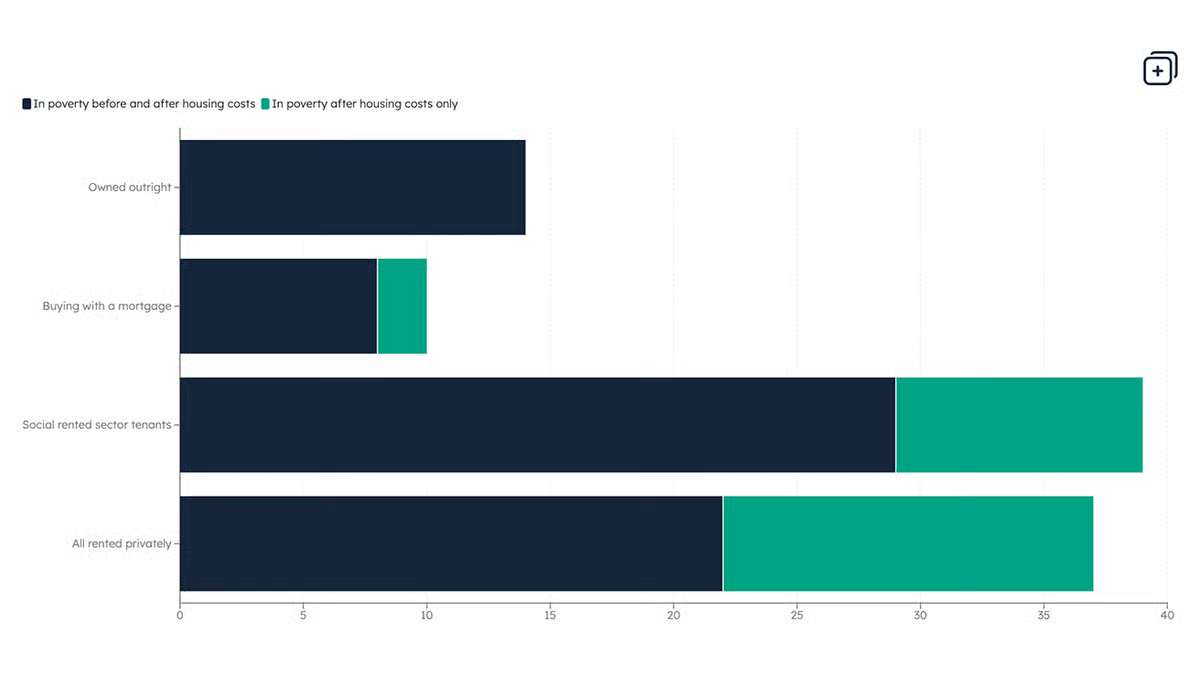 Joseph Rowntree FoundationHousingOur latest data charts show poverty rates are highest among renters, with high housing costs pulling many private renters into poverty and low incomes driving poverty among social renters.
Replying to @Stopwatch1986@lemmy.ml
You’re not going to put women back into the kitchen and de-grow China. So it’s not like it’s even possible to expect everyone to raise a family on one income.
Replying to @iopq@lemmy.world
I didn’t say it was impossible, I meant it was far harder than it was. It was the normal expected result at one point, and as time goes forward it’s less and less common.
Replying to @TheFogan@programming.dev
It was already more difficult in the 1980s because women entered the workforce. The peak male single earner household was the early 1970s before the peak of Japanese manufacturing
Replying to @iopq@lemmy.world
I’ll agree, but what I’ll say is it’s a chain… were we to put it
longtermtrends.com/home-price-median-annual-incom…
so bottom line is it’s right, it was actually a minor peak in 1970, dropping to 1975, going up to 1980… balooned like crazy in the 2005 housing bubble, and is currently sitting way above that.
but yeah I’d say key overall trend is, starting around 1970… it’s on the whole progressively gotten worse over time.
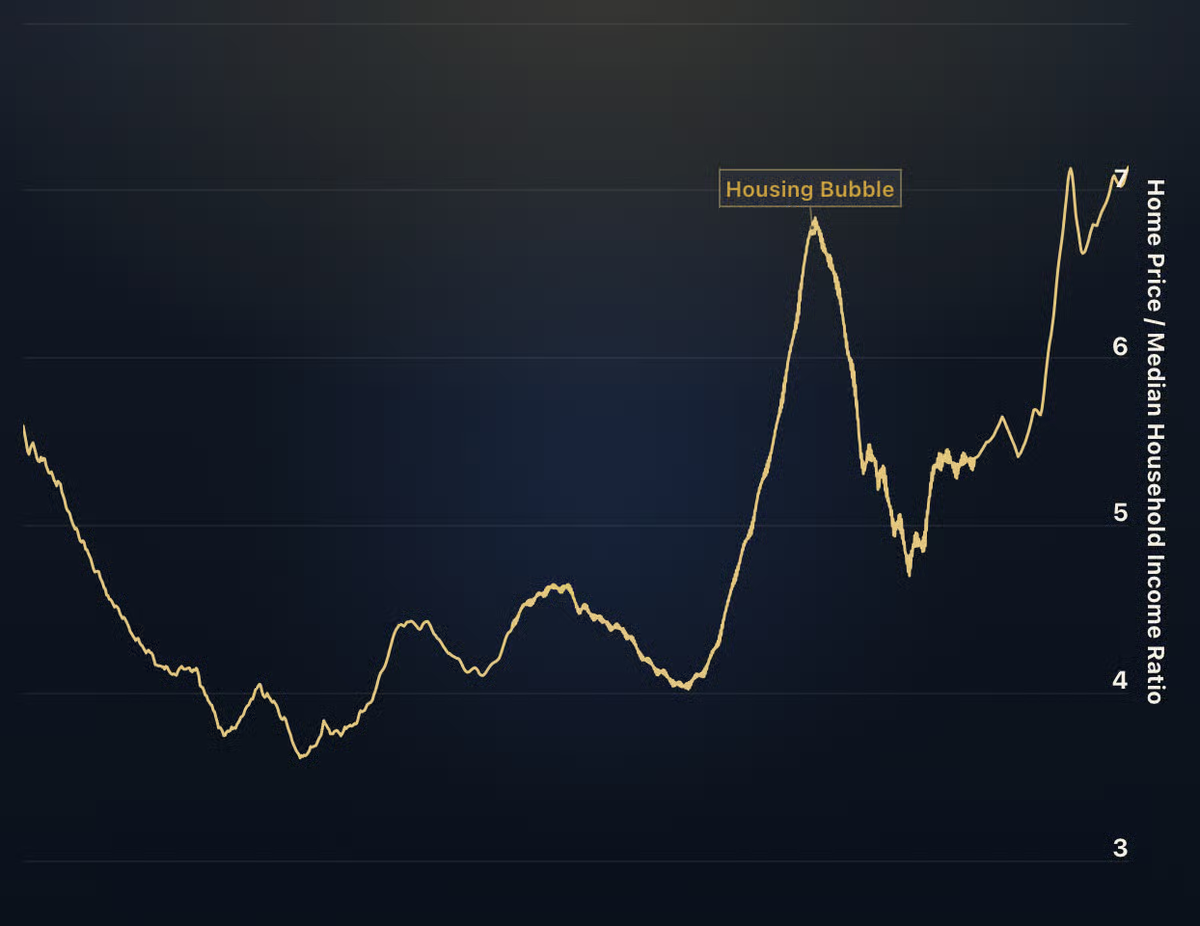 www.longtermtrends.comHome Price to Income Ratio - Updated Chart | LongtermTrendsHow affordable are homes in the US? Historically, a typical house in the US cost around 5 times the yearly household income. The
ratio in this chart divides the Case-Shiller Home Price Index by the US median annual household income.
www.longtermtrends.comHome Price to Income Ratio - Updated Chart | LongtermTrendsHow affordable are homes in the US? Historically, a typical house in the US cost around 5 times the yearly household income. The
ratio in this chart divides the Case-Shiller Home Price Index by the US median annual household income.Replying to @TheFogan@programming.dev
This doesn’t take into account interest rate. Homes were cheaper in the 1980s because nobody could afford a mortgage at 10% or more
Housing was actually easier to finance after the housing crash because of 0% interest rates and lots of foreclosed real estate. That is, if you didn’t lose your job due to the financial crisis
Replying to @tal@lemmy.today
What are you smoking? People aren’t choosing to continue working 40 hour weeks or multiple part time jobs because they want to. They are doing it because the economy is structured to coerce them to.
Replying to @tal@lemmy.today
Evidenced report after report shows that poverty is rising fast in wealthy countries. In the UK, a G7 economy, people in full time employment doing a decent job (eg teachers) can’t afford to buy a home or pay the rent and rely on food banks. Life expectancy is decreasing too. This is the first time this is happening after many decades. You would think that in a G7 economy these people would at least be able to survive, or even thrive. Instead, people have to make a choice between ‘heating and eating’, and young people are forced to live with their parents in their 30s.
There are many reports on children poverty too. This is not going to end well.
Frankly, the rising standards and choice narratives are not just misguided. They are insulting.
Joseph Rowntree FoundationHousingOur latest data charts show poverty rates are highest among renters, with high housing costs pulling many private renters into poverty and low incomes driving poverty among social renters.Replying to @tal@lemmy.today
I think the piece this part misses is with the amount of money being spent by these frontier companies, if they ever do crack the post-scarcity, let alone profitability layer, you damn well know their focus will be on recouping their losses and maximizing profits. Same as it ever was.
The mob boss you borrowed money from isn’t going to write it off because you did something altruistic, he’s going to break legs until he feels he’s been paid in full.
Idk man, I want to believe but when you look at the top contenders for cracking AGI today, I don’t think you would consider any of them benevolent.
When we live on a planet with so much food waste, yet people still starve… I don’t think we’re going to get there without complete societal upheaval, and it will be violent and hard.
Note I’m not advocating for violence, I don’t ever think that’s the answer… but it may end up being a phase we undertake. As long as there are haves and have nots, and with inequality growing… not looking too good for the optimist in me…
Replying to @return2ozma@lemmy.world
Won't someone rid us of this meddlesome asshole?
Replying to @Triumph@fedia.io
I’m trying but the universe keeps failing to gift me the powers of teleportation and telekinesis.
Guess I’ll just have to go the old school route.
Hey Sam, come drop into NZ for a bit.
Replying to @Triumph@fedia.io
Lots of people with fpv drone skills these days.

Replying to @return2ozma@lemmy.world
When someone kills this motherfucking asshole, I’ll have something to be happy about.

Replying to @return2ozma@lemmy.world
Didn’t his own younger sister accuse him of sexually assaulting and raping her when she was a little kid? And then the whole family circled wagons around Sam and claimed the sister was mentally ill?
I mean, getting raped and molested as a little kid by your older sibling would definitely give you some mental trauma and problems.
Replying to @ThePowerOfGeek@lemmy.world
kinda odd since hes also gay, but the media almost have very little info about his past. likely suppressed due to him being plucked from obscurity by THIEL.
Replying to @Tollana1234567@lemmy.today
Karen Hao’s book covers it. But essentially correct. A bit of detail with the family stuff but we do know the guy is machiavellian , a shapeshifter , and that the family did turn their backs on his sister who was effectively homeless and had to turn to prostitution. Needless to say Sam wasnt short of a penny prior to OpenAI days even . Hao is a decent journalist, and her book is the best summary so far I think. This stuff is less interesting than the rest to me however but I guess posing questions of character such as this can help paint the picture.
Replying to @stellargmite@lemmy.world
The picture of the past / questions of character give a sense of what they might do next, but the real questions are what are they actually doing next? Those are the things that need focus, and I get the sense that the current ruling class has learned to manipulate the masses with distractions about the evils of their past in order to get what they want in the future.
Replying to @stellargmite@lemmy.world
sam was plucked from obscurity by thiel, yea he definitely was funded by him.
Replying to @return2ozma@lemmy.world
LOOOOOOOOLL
Sam Altman?!?
HAHAHAHAHAHAHAHAHAHAHAHAHAHAHAH
Replying to @return2ozma@lemmy.world
I (am forced to) work with AI at my job and it makes me miserable. Way more often than before I just put in the hours and I’ve stopped caring about the product…

Replying to @slampisko@lemmy.world
Yeah they truly automated the best part of my role. Now it’s monitoring Claude sessions and more meetings.
I’m planning an exit, can’t be tomorrow or next year, but 5-10 years if this continues. I think they’re going to see an exodus of senior talent over the next decade.
Replying to @slampisko@lemmy.world
i was wondered, if all the tech people im seeing at conferences are only in tech positions for AI solely. we had AI conferences every week up until july. and they dint exactly hire most of the people that were laid off.

Are there any neo-pagan witches here that can curse him?
Replying to @daggermoon@piefed.world
Best i can do is the curse of Ra:
𓀀 𓀁 𓀂 𓀃 𓀄 𓀅 𓀆 𓀇 𓀈 𓀉 𓀊 𓀋 𓀌 𓀍 𓀎 𓀏 𓀐 𓀑 𓀒 𓀓 𓀔 𓀕 𓀖 𓀗 𓀘 𓀙 𓀚 𓀛 𓀜 𓀝 𓀞 𓀟 𓀠 𓀡 𓀢 𓀣 𓀤 𓀥 𓀦 𓀧 𓀨 𓀩 𓀪 𓀫 𓀬 𓀭 𓀮 𓀯 𓀰 𓀱 𓀲 𓀳 𓀴 𓀵 𓀶 𓀷 𓀸 𓀹 𓀺 𓀻 𓀼 𓀽 𓀾 𓀿 𓁀 𓁁 𓁂 𓁃 𓁄 𓁅 𓁆 𓁇 𓁈 𓁉 𓁊 𓁋 𓁌 𓁍 𓁎 𓁏 𓁐 𓁑 𓀄 𓀅 𓀆
Replying to @return2ozma@lemmy.world
CEO says
Eat a bag of dogshit.

Replying to @return2ozma@lemmy.world
Can millionaires+ shut the fuck up about work already? Most of them have never worked an hour in their lives, with the rest having worked between 6 and 18 months total, 30+ years ago.
Replying to @return2ozma@lemmy.world
Why do so many of these CEOs barely look human?
Replying to @Toga77@lemmy.world
Next we learn that the crackpot theory about lizards living among us is actually real.
Replying to @takeda@lemmy.dbzer0.com
The fact that Peter Thiel’s name is an anagram for the reptile is still funny to me.
Replying to @Toga77@lemmy.world
and sam altman is anamgram to Satans lamb, very fitting since thiel is the “anti-christ” and has apostates like sam altman and jd vance.
Replying to @return2ozma@lemmy.world
I thought the point was to work less
Replying to @return2ozma@lemmy.world
I truly hate this motherfucker.
Replying to @return2ozma@lemmy.world
Idle hands being the devil’s workshop and all that… can’t let people do what they want, most people don’t even know what they want, and of those who think that they do - if they ran around doing that they might “change the world” - and that would be bad for the status quo, so those in power in the status quo are certainly going to try to stop that…
Replying to @return2ozma@lemmy.world
Downvoted because we are platforming this asshole by sharing what he says against sharing data about what he and the other assholes do.