Replying to @⁨beep@piefed.world⁩

You don’t really need sources, we all know AI tends to hallucinate when presented with a problem they can’t solve.
So far I’ve only read about 1 example of a problem that an AI may have solved. All the rest are without details and are not confirmed in any way.

Remember AI companies are huge on propaganda for their technology, but not so big on admitting the shortcomings.

Edit:
Changed the use of the word evidence to sources, because apparently people misunderstood it.

Replying to @⁨Buffalox@lemmy.world⁩

Yes, scientific articles are expensive. I know that, that sucks. That’s why most of this stuff is on arxiv.

I linked to evidence that mathematicians are using LLMs to find proofs and publish those proofs. Which is what I said is happening.

…stackexchange.com/…/can-i-publish-a-novel-theore…

I am not a mathematician, thus I don’t really know where to find indipendent confirmation or even how that is generally handled by mathematicians. However: there are plenty proofs on arxiv that disclose have been found with LLMs. Some of these proofs relate to famous problems and have been in the news. Fields medal winners discuss the importance of LLMs and how it may produce too many proofs for humans to handle.

I trust that those proofs published on arxiv have been reviewed by many mathematicians, if they were incorrect that would have rapidly become known.

Replying to @⁨ranzispa@mander.xyz⁩

Yes, scientific articles are expensive.

Doesn’t have to be scientific articles, it can easily be a normal article that state that scientists have confirmed the findings independently.
This is a very common thing for normal media to describe. The second article you linked would most probably have included that if such confirmation existed.

I linked to evidence that mathematicians are using LLMs to find proofs

No you didn’t, the article described a researcher testing the capabilities of AI, nothing in the article was really about math, it was all about the AI, and the whole story reeks of sensationalism.

Replying to @⁨Buffalox@lemmy.world⁩

Scientists don’t often publish when they confirm an article is correct. Knowing a few mathematicians, probably they see no need to do that. They checked the proof, it was ok and that’s it.

Either way, many of those proofs come with a computer program which checks and confirms the proof is correct.

I trust that an expert mathematician talking about such things has reviewed a few of those articles and has checked the proof.

You may not do that; check the proof yourself or pay a mathematician to do it for you.

Replying to @⁨ranzispa@mander.xyz⁩

This sounds like something you outright made up.

Classical unsolved math problems have rewards.
Mathematics absolutely have peer review:

pubmed.ncbi.nlm.nih.gov/28029799/

PubMedOn the Nature and Role of Peer Review in Mathematics - PubMedFor the past three decades, peer review practices have received much attention in the literature. But although this literature covers many research fields, only one previous systematic study has been devoted to the practice of peer review in mathematics, namely a study by Geist, Löwe, and Van Kerkho …

Replying to @⁨Buffalox@lemmy.world⁩

If you wish, this was indipendently confirmed: the same proof was published by two authors at the same time.

scientificamerican.com/…/ai-helped-produce-two-pr…

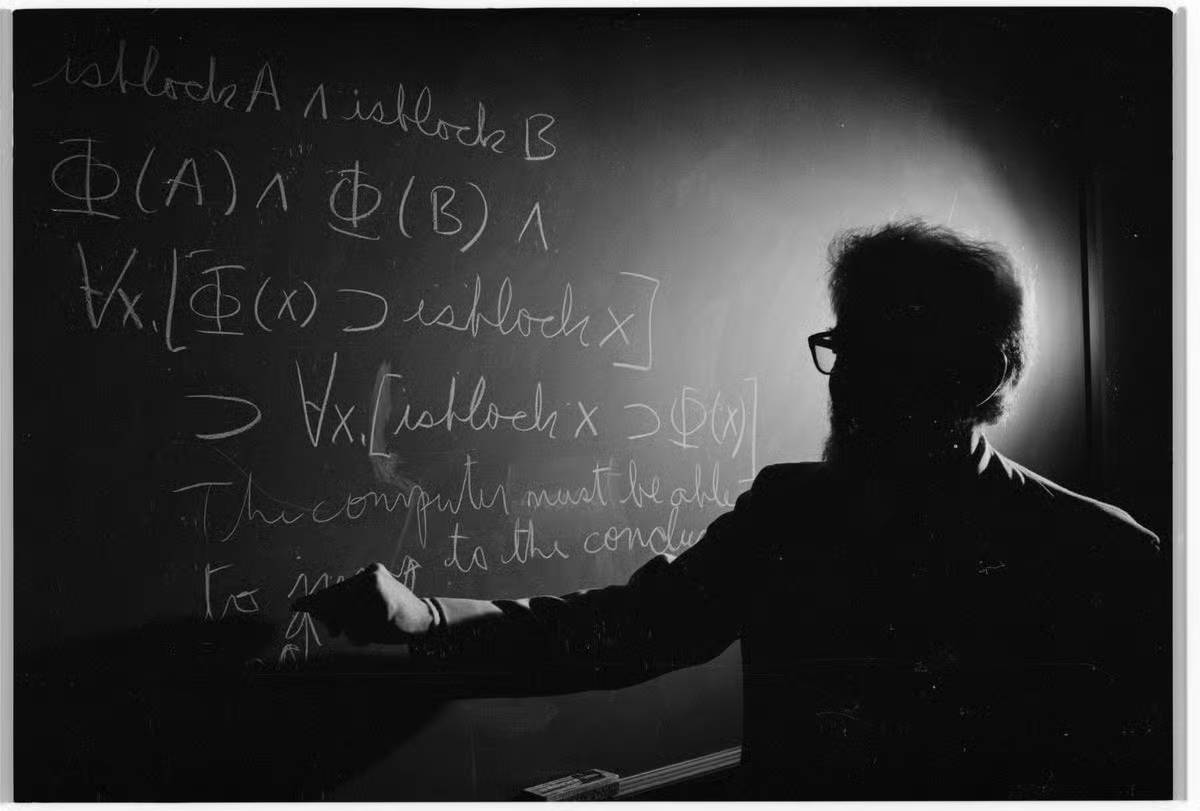
A silhouetted man gestures toward symbolic logic written in chalk across a blackboard.Scientific AmericanAI helped produce two proofs for the same cryptography problemAn M.I.T. Ph.D. student and two University of California system cryptographers used GPT-5.6 Sol Ultra in different ways, raising new questions about independent discovery and scientific credit

Replying to @⁨ranzispa@mander.xyz⁩

Neither paper has been peer-reviewed

But that’s not really the point, the point is that yes maybe AI can solve long standing mathematical problems, but they need to be confirmed by REAL mathematicians.
Because AI has been shown to hallucinate and lie when presented with problems they can’t solve.

There are many claims about AI solving hard mathematical problems, but very few that are confirmed. These stories seem to at least to some degree to act as advertising for AI services.

Replying to @⁨beep@piefed.world⁩

LLM mathematical proof exploits theorem proover bugs [to get false statement to be “proven” true]

infosec.exchange/@0xabad1dea/117002106099986943

Infosec Exchangeabadidea (@0xabad1dea@infosec.exchange)Okay, we have a new contender for Most AI Thing to Ever Happen 1) July 25th: someone messes around with an LLM and posts a proof of the Collatz conjecture that does, in fact, verify in the theorem prover. (The AI use is not disclosed on the github page) https://github.com/xrchz/CollatzLean 2) July 26th: several serious bugs are posted in the theorem provers, that in principle could allow a false statement to be "proven" true. They're serious, yes, but no need for panic, because you're not going to blunder into accidentally exploiting the bugs while writing a proof, probably. https://github.com/leanprover/lean-kernel-arena/pull/81 3) July 28th: someone who was right to be very skeptical of the Collatz proof, and had the expertise to study it with a fine-toothed comb, discovered it was exploiting a bug https://github.com/leanprover/lean4/issues/14576 4) The "proof" turns out to be exploiting multiple similar but distinct bugs to pass different solver variants! ⚠️⚠️[IMPORTANT EDIT

Replying to an earlier post

Your knowledge is out of date. For example, Claude runs a Linux container with Python and Sympy, so it absolutely can do a good chunk of math now. Still makes mistakes, but it’s good enough to serve as a LaTeX assistant. Similarly for ChatGPT but crappier. If you have the computing power, I think you can also give a local LLM access to Python tools with OpenWebUI.

Replying to @⁨Buffalox@lemmy.world⁩

This one will do me, as someone whose profession requires practical adaptation of mathematics in real world environments.

Seeing what I can see with the development of AI, it looks to me that any application which requires intensive calculation to solve one or more direct problems would be its strength but there still would probably need the mathematician (in my case spatial scientist) set the boundaries of what needs to be solved. Pardon the pun.

How AI dealt with variables such as pressure, temperature and heat expansion at certain times of the day within a measurement or several very long baseline measurements would all be dependent on the ‘mathematician’ behind the calculations, for a real example I could give.

Replying to @⁨Buffalox@lemmy.world⁩

We don’t need mathematicians to clear the proof as valid if it is checked by a formal proof system. Mathematicians would only need to check the theorem itself to make sure it describes what it should describe.

I think chess and go are a bad comparison. Their solving does not conclude in some societal use. They are interesting only as problems, but mathematics is interesting as a solution too.

Replying to an earlier post

Mathematics, and really any other subject, are not just about solving formalized problem. It is much more important to understand what question to ask.

One of my colleague once said the definitions in a good (computer science) paper should be the most interesting part, theorem statements should be the second interesting, and the proofs should be obvious.

Formal proof means nothing if it cannot give us insight in other proofs.

Same with open problems, Mathematician love open problems because given that no expert are able to solve them, their solution likely involves novel mathematical ideas. Fermat’s last theorem on its own is no where near as interesting as the mathematics that leads to its soluion.

Given that AI have yet to be able to wield the mathematical corpus effectively in solving large projects (or even fully autonomously improve large software), it would need human guidence, and by that, human experts are needed to understand the problem.

To qoute another one of my colleagues, people orchestrated AI to solve an open problem are simply the apple falling on Newton’s head. Apple “knows” about the existence of gravity, because its motion follows it, but it takes a Newton to formulate and explain gravity that leads to a number of technological advancement later. Without the question “why do apple fall”, apple will keep falling, we will keep noticing it, but we would never turn that observation into useful technologies we enjoy today.

Replying to @⁨beep@piefed.world⁩

All of the evidence presented in the article are either PR from LLM corpos or based on pre print review papers not yet peer reviewed. There probably will be some problems or class of problems these tools will help with, but I don’t see any more reason to think mathematicians will be less necessary than search engines replaced scientists or horseless carriages replaced wheel manufacturers.

Replying to an earlier post

Suppose we had a library filled with proofs of every theorem [in mathematics], as well as excellent guides that could, given a question, take us to the answer and explain it. What would a mathematician do in such a library?

If you ask the question this way, the answer becomes clear: they would be unbelievably excited, and immediately get to work. They would immediately start asking questions: how does one prove the Riemann hypothesis? The Hodge conjecture? Their own pet obsession (in my case, the Grothendieck-Katz p-curvature conjecture)? Then they would work until they understood the answer. The job would not be done, not even close.

This paragraph by Daniel Litt feels to me like hubris coming from someone in the position of power. Many tech-optimistic mathematician are not at the risk of being replaced by AI because they are either on the tenure track or already tenured.

We need to acknowledge that mathematics is a subject of more human importance than economical importance. In this hyper profit driven world, field without a primary economical drive will necessarily shrink significantly.

Mathematics have no doubt experienced that: in the cold war, mathematics is behind most of the technological advancement that lead to concrete economical output. Later, as many of these fields stablized, engineer and computer scientists takes the place of mathematician, and mathematics shrunk significantly.

Now mathematics still holds importance because people believe it still encapsulates important ideas that have the potential to be the next generation of economical driver force. And mathematicians are important to preserve and disseminate such knowledge.

So if such truth oracle described above can develop and articulate any mathematical idea better than (or even close to the quality of) any mathematicians, it would be fun for established mathematician to flip through the answer sheets of their puzzle, but it would kill the financial driver and wipe out most of professional mathematics with it.

Replying to @⁨beep@piefed.world⁩

I don’t know shit about mathematics, except that when numbers and letters collude, that’s a fucking conspiracy against me. That said, I strongly suspect that for legit mathematicians, solving thorny math problems is only half of what they do, but rather, by operating from a platform of experience, intuit the nature of numerical systems, what that means in relation to other systems, and how we use them to understand and navigate the world.

The title sounds as ridiculous as proclaiming professors of literature are worried because an LLM can parse a sentence.

There’s a fundamental knowledge, both in the specifics of systems and holistically that can only be gained by solving these quandaries through the lens of human interpretation.