posted in Technology

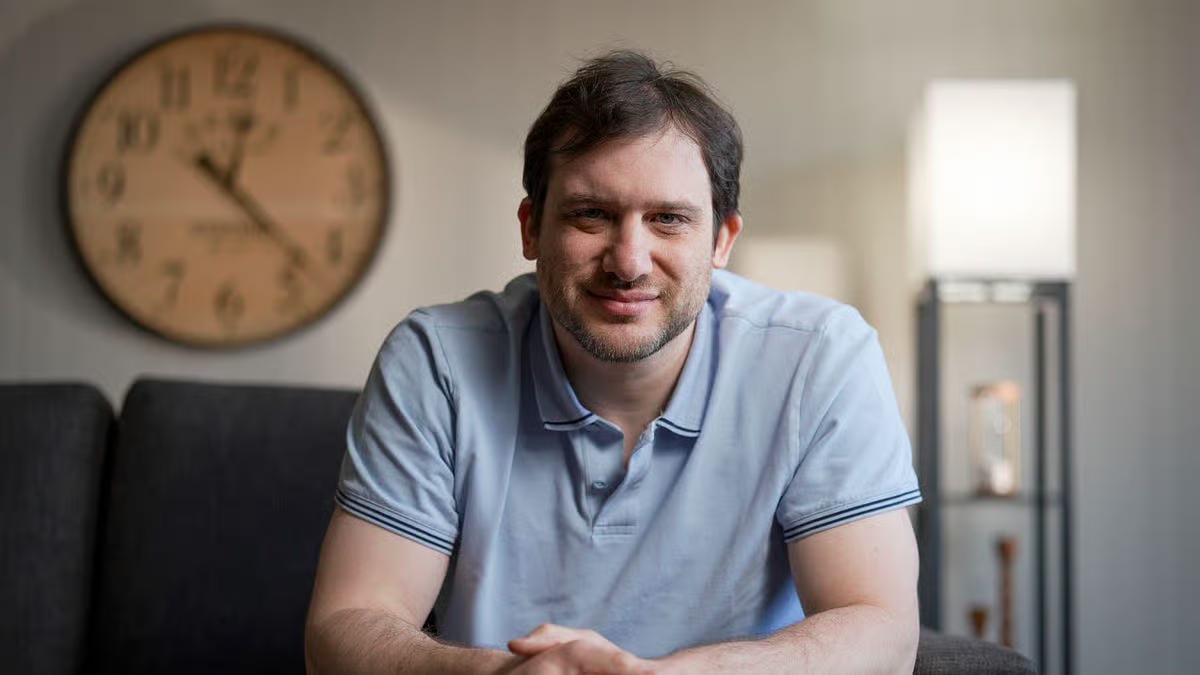
www.understandingai.orgMathematicians are grappling with the possibility that AI might eclipse themI talked to 20 mathematicians about rapid AI progress in their field.

Replying to @⁨beep@piefed.world⁩

You don’t really need sources, we all know AI tends to hallucinate when presented with a problem they can’t solve.
So far I’ve only read about 1 example of a problem that an AI may have solved. All the rest are without details and are not confirmed in any way.

Remember AI companies are huge on propaganda for their technology, but not so big on admitting the shortcomings.

Edit:
Changed the use of the word evidence to sources, because apparently people misunderstood it.

Replying to @⁨Buffalox@lemmy.world⁩

Yes, scientific articles are expensive. I know that, that sucks. That’s why most of this stuff is on arxiv.

I linked to evidence that mathematicians are using LLMs to find proofs and publish those proofs. Which is what I said is happening.

…stackexchange.com/…/can-i-publish-a-novel-theore…

I am not a mathematician, thus I don’t really know where to find indipendent confirmation or even how that is generally handled by mathematicians. However: there are plenty proofs on arxiv that disclose have been found with LLMs. Some of these proofs relate to famous problems and have been in the news. Fields medal winners discuss the importance of LLMs and how it may produce too many proofs for humans to handle.

I trust that those proofs published on arxiv have been reviewed by many mathematicians, if they were incorrect that would have rapidly become known.

Replying to @⁨ranzispa@mander.xyz⁩

Yes, scientific articles are expensive.

Doesn’t have to be scientific articles, it can easily be a normal article that state that scientists have confirmed the findings independently.
This is a very common thing for normal media to describe. The second article you linked would most probably have included that if such confirmation existed.

I linked to evidence that mathematicians are using LLMs to find proofs

No you didn’t, the article described a researcher testing the capabilities of AI, nothing in the article was really about math, it was all about the AI, and the whole story reeks of sensationalism.

Replying to @⁨Buffalox@lemmy.world⁩

Scientists don’t often publish when they confirm an article is correct. Knowing a few mathematicians, probably they see no need to do that. They checked the proof, it was ok and that’s it.

Either way, many of those proofs come with a computer program which checks and confirms the proof is correct.

I trust that an expert mathematician talking about such things has reviewed a few of those articles and has checked the proof.

You may not do that; check the proof yourself or pay a mathematician to do it for you.

Replying to @⁨ranzispa@mander.xyz⁩

This sounds like something you outright made up.

Classical unsolved math problems have rewards.
Mathematics absolutely have peer review:

pubmed.ncbi.nlm.nih.gov/28029799/

PubMedOn the Nature and Role of Peer Review in Mathematics - PubMedFor the past three decades, peer review practices have received much attention in the literature. But although this literature covers many research fields, only one previous systematic study has been devoted to the practice of peer review in mathematics, namely a study by Geist, Löwe, and Van Kerkho …

Replying to @⁨Buffalox@lemmy.world⁩

If you wish, this was indipendently confirmed: the same proof was published by two authors at the same time.

scientificamerican.com/…/ai-helped-produce-two-pr…

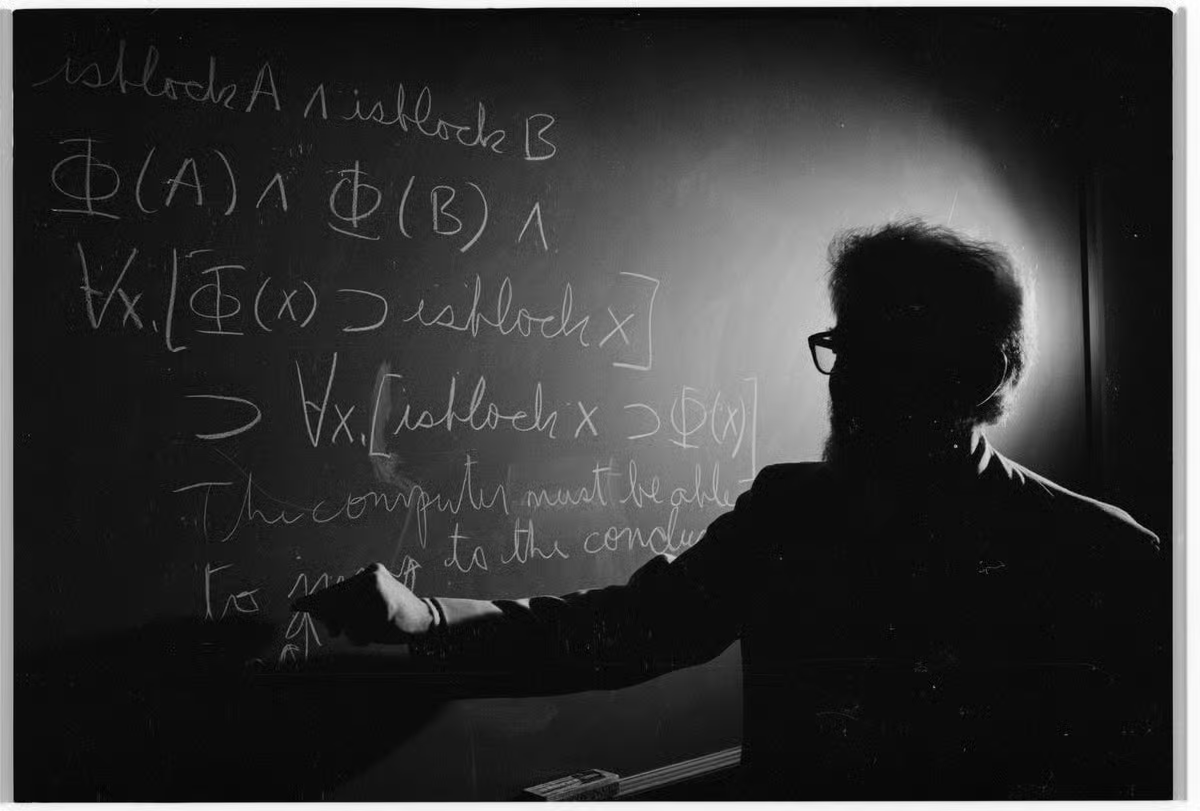
A silhouetted man gestures toward symbolic logic written in chalk across a blackboard.Scientific AmericanAI helped produce two proofs for the same cryptography problemAn M.I.T. Ph.D. student and two University of California system cryptographers used GPT-5.6 Sol Ultra in different ways, raising new questions about independent discovery and scientific credit

Replying to @⁨ranzispa@mander.xyz⁩

Neither paper has been peer-reviewed

But that’s not really the point, the point is that yes maybe AI can solve long standing mathematical problems, but they need to be confirmed by REAL mathematicians.
Because AI has been shown to hallucinate and lie when presented with problems they can’t solve.

There are many claims about AI solving hard mathematical problems, but very few that are confirmed. These stories seem to at least to some degree to act as advertising for AI services.