Replying to @⁨vane@lemmy.world⁩

It’s pretty normal for an employer to dictate what tools and applications an employee uses. If you prefer gitlab but your employer requires teamcity, you don’t really get a say, right?

However, if you think you can meet your deadlines without using a code generating AI tool, then don’t use it. Ideally, if they are as useless as you imply, no one will be able to tell whether you’re using it. The conflict should only really appear if they do increase productivity, and you refuse to use them, resulting in less productivity than your peers.

Replying to @⁨joe@lemmy.world⁩

The conflict should only really appear if they do increase productivity, and you refuse to use them, resulting in less productivity than your peers.

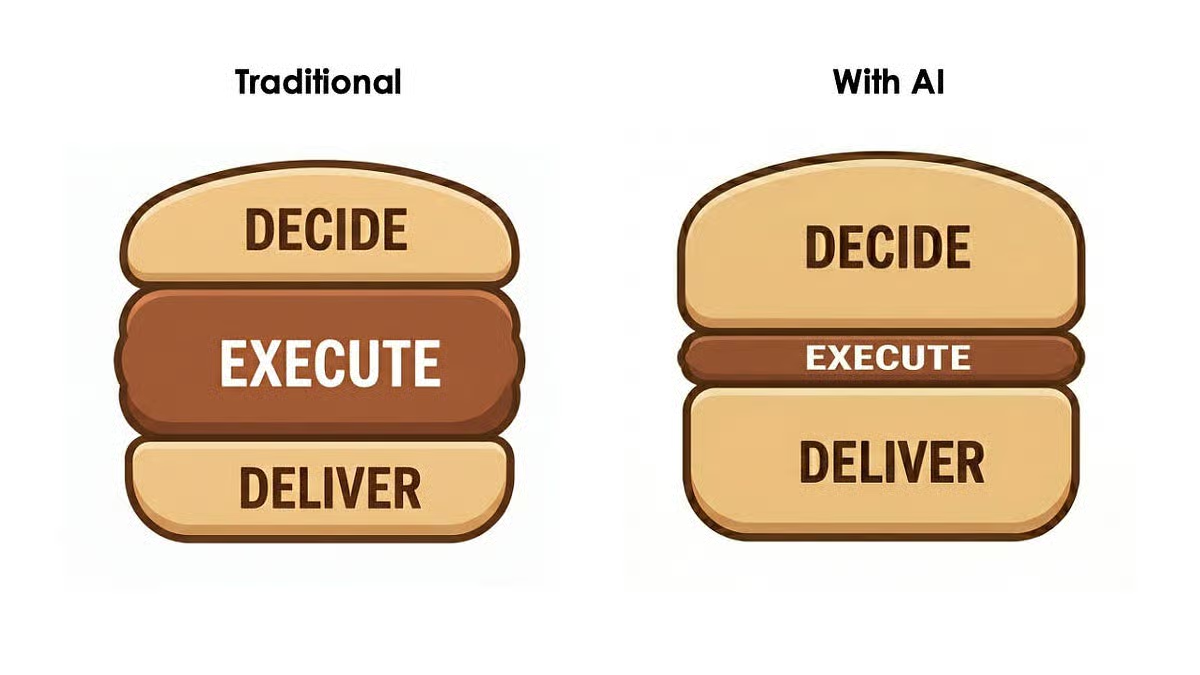
While it should be easy to point out where this helps, it very much is not in reality because AI accelerates execution on ideas, but corporations nearly always suck much more at deciding which ideas to actually implement in the first place.

I predict that the longer this goes on, the more useless, untested half-features will be stuffed into software and the more bloated “fall back” implementations full of duplicated spaghetti code will exist.

If the tools don’t stick around because it’s too cost prohibitive to keep using them, we’re going to be cleaning up after the bots for a decade.

It’s been a boon for personal slopjects for me. But that’s because I could never find time for execution in the past. Now I just have the (free tier) AI slop up my ideas.

Replying to @⁨joe@lemmy.world⁩

Which happened without AI, too.

Sure, but not at this speed. The bots can churn out a mountain of non-sense that does not work faster than people can review it and the bots themselves will lie to you and say “it’s all implemented”.

For people who have clear ideas of what to implement but struggle to find the time, this is a big gift. You can work hand-in-hand with the bot and say “nope, not that, this” until it implements what you had in mind. For aimless corporations with “ideation” meetings who cannot stop coming up with terrible ideas that none of their customers want, it’ll hasten the process of them making their software worse over time.

That’s exactly what I’m seeing at my current company.

Replying to @⁨joe@lemmy.world⁩

I agree with that as well. A lot of the problem with my current company comes straight from the executive leadership level. I’m afraid that the culture will only change when they change (or more likely, the company will eventually just go bust).

They bought the lie that AI will replace all of software engineering, whereas I see the picture more like this:

normaltech.ai/…/why-ai-hasnt-replaced-software-en…

A CEO that thinks that they’re going to develop all of the software, even with Claude code, is nuts. They simply do not have the necessary skill set to run a software project even if 100% of the hands-on programming is done by AI. They are not going to be sitting there telling a machine to move things around on a web app. They are going to believe the bot when it says that “it is implemented”.

www.normaltech.aiWhy AI hasn’t replaced software engineers, and won’tCoding agents as normal technology

Replying to @⁨joe@lemmy.world⁩

And maybe your point is what Doctorow was trying to make all along, but he pushed too far in the other direction? Even now, Code Generation is a useful tool, as long as it’s used as only a tool by someone who knows what they’re doing.

In this piece — which I read via RSS feed a number of weeks ago before it was published in this medium — he is writing about what most peoples’ experience is in a company where they have decided to “do AI”, and what most CEOs think about when they think about “doing AI”.

This usually comes in the form of a company chatbot or “agentic workflow”, and in the vast majority of cases these things are very much not helpful and can actively be annoying because attention is paid to developing these things when more practical and useful features could be developed instead (see: …mataroa.blog/…/i-will-fucking-piledrive-you-if-y…).

In other pieces, he discusses — using what I would call sort of esoteric terms that he often defines inline — people in saner places that get to choose how and why to use AI to assist with their jobs. But that’s not the majority of people’s experiences and that is certainly not what CEOs are often talking about.

I think he’s being somewhat hyperbolic in this particular piece, and maybe that’s due to the amount of “AI is changing everything” or “AI has changed everything” that is appearing in LinkedIn / X posts everywhere, when it’s difficult for most to even name a single thing that the chatbot has spit out that has improved lives, and the vendored chatbot attached to an existing piece of software (which is mostly what people end up doing when they “do AI” at a company) is completely useless.

If I take myself as an example, he’s largely right that I have to play this game with internal development teams that come up with “agentic workflows” and try to get me to use them to do my job when it’s a lot easier and better to just…use Claude code myself.

AI hasn’t “changed everything”. The only thing it’s really done so far is produce a lot of chatbots and agentic workflows that aren’t very useful. It remains to be seen if: (1) it can ever be made to work more efficiently, (2) if you can ever actually run a profitable business building or running a “neocloud”, and (3) what the broader effects on software will be from mass usage of this technology.

The early signals on all of these very real concerns (not to mention others such as environmental, cultural, and economic impact) are not very positive.

ludic.mataroa.blogI Will Fucking Piledrive You If You Mention AI Again — Ludicity

Replying to @⁨joe@lemmy.world⁩

Company will be able to tell if you’re using it because companies behind sota models come with monitoring. You will have meeting with hr and your manager when you will be forced to use it even if you meet quotas. They will argument it that maybe you can do more and increase your normal quota with expected ai usage increase in productivity even if you had best productivity in team without ai and your productivity stays the same. Suddenly you will be under performing because you are refusing to use ai so you will be first to fire even if you are best employee. That’s how corporations work. They are monitoring usage because it costs them money. For big corporations they pay upfront to get discounts. Company also make many trainings and meetings to encourage everyone use AI models they pay for but nobody wanted.

Replying to @⁨muusemuuse@sh.itjust.works⁩

In other words, corporate leadership is starting from the premise that AI has (or will) radically change the business, and they’re working backwards from that premise to find the evidence to support this article of faith.

This quote is quite funny in this context, because it’s literally what people do with AI. Half of the frontpage of lemmy is AI. The other half is people saying AI is bad with no realization of the irony, because they don’t see good AI. It’s like CGI. Everybody hates CGI, except they don’t. CGI is everywhere. They just hate bad CGI.

Replying to @⁨muusemuuse@sh.itjust.works⁩

Like most things, meaning depends on context. In the most common context of “news about AI” we’re talking about generative AI: image/video generators, LLMs, and to a lesser degree coding assistants. If you want to know more about what these technologies share in common, look up what a “perceptron” is and how it works.

More generally AI could mean anything from a neural network based approach to problem solving, to a completely deterministic, hand coded heuristic. A pure decision tree could be AI in the case of video game NPCs, for example.

Replying to @⁨AwesomeLowlander@sh.itjust.works⁩

I mean, yes. Linux is an algorithm. The programmes called AI are also still algorithms - they’re still deterministic, just too much of a tangled mess, too complex, for a anyone too realistically break it down step by step.

There are some math problems that cannot be described algorithmically, but because of that they’re also non computable. Uh, some thermodynamics and quantum stuff from what I’ve heard.

Replying to @⁨muusemuuse@sh.itjust.works⁩

Since that was a lazy question I decided to be lazy and just copy paste it into Gemini. Enjoy! I have no idea what the point of this is!

Artificial Intelligence isn’t a single technology; it has been a massive umbrella term since the 1950s. Broadly, it means creating computer systems capable of performing tasks that typically require human intelligence.

If LLMs are just one tiny branch on the tree, here is what the rest of the tree looks like:

Machine Learning (ML): This is the engine driving most modern AI. Instead of a human programmer writing strict "if/then" rules, we feed the computer massive amounts of data and let it figure out the rules itself. This is what powers your Netflix recommendations, credit card fraud detection, and the algorithm deciding what you see on social media.

Computer Vision: Teaching computers to "see" and interpret the visual world. This is how self-driving cars identify stop signs versus pedestrians, how your phone unlocks when it sees your face, and how medical software spots anomalies in X-rays faster than human doctors.

Robotics: The physical application of AI. This isn't just mechanical engineering; it is the software that allows a machine to navigate the unpredictable, physical world. This covers everything from the Roomba vacuuming your floor to automated factory arms and those creepy, dog-like robots from Boston Dynamics.

Natural Language Processing (NLP): This is the branch focused on understanding and generating human language. LLMs live here, but so do older, simpler technologies like spellcheck, Google Translate, and the early versions of Siri or Alexa.

Expert Systems & Rule-Based AI: This is the older, "classic" AI. It relies on a massive database of human knowledge programmed as logical rules. When the IBM computer Deep Blue beat the world chess champion in 1997, it wasn't using an LLM; it was using raw computational power to calculate millions of possible moves and their outcomes based on strict rules.

Predictive Analytics & Optimization: The invisible math running the modern world. This is AI used by logistics companies to find the absolute most efficient routes for delivery trucks, or by hedge funds to execute high-frequency stock trades based on market micro-fluctuations.

Replying to @⁨AgentSeven@lemmy.zip⁩

LLMs are like a dishwashers. You could wash all the dishes yourself and probably get them cleaner in less time, but it’s useful to let a machine do the work, even I though it’s mandatory inspect every single dish to make sure the machine got them clean enough and re-wash a certain percentage of them. Dishwashers are useful, but the world wouldn’t end if we didn’t have them. They also have the benefit of using less water than when do them yourself, which certainly isn’t the case with LLMs.

Replying to @⁨melfie@lemmy.zip⁩

In the same line of thinking, this is why I hand wash my car, because the automatic car wash either does a bad job (touchless) or will scratch the paint up all over (brushes). Many people don’t care very much about their cars though, so why put in the effort?

I find unreliable tools to be one of the most infuriating parts of my job, and unfortunately my entire job has effectively pivoted to spending all day babysitting an AI that frequently ignores instructions and can’t learn without a ton of expensive fine-tuning training.

I don’t let AI touch any of my personal code I care about, and with how much of the code at work is written by AI, it’s pretty demoralizing. Why put in any effort designing something if it’s just going to get blown away by a coworker’s agent the next day?

Arguing with the AI over why its code review is wrong is also a whole other part of my day now…

Replying to @⁨fizzle@quokk.au⁩

I work at a sales-first (read: no accountability) software company, ran by inept nepo-babies and a hostile VC. I frequently have to completely re-do all of the sales engineering work when a new project starts, because they refuse to standardize or talk to each other.

After enough time doing this shit by hand, I took my best examples from previous projects and had an agent “fix the errors based on the conventions I established over here”. Instead of going line by line on these big serialized data formats now, I do about 10min of checking the results and editing down the change log.

It’s wack that I have to re-do someone else’s job still, but at least I can force some version of standardization without killing myself on the tedious bits.

Replying to @⁨fizzle@quokk.au⁩

It’s improved mine. I save hours (that I didn’t really have anyhow) on meaningless tedium. I thought that was pretty obviously implied though?

Maybe it helps to say that this was in no way forced on me. The stuff my employer has done to “adapt AI” is laughable and seemed to be nothing more than lip service to the execs who want to slap that sticker on the product.

The gains for me personally have been strictly using it as a tool in niche situations. I prefer to do things the hard way when it’s for me but I’m not breaking my back for a corporation.

Replying to an earlier post

Because they’re not really successes.

No one here is saying AI has reduce their workload so now they spend half their time catching butterflies.

The answers are all saying that AI has automated some mundane task that wasn’t particularly important, and now they can spend their time doing something more interesting.

Is the changes to their role, multiplied by millions of employees, actually better for humanity or society?

In a way, this is what Doctorow is arguing: where is the data showing the productivity gains.

My follow up question is, how are these productivity gains being used, if they exist.

Replying to @⁨fizzle@quokk.au⁩

Aren’t you assuming productivity gains will lead to free time? Why? It never has. Most of us work a fixed amount of time and get paid for that time. Not the amount of tasks we finish if that can even be measured.

Salaries have also not increased with increased productivity long before chatbots came online. So they won’t suddenly increase now.

AI is much more just like a new laptop you get from work. The new device is faster, has more RAM and allows you to do more, potentially.

The big question is, if the purchase was worth it. Unlike a new laptop, LLMs are an ongoing cost to users and providers. Nobody except for GPU producers are actually making money right now. Hyperscalers make some of the money back they themselves invested into the companies using their services, but in the end the ROI looks pretty dim for anyone.

So even if there are real productivity gains, you won’t see people relax with their kids more. And even if these gains are significant they may not prevent a huge economic collapse so we all will have plenty of time with our kids in the end anyway.

Replying to @⁨fizzle@quokk.au⁩

With ownership being as concentrated as it is now (more concentrated than during the guilded robber baron age), naturaly, most of the benefit flows to the biggest owners, and AI seems poised to deepen the wealth inequality further.

In a scenario without the insane wealth concentration, and with a dignified and decent economic floor being guaranteed universally, I would be in favor of any AI that does not burn our planet to a crisp and stink up the neighborhood with the gas turbine exhaust.

So in our world as it is, I have to be agaisnt the AI for the foreseeable future.

Replying to @⁨floofloof@lemmy.ca⁩

Sure, although I would phrase it I think a bit more pointedly: “it has become impossible to tell managers mesmerized by artificial intelligence that the tools are not, in fact, capable of what they imagine they are capable of.”

This points, rightly, at it being a failure on the part of the managers - not artificial intelligence. And God knows that’s spot fucking on.

Replying to @⁨AgentSeven@lemmy.zip⁩

It is a double edged sword.

If you’re already experienced developer and you use it skillfully, validate produced code it can help.

If you aren’t (and unfortunately everyone thinks they are better than they actually are), it actually can do the opposite, it can help generate a lot of junk code.

Now when working in a team usually majority of people aren’t that great developers typically there might be one or two star developers. The problem is that the other people will still use AI and generate MRs. Reviewing those is extremely time consuming and no one wants to do it. It’s weird to say what’s exactly wrong with those MRs they seem to do things but they seem to do things in a more complicated way.

The thing is that no one wants to review those MRs, everyone is afraid to point AI slop, so the quality of code goes down and even the people who previously were good are getting lost in the code themselves.

Replying to @⁨AgentSeven@lemmy.zip⁩

It depends on the tool to be honest. If it’s Claude code and you’re a programmer, sure that’s helpful. But often it’s an “agentic workflow engine” that’s been developed in house that’s complete garbage, or a chatbot that doesn’t know anything telling you that it can’t answer your question that was put together by your company. These custom tools are almost always not helpful.

Doctorow knows this as well, he writes about this crap constantly and has broken it down by user type in other pieces.

Replying to @⁨AgentSeven@lemmy.zip⁩

I have tons of random receipts that come in every month that need to be captured, memoed, categorized and sent off to finance.

I made python to read image/pdf/whatever to text, easy.

I regex the value out, hard and fragile

I try to pull the vendors name out, just not reliable

Category… nearly impossible so i need to make some form of memory system to remember once I do it.

Python renames the file with input if it needs it and provides the meta

OR

python to text because it’s effciient

api call to Ollama and let my old 2070 work it out. (highly reliable)

python renames the file and provides the meta

It’s small, low power, hard to do with code, basically the perfect use case. This is a good use of AI

Go Rewrite FFMPEG in Rust… that’s a bad use of AI.

There’s a lot of people out there using it in ways that cost a lot more than human eyes and have horrible societal and environmental impacts.

There’s a lot of people using it for dictation, document triage and basic scripting where it has great advantages and isn’t making the world a worse place.

His article is at odds with a great deal of his book. I wonder if this isn’t just a grab to get hardcore anti-ai to buy it.