I generally respect this guy’s opinion (I probably use the term “enshitification” multiple times a week!), but pretending that “AI” and “Chabot” are interchangeable terms seems wildly reductive, and the subtle presumption that the process of changing is a binary changed/non-changed situation instead of a curve is just ignorant.
If the internet was “turned off” after 4 or so years not much would have changed, either.
To the average person (and this includes politicians, basically anyone not a software engineer developing the tools )who Cory generally writes to try and inform, they are the same.
Should they be? No. But that’s a whole different thing and trying to change that in the general public mind doesn’t change his current point about AI as the public thinks of it right now.
Speaking at the level of your target audience is wise, but there is a point where information is not just simplfied, but lost, and I think equating chat bots with AI in the broader sense is past that point. It would be like equating websites with the internet.
I think the comparison is acceptable with maybe a terminology clarification in the footnotes, because “AI” is the false term under which this current bullshit is being marketed.
And people who believe the core mechanism in large language models to be AI are so uneducated that they will probably neither understand the distinction to legitimate AI research, nor bother to read footnotes.
That’s exactly the thing. Those who understand such a footnote don’t need it, and those who might learn more from it are unlikely to understand it. The above commenters are simply being pedantic.
Pedantic or AI bros ;) I find this new generation of gullible tech users scary. Recently saw someone voice their disappointment with Codeberg’s anto-vibecoding stance, and the person was describing themselves as “tech optimist”, which I believe is a great way to self-out as being extremely gullible.
Think all you want, statistical text prediction has nothing to do with AI. The “intelligent” algorithms are all in the pre- and postprocessing steps that make the output sound good enough to fool gullible people into assumong intelligence.
Words are meant to convey meaning, and I bet you would lose a lot of non-technical people if you tried to explain the intricacies of what makes large language models worse than content recommendation systems, and doing this would be redundant for technical users.
So Corey can safely use the two words interchangeably and communicate with technical and non-technical alike.
Is equating chatbots with AI any different than equating a bunch of if/else statements with AI? Is any of this AI considering none of it involves actual intelligence or informed decision making?
Sure AI is more than LLMs, but those are the face of it in the public’s eye and is what’s driving these trillion dollar corporate valuations, which then lead to every company on earth declaring that their product is “AI!”
Yep, most people would not understand Machine Learning or Big Data analysis generally being AI, so just market your product by the sub category and you don’t have to deal with the expectancy of GenAI
I apologize to anyone I may have just gravely offended.
lol
I don’t know how “non-techie” you are, but a good example is online games. When you’re playing Fortnite, Roblox, World of Warcraft, etc you’re not going to a web page, but you’re on the internet.
I also can’t imagine bragging about being so busy doing work for the hope of a raise that I didn’t have time to pursue things I felt strongly about. Recenter your priorities.
I already got two raises in the past 18 months and it brings me joy to see things happening at work more efficiently, all on 20$ claude subscription, that’s fine ill pay $100/mo for the same stuff in a year, easily worth it (my employer pays it anyway)
Sorry if it replaced your only marketable skill or something, and we absolutely should have universal basic income for these kinds of cases!
I think you’re making a strawman argument here. He isn’t arguing that it’s a binary switch that has failed to throw, he’s arguing that we don’t have compelling evidence that the ends justify the means:
In other words, corporate leadership is starting from the premise that AI has (or will) radically change the business, and they’re working backwards from that premise to find the evidence to support this article of faith.
And this is completely true! Supposedly “data informed” organizations are trying to find a yardstick that shows actual, meaningful improvement in business outcomes from AI. In my own organization we have people touting LOC yet again because “big number”, but anyone who’s ever worked in software can tell you it’s an asinine metric to use as a KPI.
It’s inherently unscientific to start with the answer and work backwards to a satisfactory question. His point that this push is coming from the least knowledgeable of real processes- and more closely resembles religious fervor than business acumen- seems to at least warrant consideration.
The world is full of people who insist that “AI is changing everything” but who – when pressed – have to admit that what they mean is that they’re pretty sure that AI will change everything.
If Donald Trump ordered Big Tech to turn off all of your country’s chatbots tomorrow, nothing would change. Every one of your country’s ministries and corporations would chug on with nary a hitch. Households, too, though perhaps a few of the younger members of those families would have to do their own homework again.
He is definitely pretending that change is either on or off.
Are CEOs jumping the gun on how quickly they adopt AI into workflows? Definitely. However, there’s a big difference between “AI isn’t at a threshold where it is disruptive” and “AI isn’t disruptive”. Or, to belabor the metaphor: CEOs are jumping the gun, but the race is about to start and they’re on the correct track.
If you watch a full podcast (he has done a ton in the last couple weeks), he clearly identifies AI as not a mere hype technology, as something interesting and potentially useful from a technology perspective, and he definitely doesn’t conflate a chatbot with all AI. That doesn’t undermine the vast problems with it, how it’s being used against regular workers, the threat the bubble poses to the economy, the criti-hype cycle, etc.
I think you’re oversimplifying “Cory Doctorow” based on the article you’re reading or specifically how he presents a more complex idea to different audiences.
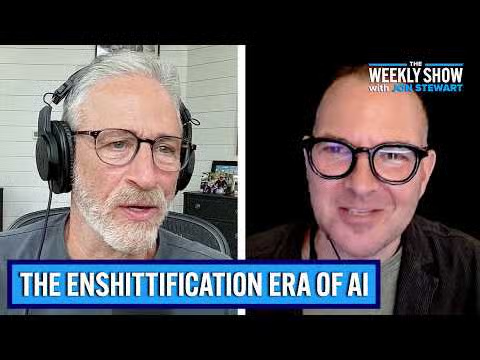
Watch the Jon Stewart podcast interview if you want more nuance:
A key word in that sentence is “if”, it is a rhetorical example, that’s probably pretty much correct at this point. It’s not a recommended course of action, it’s a declaration that it contrary to crazed hype, it isn’t currently as core to everything as would be befitting the current hype level.
I would argue that the CEOs aren’t on the correct track, they aren’t really in a particularly specific trajectory. I just had a debate with someone on this and their stance was “well in a hundred years do you expect things to be like they are”. My response “I cannot possibly speak to that, but we need to speak to today instead of pretending we know how things will be in a hundred years and pretending they are already at that level”. The “imagine a hundred years from now” by a relative outsider to the tech is dominating CEO mindset, and that’s problematic.
Once the bubble pops, we will almost certainly see a more durable and sane adoption for these technologies. For now, the hype is a problem as it enables some of the worst possible stewards of the technology and favors grift over progress.
In the same way that most people if you say you’ll take them to their destination with your vehicle, they assume in your car and not on the back of your bicycle, although both are technically correct.
Pretending AI and Chatbot are interchangeable is a marketing strategy by the companies who make these advanced chat bots. “They are artificially intelligent bro”.
I don’t disagree that the term AI has shifted significantly in the last 4 years or so, but I was actually meaning it in the other direction, as in, there is more to generative AI (what people are calling “AI” these days) than just chat bots.
That your definition is only advantageous to the argument you want to make. Everybody else understands “common usage” by non-technical folks. I’m a “technical folk” working in the area and I understand the general use by the “regular folk”.
And often I wonder, how many people have been fooled, and how much of the enthusiasm and over the top fantasy is astroturfing by a few people incentivized to sway public opinion?
And how much of the doomerism is a campaign to keep the common man from using a revolutionary tool for, well, revolution, by alienating those most likely to do revolutionary things with it?
Once you look at the actual numbers for pollution, water usage, etc it becomes very clear that the issues are vastly overstated. So, why?
EDIT: you should go on claude’s reddit and look at all of the tools people have built to keep companies and politicians accountable, to renegotiate billing, to improve their lives at the expense of capital. Or you can just go on thinking you’re right!
Fuck reddit but i have a friend who automated fooa requests with claude, sent foia requests to every county in the state and has all the tracking and everything automated. Only thing he needs to do is review the emails before they get sent. It’s amazing and he’s bring transparency to every corner of the state using ai.
I keep comparing the datacenter numbers to Bitcoin - only BTC, not all of crypto, is still using more electricity than AI. That may change in the future, but JFC people, where was the outrage about the global Ponzi scheme?
I generally respect this guy’s opinion (I probably use the term “enshitification” multiple times a week
A lot of people don’t use it the way he used it though. He used it specifically for two sided markets (eg a service that has both businesses/advertisers and personal users) where the focus shifts to the business customers, but people have started using it to mean anything that used to be good but isn’t good any more.
I think it’s a worthy simplification that sums up the current state of things well. We have AI that broadly has different uses and then we have the ChatBot/ChatBot derived AI applications. The market is not going insane over the broader AI category. Executives are not tripping over themselves to say things like machine vision is going to replace all labor, or at least all white collar labor. The chatbot is the only thing in the conversation of consequence.
All the “everyone says AI is the reality, so everyone feels like they must say AI is the reality” refers to this specific category. It might be veering towards being oversimplified, but it’s trying to balance a perspective that is also oversimplified. Generally, we aren’t good at weighing simple straightforward takes against complex nuanced takes, so you have to “net it out” to have any hope of the point landing.
“Chatbot” style AI is wildly good and bad at varying kinds of tasks, and a lot of that has to do with how it has been prepared.
Some LLMs have been trained to make images - I’ve not been too impressed with them, but that’s what they’re “good” at - and better than the LLMs that have been trained to write computer code when you ask the coding LLMs to draw a picture.
The code writing LLMs have actually improved the most at reviewing code over the past 8-9 months, and that ability to review their own code makes them dramatically better at writing code as well.
I find Google Gemini to be pretty impressive at scanning laws and regulations and finding, not creative, but functional solutions to stated problems within the constraints of (often frustratingly bizarre) legal structures.
And all of them will lie to you, tell you what a great idea you have, etc. They’re not really lying, they’re mostly just taking what they read at face value without checking corroborating sources enough to find the obvious (to you) blunders. If you want the LLM to be sure, ask it to go on the RAG (Research Augmented Generation) - check everything before saying it, they can do that, especially “paid mode” engines, but it reduces their capacity for analysis of complex problems by 3-10x, because they’re spending so much context window “being sure” - you can alternatively spend 3-10x as long solving complex problems / accomplishing complex tasks if you have them do their homework, verify everything from “the best” available sources 3x and build up a local document set of “trusted information” which is used in preference to whatever it might find at random on the internet. This isn’t as sexy as “Hey Claude, code me up a database that does X Y Z” and getting the result in 30 seconds, but it is how professionals have been doing their jobs for centuries: learn reliable information first, then act on it.
To be clear, Doctorow discussed switching off AI and proposed that there would be little to no change on the world. I was just changing the technology to show the flaw in the stance.
I don’t think they’re all lying; most are just misinformed or using the term differently than Cory.
It’s like saying “global warming is changing everything.” Technically, not true, but the knock on effects of specific aspects of it recently hit an inflection point that causes it to affect the lives of everyone.
This has also happened in the field of artificial intelligence; LLM chatbots are only the visible mushroom fruits of the vast mycelium network that has been silently growing underground for years.
Hoover maintained separate, master national blacklists—such as the Security Index—which tracked tens of thousands of citizens deemed “subversive” or political dissidents for immediate detention in the event of a national emergency. He managed his master national blacklists through a fluid, multi-tiered indexing framework that evolved over five decades. These blacklists were not mere static documents; they were part of a highly coordinated operational pipeline designed for the mass roundup and indefinite detention of American citizens during a perceived national emergency.
To add or manage a person on a master blacklist, Hoover’s Bureau followed a strict administrative lifecycle:
The Dossier Trigger: When an individual was flagged via covert programs like COINTELPRO, agents opened an investigative file.
The Index Card Core: If the person was deemed a threat, a dedicated index card was generated. These cards contained the person’s name, aliases, address, physical description, occupation, and a specific "detention rationale.
"The Geographic Apportionment: Cards were duplicated and cross-filed. One went into the master archive at FBI Headquarters in Washington, D.C., and another went into the local FBI Field Office responsible for the geographic area where the target lived.
The Arrest Portfolio: For top-tier targets, field offices maintained ready-to-go arrest portfolios. If Hoover or the President gave the command, field agents could immediately seize the individual without needing to waste time researching where they were or why they were being detained.
The Fluid Evolution of Sub-Lists
Hoover managed the master blacklist by segmenting it into constantly shifting sub-indexes based on perceived ideological threats, which allowed him to scale the operation up or down
As the lists ballooned to over 20,000 active high-priority targets (and over 10 million Americans cross-indexed in general domestic files), Hoover modernized his management using early technology. The Bureau adopted mechanical punch-card sorting systems. This allowed clerical staff to instantly filter the master blacklist by city, profession, or political affiliation, providing Hoover with rapid statistical snapshots of domestic dissent to present during congressional budget hearings or White House briefings.
On the contrary - the people who tell you AI doesn’t add any value and will disappear in a few years are either lying, dumb, or completely ignorant of what AI can already do.
I’m a software developer since the 90s, basically before the internet, we had some C books for reference and that’s it. I can tell you that I started last year to use copilot in vscode and some chatgpt on a web page, and it basically changed my world, and all my 50+ years old coworkers are amazed by what it can do really.
You are right it will not fade at all in software development.
Tech in general. I’m a sysadmin in research computing. You know how many clients at prestigious universities are using AI for mathematics, biology, etc? All of them
ive heard alot of posts subs about it, they are basically just graduating learning to use AI to bs through the whole degree and wonder why they arnt getting jobs, or they arnt learning anything, plus writing peer-reviewed papers?
Completely disagree. The difficult part of software development was never writing code OR speed of delivery. It was understanding requirements and problem solving. LLMs still can not do either of those things and there is no evidence they ever will be able to.
An example of how harmful LLMs actually are to development can succinctly be described with an issue I had a few weeks ago. I found an issue in an open source project, code was fine if a bit hard to understand. I came up with a PR to fix the problem.
In the time from me checking out the code to submitting the PR, a little less than 24 hours, the maintainer had completely rewritten the entire project with Claude. It was complete nonsense. Incredibly difficult to understand. Abstracting things that didn’t need abstracting. My PR was useless, because the entire project was new. The maintainer definitely didn’t understand the changes either. If a bug came up there’s no way AI would be able to solve it (the bug was still there even though the code was entirely new).
LLMs don’t understand the code. They just make things that look like they will work. And then a human has to maintain it (or keep paying billions of dollars for Claude to try to fix it).
the person in your scenario is just fkin stupid. When people say that llms are helpful for coding, they aren’t talking about telling an llm to rewrite an entire codebase.
You are right, but right now we are living in a very messy reality where it’s hard to know who’s being stupid and who is using it well. One person I know that, well, I was never a huge fan of his work but at least it was somewhat serviceable is now all-in on AI and his code has been rewritten in a similar manner as the parent poster comments. He’s got no idea how it works or how it should worked, the AI decided to rewrite it in an entirely different language, and it’s a buggy mess and it never fixes the bugs without making new bugs. Then he hit his token quota 3 weeks early and basically said he was going to stop working on it because he no longer could manually work the codebase. He didn’t ask for a rewrite, but AI advised him that his language choice was a poor fit and reworked things in another language, one that none of us use to that level of seriousness. It also made it largely based on super convoluted regular expressions.
The problem is that the leadership is singing the praises of these people, they were on their ‘leaderboards’ of AI adoption and much like the craze of praising “lines of codes”, we are neck deep in the most stupid non-technical evaluation of technical work you could imagine.
I’m sorry but to me your comment is a bit misguided. You raise extremely valid point and are completely right in what you say, and yet all your argument fails to prove that software development hasn’t changed.
The difficult part was understanding requirements and problem solving: absolutely true. Yet most of the time of a developer was spent in writing code. Now it’s spent refining the analysis so that the LLM stops producing slop. And many programmers are doing it, even with all its downsides, because for them the fun part is understanding the requirements and problem solving, not writing code nor delivering fast. They are delegating those tasks to a machine, even with all the risks and issues.
Your second point (and the anecdote) further proves how programming changed. Before it was unthinkable that some random person, likely with no clue about what they are doing, would refactor an entire codebase in a night.
Both are massive changes. For the best? Arguably not, but I seriously doubt there will be any going back now.
Now it’s spent refining the analysis so that the LLM stops producing slop
The thing is that actually doing this isn’t faster than writing the code, robs the practitioner of learning, and more often than not doesn’t actually happen, so you have a harder to maintain codebase with more bugs and less knowledgeable developers to maintain it.
Edit: and as a fun bonus accelerates glacier melting!
I think you’re right in general. I think juniors and those who havent yet had experience are not going to understand a goddamn thing and produce broken, insecure, unmaintainable slop.
I’ve written my share of garbage code – completely by hand! And i’m much better for it.
Once you have that experience, once you’ve written a few backends and frontends, there’s not much left to understand. Move the data from here to there. Display it, transform it, slice it up. For webdev AI is a huge force multiplier. I can make a dozen features or apps in the time it used to take me to learn one framework I was curious about. It even helps me learn faster because of how quickly I can test new patterns and ideas.
There’s certainly a right way to use it if you want to continue being edified, burning the planet down aside.
If we only used AI for codegen, this probably wouldn’t be much of an issue. Those cat videos take more energy than building a complete app. Also, it’s all pretty new and the newest tech 40 years ago would have filled a warehouse and had the computational power of a potato, but here we are now. I expect we’ll get more efficient at it and in the ways we use it. And there’s already a huge worldwide shift in energy capture (America aside…)
I’ve written my share of garbage code – completely by hand!
Whenever I look back at old code, mine or others, the first words that usually come to mind are “what you have to understand about this is… we were on a tight schedule, we never thought this was going to be used in production, we weren’t allowed to execute the planned and contracted refactor… etc. etc. etc.”
Unfortunately many people would rather spin the wheel for a chance to win magically produced functioning code, rather than doing the work themselves with sure results - even if it takes the same or more time.
And the kind of current politicians there are around the world proves that most people don’t give a fuck about the ice-caps (though I would also argue that it’s not so much the random person calling an LLM that is poisoning the waters - even though it does have a non-negligible effect -, rather it’s massive sociopaths in charge of the companies creating LLMs that are perfectly fine with destroying the environment and other people’s money in a vain dream of being the owner of some kind of “new order")
This is a point that really sticks with me. Using it for the sometimes spot on cakewalk segments is a fairly productive win. By the time you stubbornly insist on driving it entirely blackbox with chat and trying to get the right results without actually touching code… Well, even when it works, it’s often more work than just doing it yourself.
Someone rebased a UI I worked on in a new version of the UI framework. As a result, there was this one odd gap in the UI in one specific place. A vibe coder spent 3 hours back and forth with the AI trying to get it to correct the gap and finally submitted their merge request. Hundreds and hundreds of lines of CSS. So I declined the merge request, open the gui, looked at the gap, hit f12, adjusted a single padding statement, and it was all good. People are struggling with defining all sorts of criteria and rigging it to let it try and try and try again and hopefully laid out every contingency, every corner case, and spent hours laying the ground work and could have done similar in a more straightforward way.
Using it for the sometimes spot on cakewalk segments is a fairly productive win.
One thing that absolutely blows my mind is how many people will say how much time it saves then with repetitive or boilerplate code. It is obvious these people have never actually tried to optimize their workflow even a little bit before. Regex replace, snippets, and keyboard macros have existed in text editors forever and are actually deterministic.
As little as possible of my work is boilerplate, but some times there will be something like “I want to take width,height, and depth as arguments from the command as variables”, and poof, all the argv tedium is done.
And even better, that can be done entirely deterministicly, and once written, free to use! Instead of fixing the root cause they’re using the ultimate hammer. It’s such a cognitive surrender and a complete moral sellout.
Not at all. It gives the practitioner the option of skipping the learning.
Starting in the 1990s I started skipping the learning of assembly language, compilers got good enough that I just don’t need to know how the latest SIMD/MIMD/ whatever instructions work, I just express what I want in C and gcc or whatever handles the optimization for me.
Comparing it to an (almost) entirely complete abstraction where you (almost) never have any benefit to looking under the covers like c over assembler is completely dishonest.
entirely complete abstraction where you (almost) never have any benefit to looking under the covers like c over assembler is completely dishonest.
Is it, though? In the early 1990s I could still optimize compiler output by hand, here and there. In the 1980s it was common practice and necessary in many circumstances to make complex things happen on the constrained hardware. In the 1970s there were a lot of programmers who never touched Fortran, just practiced assembly all the time because Fortran was too inefficient for their needs.
I’ll say that LLMs, this year, are something like compilers were in the 1960s - a revolutionary improvement in accessibility of coding, being able to express what you want in “natural language” - like COBOL did starting in 1959.
LLMs have plenty of pitfalls that COBOL doesn’t today, but I’ll note that Borland Turbo C++ compiler in 1991 was too damn buggy to do anything much more complex than “Hello, World.” with.
Yes. Acting like an LLM over a programming language is anything close to a higher level over lower level programming language makes you completely full of shit.
Yet most of the time of a developer was spent in writing code.
That’s what developers told the world. Now they’re exposed, it never really took that long to write the code. (Only partly joking.)
Actually, a whole lot of time went into reading other developers’ code, getting documentation in sync with the actual implementation. And if you didn’t do all that, you tended to have a lot more bugs / vulnerabilities, etc. The LLMs are wicked fast at reviewing code, they don’t find ALL the problems, a lot of problems they do find aren’t worth fixing, but they do find more actual actionable problems per minute than most developers can find per hour in a big code base.
That’s because it’s not actually reviewing the code, rather just producing text that statistically looks like review comments.
So it does look vaguely useful, e.g. if code has null checks, review comments usually won’t ask for them to be added, but it’s never actually reviewing, or understanding, or reasoning, or anything else people claim.
It’s like an actor playing a doctor in a TV show, they’re not actually diagnosing patients, they’re just following a script that looks like it.
Doctors “humanity” kills a lot of people, every day, that wouldn’t have died if they did a statistical matching of their symptoms to the available research literature.
It was understanding requirements and problem solving. LLMs still can not do either of those things and there is no evidence they ever will be able to.
I don’t know… I just made a scheduling / timesheet creation app. Multi-user, overlapping clients and providers, multiple funding sources. Took 10 calendar days to make the initial app working part time, maybe 2-3 hours a day. Initially written in Python, decided at that point I’d rather have it in Go. Because the initial app had robust requirements and design docs, the translation to Go happened in less than 5 calendar days, with almost zero human involvement beyond telling the agent “continue” at each stopping point. After the Go translation was done (and debugged by the LLM to a flawless translation - only difference is that it runs faster), I was given a new timesheet to use for some of the workers, weekly instead of bi-weekly. Pay weeks start on Monday instead of Thursday. Various wrinkles about how the employees and clients and services are identified, weird sub-totals by service. All I told the LLM was: “Here’s a new timesheet that we’ll be using for some workers, design the necessary modifications and extensions to accomodate it.” It did, independently. It highlighted three shortcuts it took and I told it not to take those shortcuts, it adjusted.
That’s not quite rocket science, but it’s still impressive: to dissect the given .pdf, determine what data goes in what fields, in what formats, with what calculations, based on just reading the page, then adapt the existing app to fill it out automatically.
In other words, you’re arguing that their usage without discernment is detrimental.
Cory agrees on this very same article, and it also includes the same nuance this chain is trying to give voice to:
The other question Suresh implicitly raises is: “How can you reconcile the failure of AI in the enterprise with the individual claims of skilled technologists who insist that AI is helping them do great work?” The answer is that these AI users are “centaurs” – experienced workers who are assisted by automation on terms that they set for themselves.
Thanks to their skill and experience, these workers possess discernment, the ability to tell good code from bad, and (more importantly) good uses of code-generation tools from bad. They demonstrate the adage that worker-driven automation improves quality, while capital-driven automation improves throughput.
We wouldn’t be having this conversation if LLMs had been given the chance to grow into being the same way the web did. Whereas we would be having this same conversation with the letters swapped if corporations were the ones to spawn the WWW instead of the way it came about.
It’s not just “usage without discernment”, it’s that AI flattens some costs which are very obvious and very measurable (coding) in such a way that it introduces or amplifies other costs which are much more diffused and hard to measure (code and design reviewing, bug fixing, maintenance, adding new requirements), plus AI is totally incapable of doing the higher level tasks that shape what code needs to be done (technical analysis, requirements analysis and in bigger companies technical architecture).
People who are non-experts, aren’t really senior domain experts or have some kinds of unbalanced expertise (they’ve never really progressed beyond being a coder, or they don’t have full life-cycle experience with big projects or they’re in an industry or position where they just make the code, shove it out the door and it’s not their problem anymore) just look at the one thing they in their ignorance think is THE cost in programming - coding - and go “hey, this AI thing is amazing” even while AI is creating all sorts of much more time consuming problems which they don’t really understand formally (they think those things are just “bad luck”, “there’s nothing we can do about avoiding this” and “it’s just the way things are in programming”) that require the time of people with higher expertise levels (i.e. who are more costly) to solve and AI doesn’t even help with the kind of stuff which if done wrongly or not at all can condemn a software project to fail before it even starts like just half-way decent Technical and Requirements Analysis.
That’s why you get some programmers going “this AI shit is amazing” whilst the really senior software development types are just nodding their heads and thinking “these people are ignorant as fuck juniors”.
I gave one example. In fact that’s one of the least bad examples. If that was the only problem with LLMs it wouldn’t really be that bad. But the actual reality is so much worse. But I was arguing to the point that the person I replied to made, which was about development. The problems I have with AI are not fixable without literally every government on earth taking a stand, which just will not happen.
Using LLMs for development is fantastic as long as you know how to use it, which is how it is for every tool.
The difference with LLMs and other tools is that anyone can use them easily and get incredible results……as long as you don’t look under the covers. The developers that use them well are getting results and code that are indistinguishable from code they’d write themselves.
I’m not a kid doing some vibe coding, of course I know what I want and basically know how to implement it, the AI is just helping me writing it, auto-complete and all.
The overwhelming majority of software development occurs on a team. You understanding what you’ve asked an AI to do doesn’t mean jack when you need to make sure an entire team can understand it five years from now. And LLMs tend to write code that is incomprehensible to another person the next day.
? developer can write 50 lines per day, LLM help us for some auto-complete or some easy 5 lines routine/functions, but we are not blind and do not accept them blindly without understanding them. And we have pull request and reviews etc and prior to this we have architecture and class diagram and SDD and acceptance criteria and all kinds of things.
You do think that in big companies a developer will use LLM to generate thousands of line per day by himself?
I’m my experience people give tech demos, everyone is impressed, my coworkers say it makes them multiples faster, then I have more work making sure the wheels don’t fall off.
The echo chamber on this site about AI is really quite something. Someone confidently told me Mythos probably didn’t exist and they were upvoted for it and I was downvoted for pointing out the existence of Project Glasswing.
Like, Mythos isn’t real? Fable has been out for like two months lmao
LLMs seem to be pretty bad at home improvement sort of questions in my experience. I suspect they don’t have a team of carpenters they use to RL the models, like they do for software engineers, etc
It is just mimicking text it has been programmed for.
For it to be “good” at mimicking home improvement, it’s source needed to be full of home improvement talk. The best carpenters, plumbers, whatever aren’t on reddit, or wherever talking shop. They’re working, or making OSHA jokes at the bar.
I work in construction and so far I must admit that I have no idea what the hype is about.
But I have decades of experience, meaning I don’t know shit about anything BUT I know how to quickly find usefull information in the codes or in pertinents books.
If I were younger I might have fallen into the trap. If so I would probably be in jail by now, because in my tests I’ve seen LLM be dangerously wrong.
Nothing is helpful until you need help. The fact that you think AI is helpful for you don’t have to force me to use AI. If you pay me $100k+ per year and you force me to use your tools to do my job why you even hired me ? To force this cult on me or to do the job ?
I don’t need you to use you turn signals, but it’s helpful. I’m pretty sure I could come up with a multitude of situations where your first sentence is refuted without contest.
It’s pretty normal for an employer to dictate what tools and applications an employee uses. If you prefer gitlab but your employer requires teamcity, you don’t really get a say, right?
However, if you think you can meet your deadlines without using a code generating AI tool, then don’t use it. Ideally, if they are as useless as you imply, no one will be able to tell whether you’re using it. The conflict should only really appear if they do increase productivity, and you refuse to use them, resulting in less productivity than your peers.
The conflict should only really appear if they do increase productivity, and you refuse to use them, resulting in less productivity than your peers.
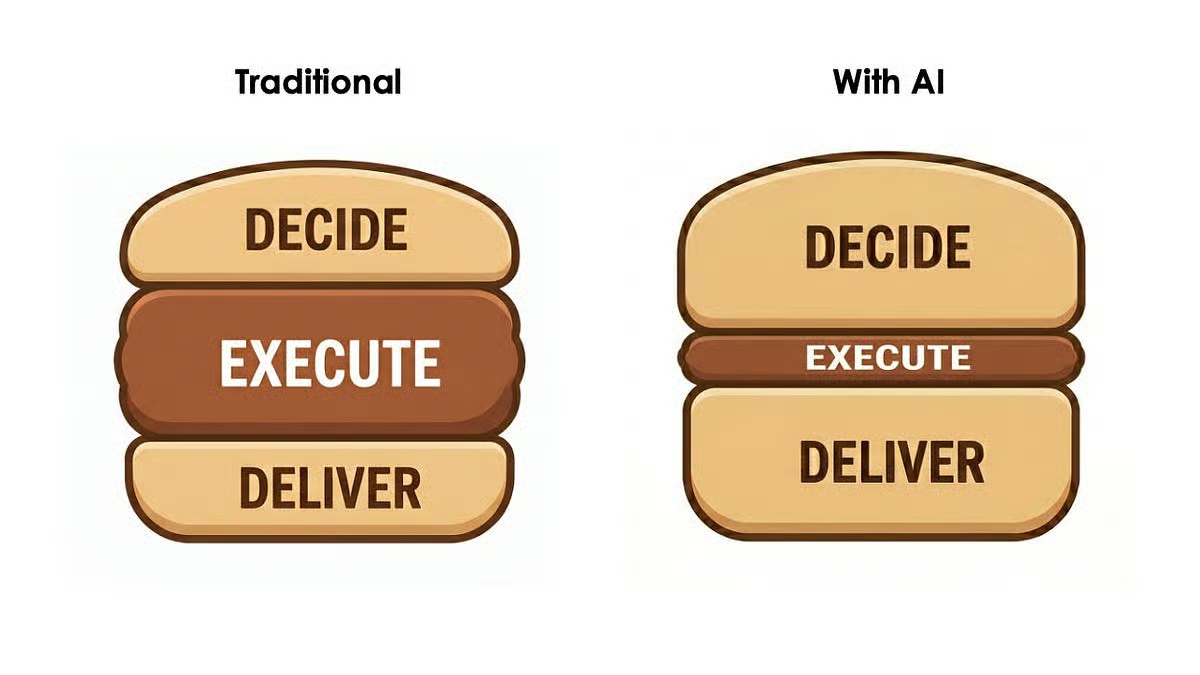
While it should be easy to point out where this helps, it very much is not in reality because AI accelerates execution on ideas, but corporations nearly always suck much more at deciding which ideas to actually implement in the first place.
I predict that the longer this goes on, the more useless, untested half-features will be stuffed into software and the more bloated “fall back” implementations full of duplicated spaghetti code will exist.
If the tools don’t stick around because it’s too cost prohibitive to keep using them, we’re going to be cleaning up after the bots for a decade.
It’s been a boon for personal slopjects for me. But that’s because I could never find time for execution in the past. Now I just have the (free tier) AI slop up my ideas.
Sure, but not at this speed. The bots can churn out a mountain of non-sense that does not work faster than people can review it and the bots themselves will lie to you and say “it’s all implemented”.
For people who have clear ideas of what to implement but struggle to find the time, this is a big gift. You can work hand-in-hand with the bot and say “nope, not that, this” until it implements what you had in mind. For aimless corporations with “ideation” meetings who cannot stop coming up with terrible ideas that none of their customers want, it’ll hasten the process of them making their software worse over time.
That’s exactly what I’m seeing at my current company.
That’s a fair point, but it’s not an issue with AI; it’s an issue with corporate culture. Corporate culture can and does change, especially with advances in technology, but there will be a churn period where it’s chaotic and mistakes are made.
I agree with that as well. A lot of the problem with my current company comes straight from the executive leadership level. I’m afraid that the culture will only change when they change (or more likely, the company will eventually just go bust).
They bought the lie that AI will replace all of software engineering, whereas I see the picture more like this:
A CEO that thinks that they’re going to develop all of the software, even with Claude code, is nuts. They simply do not have the necessary skill set to run a software project even if 100% of the hands-on programming is done by AI. They are not going to be sitting there telling a machine to move things around on a web app. They are going to believe the bot when it says that “it is implemented”.
In this, I think we more-or-less agree; I just don’t see that as a fault with AI, nor as a reason not to continue to develop/adopt AI.
And maybe your point is what Doctorow was trying to make all along, but he pushed too far in the other direction? Even now, Code Generation is a useful tool, as long as it’s used as only a tool by someone who knows what they’re doing.
And maybe your point is what Doctorow was trying to make all along, but he pushed too far in the other direction? Even now, Code Generation is a useful tool, as long as it’s used as only a tool by someone who knows what they’re doing.
In this piece — which I read via RSS feed a number of weeks ago before it was published in this medium — he is writing about what most peoples’ experience is in a company where they have decided to “do AI”, and what most CEOs think about when they think about “doing AI”.
This usually comes in the form of a company chatbot or “agentic workflow”, and in the vast majority of cases these things are very much not helpful and can actively be annoying because attention is paid to developing these things when more practical and useful features could be developed instead (see: …mataroa.blog/…/i-will-fucking-piledrive-you-if-y…).
In other pieces, he discusses — using what I would call sort of esoteric terms that he often defines inline — people in saner places that get to choose how and why to use AI to assist with their jobs. But that’s not the majority of people’s experiences and that is certainly not what CEOs are often talking about.
I think he’s being somewhat hyperbolic in this particular piece, and maybe that’s due to the amount of “AI is changing everything” or “AI has changed everything” that is appearing in LinkedIn / X posts everywhere, when it’s difficult for most to even name a single thing that the chatbot has spit out that has improved lives, and the vendored chatbot attached to an existing piece of software (which is mostly what people end up doing when they “do AI” at a company) is completely useless.
If I take myself as an example, he’s largely right that I have to play this game with internal development teams that come up with “agentic workflows” and try to get me to use them to do my job when it’s a lot easier and better to just…use Claude code myself.
AI hasn’t “changed everything”. The only thing it’s really done so far is produce a lot of chatbots and agentic workflows that aren’t very useful. It remains to be seen if: (1) it can ever be made to work more efficiently, (2) if you can ever actually run a profitable business building or running a “neocloud”, and (3) what the broader effects on software will be from mass usage of this technology.
The early signals on all of these very real concerns (not to mention others such as environmental, cultural, and economic impact) are not very positive.
Company will be able to tell if you’re using it because companies behind sota models come with monitoring. You will have meeting with hr and your manager when you will be forced to use it even if you meet quotas. They will argument it that maybe you can do more and increase your normal quota with expected ai usage increase in productivity even if you had best productivity in team without ai and your productivity stays the same. Suddenly you will be under performing because you are refusing to use ai so you will be first to fire even if you are best employee. That’s how corporations work. They are monitoring usage because it costs them money. For big corporations they pay upfront to get discounts. Company also make many trainings and meetings to encourage everyone use AI models they pay for but nobody wanted.
Part of the problem is AI isn’t a literal thing with a fixed definition. It’s more of a marketing term that translates into “I want you to buy this thing”. So some things are considered AI that are legitimately useful and others are not and then there’s the debate if wether it’s because it really is AI or if it is and AI just sucks.
In other words, corporate leadership is starting from the premise that AI has (or will) radically change the business, and they’re working backwards from that premise to find the evidence to support this article of faith.
This quote is quite funny in this context, because it’s literally what people do with AI. Half of the frontpage of lemmy is AI. The other half is people saying AI is bad with no realization of the irony, because they don’t see good AI. It’s like CGI. Everybody hates CGI, except they don’t. CGI is everywhere. They just hate bad CGI.
What is AI? Explain as if i just woke up from a coma. We don’t have flying cars, we have dumpster deloreans, but everyone is talking about AI. What is it?
Like most things, meaning depends on context. In the most common context of “news about AI” we’re talking about generative AI: image/video generators, LLMs, and to a lesser degree coding assistants. If you want to know more about what these technologies share in common, look up what a “perceptron” is and how it works.
More generally AI could mean anything from a neural network based approach to problem solving, to a completely deterministic, hand coded heuristic. A pure decision tree could be AI in the case of video game NPCs, for example.
I mean, yes. Linux is an algorithm. The programmes called AI are also still algorithms - they’re still deterministic, just too much of a tangled mess, too complex, for a anyone too realistically break it down step by step.
There are some math problems that cannot be described algorithmically, but because of that they’re also non computable. Uh, some thermodynamics and quantum stuff from what I’ve heard.
I’d say it’s more like a way to describe a certain kind of algorithm. One that adapts in some way to inputs that defy simple classification. Ultimately you’re probably just safe to replace AI in modern news and internet discussion with LLM or CNN.
Since that was a lazy question I decided to be lazy and just copy paste it into Gemini. Enjoy! I have no idea what the point of this is!
Artificial Intelligence isn’t a single technology; it has been a massive umbrella term since the 1950s. Broadly, it means creating computer systems capable of performing tasks that typically require human intelligence.
If LLMs are just one tiny branch on the tree, here is what the rest of the tree looks like:
Machine Learning (ML): This is the engine driving most modern AI. Instead of a human programmer writing strict "if/then" rules, we feed the computer massive amounts of data and let it figure out the rules itself. This is what powers your Netflix recommendations, credit card fraud detection, and the algorithm deciding what you see on social media.

Computer Vision: Teaching computers to "see" and interpret the visual world. This is how self-driving cars identify stop signs versus pedestrians, how your phone unlocks when it sees your face, and how medical software spots anomalies in X-rays faster than human doctors.

Robotics: The physical application of AI. This isn't just mechanical engineering; it is the software that allows a machine to navigate the unpredictable, physical world. This covers everything from the Roomba vacuuming your floor to automated factory arms and those creepy, dog-like robots from Boston Dynamics.

Natural Language Processing (NLP): This is the branch focused on understanding and generating human language. LLMs live here, but so do older, simpler technologies like spellcheck, Google Translate, and the early versions of Siri or Alexa.

Expert Systems & Rule-Based AI: This is the older, "classic" AI. It relies on a massive database of human knowledge programmed as logical rules. When the IBM computer Deep Blue beat the world chess champion in 1997, it wasn't using an LLM; it was using raw computational power to calculate millions of possible moves and their outcomes based on strict rules.

Predictive Analytics & Optimization: The invisible math running the modern world. This is AI used by logistics companies to find the absolute most efficient routes for delivery trucks, or by hedge funds to execute high-frequency stock trades based on market micro-fluctuations.
I asked the question to demonstrate something. You didn’t want to participle in the discussion and that’s fine, but that doesn’t mean the question is “lazy”
LLMs are like a dishwashers. You could wash all the dishes yourself and probably get them cleaner in less time, but it’s useful to let a machine do the work, even I though it’s mandatory inspect every single dish to make sure the machine got them clean enough and re-wash a certain percentage of them. Dishwashers are useful, but the world wouldn’t end if we didn’t have them. They also have the benefit of using less water than when do them yourself, which certainly isn’t the case with LLMs.
In the same line of thinking, this is why I hand wash my car, because the automatic car wash either does a bad job (touchless) or will scratch the paint up all over (brushes). Many people don’t care very much about their cars though, so why put in the effort?
I find unreliable tools to be one of the most infuriating parts of my job, and unfortunately my entire job has effectively pivoted to spending all day babysitting an AI that frequently ignores instructions and can’t learn without a ton of expensive fine-tuning training.
I don’t let AI touch any of my personal code I care about, and with how much of the code at work is written by AI, it’s pretty demoralizing. Why put in any effort designing something if it’s just going to get blown away by a coworker’s agent the next day?
Arguing with the AI over why its code review is wrong is also a whole other part of my day now…
Not yet because people are still learning how to use it, but im literally ten times more organized than i was before i started using AI to automate notetaking planning calendaring all that.
I work in government and part of my job is writing memos or documents that nobody will ever read but that some congressional mandate requires me to have on file. I absolutely offload that to AI so I can do my real job.
This is another answer that misunderstands my question. It’s changed your job but has it improved the quality of life of the public served by your office ?
I work at a sales-first (read: no accountability) software company, ran by inept nepo-babies and a hostile VC. I frequently have to completely re-do all of the sales engineering work when a new project starts, because they refuse to standardize or talk to each other.
After enough time doing this shit by hand, I took my best examples from previous projects and had an agent “fix the errors based on the conventions I established over here”. Instead of going line by line on these big serialized data formats now, I do about 10min of checking the results and editing down the change log.
It’s wack that I have to re-do someone else’s job still, but at least I can force some version of standardization without killing myself on the tedious bits.
It’s improved mine. I save hours (that I didn’t really have anyhow) on meaningless tedium. I thought that was pretty obviously implied though?
Maybe it helps to say that this was in no way forced on me. The stuff my employer has done to “adapt AI” is laughable and seemed to be nothing more than lip service to the execs who want to slap that sticker on the product.
The gains for me personally have been strictly using it as a tool in niche situations. I prefer to do things the hard way when it’s for me but I’m not breaking my back for a corporation.
Either you’re arguing in bad faith by nitpicking for some reason, or you are incredibly dense. Do I need to send you my calendar dude? I just freed up some time, maybe we can hop on a call and I can spell it out for you?
You’re getting direct examples of people its helped, and you keep brushing it off and asking what about everybody else. You’re obviously not going to get a single answer that affects everybody, and why do small successes not matter?
No one here is saying AI has reduce their workload so now they spend half their time catching butterflies.
The answers are all saying that AI has automated some mundane task that wasn’t particularly important, and now they can spend their time doing something more interesting.
Is the changes to their role, multiplied by millions of employees, actually better for humanity or society?
In a way, this is what Doctorow is arguing: where is the data showing the productivity gains.
My follow up question is, how are these productivity gains being used, if they exist.
Aren’t you assuming productivity gains will lead to free time? Why? It never has. Most of us work a fixed amount of time and get paid for that time. Not the amount of tasks we finish if that can even be measured.
Salaries have also not increased with increased productivity long before chatbots came online. So they won’t suddenly increase now.
AI is much more just like a new laptop you get from work. The new device is faster, has more RAM and allows you to do more, potentially.
The big question is, if the purchase was worth it. Unlike a new laptop, LLMs are an ongoing cost to users and providers. Nobody except for GPU producers are actually making money right now. Hyperscalers make some of the money back they themselves invested into the companies using their services, but in the end the ROI looks pretty dim for anyone.
So even if there are real productivity gains, you won’t see people relax with their kids more. And even if these gains are significant they may not prevent a huge economic collapse so we all will have plenty of time with our kids in the end anyway.
AI has automated some mundane task that wasn’t particularly important, and now they can spend their time doing something more interesting.
That absolutely sounds like a win to me. Why is productivity gains the only thing that’s important? QoL is what matters. Unless you’re a capitalist overlord.
100%! I don’t understand how this is a hard concept to grasp. I’ve been able to make productivity gains, sure, but who gives a fuck? Even if my productivity is the same, my QoL is still much improved when I’m not buried in mundanity.
Doesn’t matter what the goal is, the context of this particular discussion is that AI is benefiting at least some people by making their lives easier. And one guy who’s trying to argue ‘so what, it only matters if productivity goes up’.
With ownership being as concentrated as it is now (more concentrated than during the guilded robber baron age), naturaly, most of the benefit flows to the biggest owners, and AI seems poised to deepen the wealth inequality further.
In a scenario without the insane wealth concentration, and with a dignified and decent economic floor being guaranteed universally, I would be in favor of any AI that does not burn our planet to a crisp and stink up the neighborhood with the gas turbine exhaust.
So in our world as it is, I have to be agaisnt the AI for the foreseeable future.
The other question Suresh implicitly raises is: “How can you reconcile the failure of AI in the enterprise with the individual claims of skilled technologists who insist that AI is helping them do great work?”
OK, but the point still stands if you allow that: It has become impossible to tell managers mesmerised by artificial intelligence that the tools are often not, in fact, helpful.
Sure, although I would phrase it I think a bit more pointedly: “it has become impossible to tell managers mesmerized by artificial intelligence that the tools are not, in fact, capable of what they imagine they are capable of.”
This points, rightly, at it being a failure on the part of the managers - not artificial intelligence. And God knows that’s spot fucking on.
They have uses in certain circumstances. They also have lots of negative aspects (that are broader and more systematic, as far as I can see). I think in a net-benefit sense they are not, in fact, helpful (to an organisation, or to a society).
If you’re already experienced developer and you use it skillfully, validate produced code it can help.
If you aren’t (and unfortunately everyone thinks they are better than they actually are), it actually can do the opposite, it can help generate a lot of junk code.
Now when working in a team usually majority of people aren’t that great developers typically there might be one or two star developers. The problem is that the other people will still use AI and generate MRs. Reviewing those is extremely time consuming and no one wants to do it. It’s weird to say what’s exactly wrong with those MRs they seem to do things but they seem to do things in a more complicated way.
The thing is that no one wants to review those MRs, everyone is afraid to point AI slop, so the quality of code goes down and even the people who previously were good are getting lost in the code themselves.
It depends on the tool to be honest. If it’s Claude code and you’re a programmer, sure that’s helpful. But often it’s an “agentic workflow engine” that’s been developed in house that’s complete garbage, or a chatbot that doesn’t know anything telling you that it can’t answer your question that was put together by your company. These custom tools are almost always not helpful.
Doctorow knows this as well, he writes about this crap constantly and has broken it down by user type in other pieces.
I have tons of random receipts that come in every month that need to be captured, memoed, categorized and sent off to finance.
I made python to read image/pdf/whatever to text, easy.
I regex the value out, hard and fragile
I try to pull the vendors name out, just not reliable
Category… nearly impossible so i need to make some form of memory system to remember once I do it.
Python renames the file with input if it needs it and provides the meta
OR
python to text because it’s effciient
api call to Ollama and let my old 2070 work it out. (highly reliable)
python renames the file and provides the meta
It’s small, low power, hard to do with code, basically the perfect use case. This is a good use of AI
Go Rewrite FFMPEG in Rust… that’s a bad use of AI.
There’s a lot of people out there using it in ways that cost a lot more than human eyes and have horrible societal and environmental impacts.
There’s a lot of people using it for dictation, document triage and basic scripting where it has great advantages and isn’t making the world a worse place.
His article is at odds with a great deal of his book. I wonder if this isn’t just a grab to get hardcore anti-ai to buy it.
I mean they are changing everything because they are being pushed and forced to be used even if they are making jobs and things in general worse and harder.
In other words, corporate leadership is starting from the premise that AI has (or will) radically change the business, and they’re working backwards from that premise to find the evidence to support this article of faith.
Sounds familiar. The proof-of-work blockchain scheme which was the fad a while ago is also often described as a solution in search of a problem.
I feel like block chain as a public ledger has found quite a few purposeful uses, and was a solution to a handful of problems most people rarely if ever encounter. Then fake money got involved
It can still be used that way. While most people talk about how corrupt politicians enrich themselves with fake currencies, more legal and legitimate uses can still use decentralized ledgers for useful things. Of course these won’t make headlines.
Well no, because we don’t have a problem that blockchain solves (better than open software, if it must be digital), and there are loads of problems that the blockchain doesn’t solve. Like how am I supposed to vote with that thing under no coercion.
I’m not really sure what you’re getting at. The blockchain is a good mechanism to maintain a source of truth that is inspectable and verifiable by anyone. It would only serve to certify that official counts can’t be tampered with in certain ways.
But it doesn’t replace the whole democratic voting process. It doesn’t protect against coercive voting, for instance.
My point originally was that blockchain can be of use to us, but tech bros ruined its rep. Same with AI. I’ve been waiting for routers with ai-powered (really, just machine learning) firewalls that can adapt rules to environments. But instead of that, everyone is obsessed with generative stuff that isnt very good.
Yeah I hear you, but the 51% attack exists. Like if you use paper ballots, you’re safer and it consumes less energy. There is just nothing better by using a blockchain, and paper ballots (for example) can be verified by anyone, the blockchain not so much.
The core issue feels like the dead torrent problem.
Its distributed, so it needs to be hosted, by several locations. Which becomes probitive over time as.it becomes huge. Its also massively inefficient for what its trying to do.
At some point, its basically just one server farm somewhere hosting a glorified MySWL database that doubles as a space heater for the entire planet every time you need to add a row.
I’m glad you specifically pointed out proof-of-work blockchains.
They’re very inefficient (economically and ecologically) by design. In almost all cases this design isn’t warranted.
Alas there are other designs and while most of them are rubbish as well, a few ones are doing things quite right.
I hope that just like other schemes than proof-of-work were thought of regarding blockchains, there will be AI models that are way, way more efficient and ideally can be run locally - for those cases that can use AI…
Wasn’t Nano predicated on those lines? I remember reading transactions could be done locally, even off-line, validated beetween the parts and only later added to the global ledger.
Funny, that you even know about Nano!
…it’s one of the often overlooked projects because it doesn’t have a ton of fuck-off-money and instead tries to focus on a solid protocol.
Nano has a lot of interesting attributes, but I fail to see how what you describe would work in practice.
If both parties want to make sure there are no shenenigans at play, they need to know about the most recent state of the respective account chains, which essentially requires them to be online for agreeing on said transaction.
But overall Nano is very fast and efficient by design and only a failure in terms of “gainz for Lambo”.
As we’re here in a thread about AI I should remark that machine-to-machine-payments - in this case: agent-to-agent-payments - would work pretty well with Nano as currency because of the transaction finality (typically less than 1 second) and the feeless nature of transactions.
If AI agents are looking for the most viable way to transfer tiny amounts of value fast and without fees they might find Nano and use it - who knows…
…and just like Nano showed that efficient ways to create digital money are possible I’m hoping for efficient AI models that are economically and ecologically worthwhile.
What I understood then was that in person transactions could be done, as the local ledger of each user would authorize and record operations on and off the available balance and wait until network availability to syncronize with the global record.
Returning to the subject at hand: I can imagine very specialized “AI” being useful for scientifical research, where very knowledgeable people use it as a tool to facilitate processes but are nonetheless capable of reviewing whatever results it produces.
Not gigantic datacenters required for this but small, purpose made and perfected, locally run, even if on higher specifications hardware to do so, but machines built for a given task and purpose. The economic viability on it be damned; it’s a tool for research, it is not made to earn money.
To put it bluntly: if you do an offline transaction, you’re prone to fraud.
If you expect the senders account chain to have balance x (because that’s your offline record for that) and the sender has sent all funds to a different address after you synced that account chain, you receive money that isn’t there - kind of like an invalid cheque.
I have no clue how that would work in practice, because to know a random account in advance, you’d have to sync the whole amount of account chains there is (called block lattice in Nano’s case).
With a mobile device that’s hardly feasible and without a mobile device I don’t see how you’d get in contact with people to make such an offline transaction.
That kind of specialized AI is what I imagine to be a use case for locally run AI, too.
After all you don’t want to build processes on an AI, where you have zero control over what happens behind the curtains.
That includes feeding potentially sensitive data back to it as well as being unable to control the training data set, its learning, version numbers, etc.
What I understood then was that the local ledger of a given user of the coin would authorize and register the transactions done on/off the recorded balance and, when network available, would broadcast such transactions to the global ledger.
The global ledger was the total sum of transactions, not imperatively required to authorize transaction by transaction.
Nano uses “proof of stake” instead of proof of work to decide the order of transactions, and who receives block rewards.
The main problem with PoS is that it’s essentially the same as Federal Reserve bonds: all the new money goes towards people with extra money to freeze. This is part of why inequality has spiraled out of control since the Nixon Shock. Proof of work literally burns most of the profits because of difficulty adjustment.
A more specific problem with Nano (formerly RaiBlocks) is that the entire supply was centrally issued, with a pinky promise from this private organization that they only issued coins by CAPTCHA. If they were lying, then they could have issued 51% of the supply to themselves for permanent control. The only way we’d be able to detect it is if the price kept going down for years.
It’s also notable that MBAs tend to be people who are into the networking versus the work and they will follow the trends wherever they leave because that’s what good monkeys do.
I work at a university and manage large teams of students. Without exception, each time I have hired a business student, they have had a fantastic interview and then contributed nothing to the team. In most cases, they stayed long enough to create a resume entry and then went on to the next “bigger” thing. I don’t discriminate against hiring from them, but I do not advertise job openings in their circles anymore.
In the near future an ai company will turn on their ASI and ask it what to do about climate change and it will say “first off shut me down, second off eat the rich” and only then will we know we did it
The Author’s Note section of State of Fear, Michael Crichton made numerous predictions that some of which have come true thus far.
It was published in 2004
One of which is that any climate change related legislation implemented by one party, will eventually overturned / reversed when the other party takes power.
Nothing is more inherently political than our shared physical environment, and nothing is more ill served by allegiance to a single political party. Precisely because the environment is shared it cannot be managed by one faction according to its own economic or aesthetic preferences. Sooner or later, the opposing faction will take power, and previous policies will be reversed. Stable management of the environment requires recognition that all preferences have their place: snowmobilers and fly fishermen, dirt bikers and hikers, devel-opers and preservationists. These preferences are at odds, and their incompatibility cannot be avoided. But resolving incompatible goals is a true function of politics
He also predicted that in around 2100, people will be far richer, use lots of energy than ever before, and the global population will be much smaller.
I hate to be the bearer of bad news, but we’re already past the point of no return.
The climate is changing more drastically every year. Hurricanes and typhoons are more severe and the season lasts longer than just a couple years ago. Thunderstorms are more severe, with longer and hotter periods between them and fewer regular rain events. Ocean currents are changing and stopping, meaning the flows that sea life use aren’t there. There is no longer a constant polar ice cap on the north pole.
We will not be staying under 2°C average warming, which was the target back in 2010.
The question isn’t where the point of no return is - we’ve been beyond those the whole time. The question is how bad we want to let it get. Ever fraction of a degree extra warming means worse impacts.
Agree that less than +2°C is unlikely (though not completely impossible). But still, better that than +2.5°C, etc.
In this way AI reminds me of when Elon was saying we should build a giant vacuum tube instead of a train in California.
They all pretend this AI god that they’re sure will surface will solve the climate crisis partially because they already know what needs to be done and don’t want to do it. They’d rather baffle you with bullshit instead of trying to fix the problem.
It’s a self-fulfilling prophecy: if all the corporate leaders believe it will change everything and, in a fit of FOMO, force it into every corner of our lives, then everything will be changed. But not so much because of what AI can do, as because of a mass delusion among the LinkedIn types.
It’s changing a lot of things, but many of them in only relatively minor ways. It’s not affecting e.g. food supply systems in a significant way - it might be screwing up the management structures of companies involved, but that will be repairable fairly quickly…
His analogy about turning off AI is bloody weird. Pick almost any technology from history. Chances are if you had turned it off a few short years after it was first introduced, it wouldn’t have had any major impact. Why would AI be any different?
Corey Doctorow is an industry plant, anyone who goes to Burning Man and writes books like he does, has some major skin in the Techno Feudalism game.
Edit:I can only offer what is revealed to me. It’s too much for me to handle. Our reality is planned out. AI is here to enslave us. It’s not just some financial scheme. Doctorow is part of what they call a “hoodwink”. I personally never use AI product, never have, but I see what’s coming. I believe the solution is to stop using smart phones completely.
This is a bit unrelated but this is the cover or DJ Shadow’s Action Adventure. It has a track called “Reflecting Pool”. It was released in 2003. If this isn’t sufficient proof I don’t know what to tell ya.
Here’s an exerpt from one of his public talks about the AI bubble. From his Pluralist blog.
“OK,” the young man said, “but what can we do about the crash?” He was clearly very worried.
“I don’t think there’s anything we can do about that. I think it’s already locked in. I mean, maybe if we had a different government, they’d fund a jobs guarantee to pull us out of it, but I don’t think Trump’ll do that, so –”
“But what can we do?”
We went through a few rounds of this, with this poor kid just repeating the same question in different tones of voice, like an acting coach demonstrating the five stages of grieving using nothing but inflection. It was an uncomfortable moment, and there was some decidedly nervous chuckling around the room as we pondered the coming AI (economic) apocalypse, and the fate of this kid graduating with mid-six-figure debts into an economy of ashes and rubble.
However it was Doctorow himself that mentioned his Burning Man attendance on a live tech podcast I was listening / watching 5 or so years ago.
Here’s an excerpt from audience questions after a he gave on the AI Bubble (or Apocalypse as he puts it often), published on his blog Pluralist. Written by Doctorow
“OK,” the young man said, “but what can we do about the crash?” He was clearly very worried.
“I don’t think there’s anything we can do about that. I think it’s already locked in. I mean, maybe if we had a different government, they’d fund a jobs guarantee to pull us out of it, but I don’t think Trump’ll do that, so –”
“But what can we do?”
We went through a few rounds of this, with this poor kid just repeating the same question in different tones of voice, like an acting coach demonstrating the five stages of grieving using nothing but inflection. It was an uncomfortable moment, and there was some decidedly nervous chuckling around the room as we pondered the coming AI (economic) apocalypse, and the fate of this kid graduating with mid-six-figure debts into an economy of ashes and rubble.
Okay. I’m not sure how that excerpt proves he’s an industry plant. It sounds like he’s talking about the massive financial crater that will be left behind when the fact that zero companies in the AI sector that do not manufacture hardware are profitable catches up with them and the bubble pops, which I personally think he’s right about.
I see a lot of useless people creating a ton of busy work that just becomes an unbearable workload for the people under them. Working in manufacturing environments which (you aren’t gonna believe this) are all horrifically understaffed is bad enough. Now i get to watch good workers get buried under Solvace/Fabriq/etc checklists and Leading2Lean/PerformOEE/etc task lists and spreadsheets and meetings to discuss kpis and metrics.
Yeah, right. My boss gave me a bunch of risk assessments to read through and let slip that AI had ‘helped’ produce them. So I said I’d get AI to summarise them. All this vast computing power and climate damage is being used for bullshit.
Person A gives an AI a list of bullet points and instructs it to expand the bullet points into an email.
Person B receives the email and asks AI to summarize it into bullet points.
An ocean of water could have been saved if the Person A had just emailed the bullet points directly, and the information transfer would have been far superior.
Hate to day it, but every industry has turned into that. At least in my anecdotal experience and my network’s anecdotal experience, useless people using AI to create shit that means extra work for others is happening everywhere. Not saying you should stay in manufacturing if you hate it, but just be aware that you probably won’t be leaving that issue behind.
Well I wouldn’t recommend data & analytics right now, if you treasure your sanity.
Imagine tech debt accumulated over decades absolutely skyrocketing because LLM can generate thousands of lines of SQL or Python that noone understands.
I mean, I’m sure the same applies to all tech sectors and likely worse. I do admit it also helps us fix and uncover some old and buried bugs. It’s just not used with any sort of care or long term plan.
I’m a long term contractor. Process engineer and Certified Quality Engineer with up to date ASQ certs. I can technically go anywhere but i really love manufacturing processes.
This moment in history is a lot like when power tools were first invented. The bad news is corporate leaders seem to view AI as a means to downsize people. The good news is that AI lets many people who formerly lacked the ability to do anything on their own to move on the “I wish I could do ____. but _____” ideas in their head. It could be anything. You can run a competent local AI model in LM Studio with a $1000 gaming PC or you can pay $20 a month to run a frontier-quality open weights model without the usage limits of the big names. The free AIs can help you get started on doing that.
Big companies are using AI for a lot of stupid crap that they try to make sound very profound. They assume customer service and quality assurance are no longer “a thing”. This era reminds me of the 1970s when Bill Gates and Steve Jobs had their opening. Sometimes the big guys get sloppy. We’re at that point right now. Enshittification is everywhere.
A more recent (and maybe closer) analogy is the advent of ebook readers and the heralding of the Death Of The Book. I suspect we’ll be in a similar place in a few years - books stores are doing just fine, perhaps even better than pre-ebook.
never seen it helpful to anyone, except for the people wanting to do the layoffs. most of the time it gives misinformation to people looking for abstract-to-reality ideas.
I mean its use as a tool, maybe in a small business context. The individual can be the “visionary” giving their idea for a book to a de-facto ghost writer. AI’s will often give you back info that confirms your ideas, so its like any other tool. If I am not good with a hammer then I smash my fingers and if I’m not good with AI then I convince myself the earth is actually flat.
The recent Bank of England report indicates that, yes, small businesses are seeing the biggest benefit of the tool (AI agents), but they are not spending big dollars on it. Free models and/or entry accounts are more than enough per their survey.
I agree, its a tool. I have used free models for the last few weeks to make python scripts into portable exes to help streamline some onsite job activities that normally are done multiple times a month. I never would have the time to research how to code python, figure out libraries and such to put together, and then compile all that into an exe. You’ll never see me spend money on AI when the free models work well enough not needing “frontier” features.
The funny thing to me is that Lemmy users seem to be so staunchly against LLMs, that they are unable to even acknowledge the small things it truly is good for as a tool. It’s like the opposite of hackernews on here.
I don’t expect movement towards AI among small business to show up in total cloud AI revenues.
Small businesses are typically more competently run than the typical big corporation, so I doubt they’re going to do things like lay most of their quality control people off thinking AI will do it. Big companies are mostly mid-wit trendies not anything that bright. Due to the perpetual motion of mature companies once they get off the ground, its hard for their stupid decisions to lead to bankruptcy. It takes a long time. They’re essentially doing the bumper cars version of business, while small business is in the 1960s Formula 1 where any major mis-step could end their companies’ existence.
Small businesses also don’t need to spend a lot. Their needs could be met by a semi-skilled local IT guy they hire to set up LM Studio on a gaming PC to run a 26B or 35B model. Big companies will spend the same amount on their peoples’ Dell or HP laptops business laptops that cost about the same but can’t run local AI.
Open weights models like Kimi and GLM provide near-frontier quality on any low cost service that installs them. GLM 5.2 is excellent.
I don’t know about other industries, but I’m a programmer, and I firmly believe that people who cannot be bothered to put in the hours to learn to do so the old fashioned way, should not make software.
Vibe coding is how you get software designed by people who do not know how to design software and implemented by a chatbot that is infamous for writing buggy, insecure, impossible-to-maintain code.
Software developers will always be needed, at least to make sure the vibe code didn’t make a logic error that will cause the elevator to crash when someone pushes the wrong series of floor buttons, etc. However its making a lot more coding equivalent to an Excel Macro, where an end-user can do it without a pro developer being involved. Things like JSONs for AIs or basic python apps. It might even lure some of those people into learning a little about the language.
I typed into Google “potatoes pressure cooker” to get a reminder of how long to cook them. The AI told me, and correctly said that I should use the steamer sieve, but also told me to salt the water. The water that would be under the potatoes and that wouldn’t touch them.
I asked why, and the AI said that little splashes of salt water from the boiling would land on the surface of the potatoes and salt them gently, that the salt would increase the boiling temperature, and that the vapour would be aromatic.
I pointed out that the amount of salt landing on the surface of the potatoes would be negligible, that the vapour is distilled water in gas form, and that the increase in boiling temperature from salting the water is less than 1°C. The AI said, oh yeah, you’re right on all counts. Don’t salt the water.
What it has been doing was exactly what an LLM does. It gave me the received wisdom from the internet.
That aligns with what Cory Doctorow was saying here, namely that all the AI successes were from people who already knew what they were doing and could use the AI as a tool. Not from people who had no clue and just let AI do the job.
Salting the water would increase the boiling temperature I guess, but it seems like a waste of salt because that info isn’t meaningfully changing the cooking time
Salting the water is relevant when not using a pressure cooker. It makes no sense when you’re steaming them in a pressure cooker. AI is a good tool, sometimes. But for everyday tasks, it is irrelevant and often wrong.
I do potatoes in my instant pot but leave the water in, it just gets absorbed. So the salt is effective in that case. I salt the potatoes themselves and toss them before adding the water, too, so they should get reasonably seasoned.
I use google “ai” in when thrifting for audio gear. Minimum 80% of the time it gets something GLARINGLY wrong. “Oh ho ho! You correctly pointed out that I was completely wrong on all counts! An astute observation! Let me try again but this time give you the CORRECT information.”
Exactly. I use AI primarily as a natural-language search engine, when searching for things that can quickly be independently verified. One of the best uses for it is when you know a thing probably exists, but you don’t know the name for it. You can describe to the LLM the object or problem in detail, and it will give you a name. You can then take that word and do a non-AI search to instantly confirm if it got it right.
I’ll never use an AI for something I can’t at least verify without an AI.
I really like a song that has intro and outro samples and I wanted to know where they were from, so I googled. Google AI promptly informed me that the song has no samples. Guess that settles that.
My husband was recently trying to find an exact quote from Richard Pryor’s character in Lost Highway, so he Googled it.
Google’s AI overview said that Richard Pryor was not in Lost Highway and instead gave some suggestions for other films we might be thinking of.
The quote he was trying to remember was, “There’s nine people down here, and you can ask seven of them. If you can get that price from one of them, I’ll let you ask the other two.”
I use AI as a writing tool, not as a substitute for authorship.
The ideas, intent, perspective, and final judgment are mine. I decide what I want to say, what belongs in the piece, what does not, and whether the finished version accurately represents me. AI may help me organize my thoughts, clarify a sentence, improve the flow, or find wording that better expresses what I already mean. That is not fundamentally different from working with an editor, dictating to a transcriber, or revising a draft after receiving feedback.
What matters is that I review the final work, approve it, and put my name on it. By doing that, I take responsibility for every sentence. If the writing is thoughtful, accurate, and effective, I am responsible for those choices. If it is careless, misleading, generic, or full of slop, that is also my responsibility. Blaming the tool would be an attempt to avoid accountability.
AI does not decide what I believe. It does not decide what I am willing to defend. It does not decide what I publish under my name. I do.
The tool may assist with the writing process, but the authorship comes from intention, judgment, selection, revision, and responsibility. The final work is mine because I chose it, shaped it, approved it, and signed my name to it.
“authorship is when i make a few edits and sign my name to slop”
if you have willingly handed over your primary writing tool to a machine (for which there is no real meaning, association, appreciation, or delight in words), it is difficult for me to take your commitment to writing or “authorship” seriously.
I did not say “authorship is when I make a few edits and sign my name to slop.” That is not my argument.
My argument is that authorship is grounded in the origination of the ideas and intent, control over what goes into the work, judgment over how those ideas are expressed, endorsement of the final form, and responsibility for the result. Assistance with the linguistic realization does not, by itself, transfer authorship.
You point out that the machine has no meaning, association, appreciation, or delight in the words. I agree. But I do. That is precisely the distinction I am making. The machine does not know what I mean, care whether it represents me, recognize when an analogy fails, or decide whether an argument is worth defending. I am doing those things.
You seem to be defining “writing” as personally generating the initial sequence of words. Maybe that is where we actually disagree. But that definition cannot simply be assumed and then used to prove that I am not writing. Why should authorship reside specifically in first-pass word generation rather than in the thought, intention, judgment, revision, and control that determine what the final words mean?
A sneer is easier than an answer, and certainty is a lovely refuge when you have no intention of defending it.
You accuse me of surrendering thought to a machine, and then, the moment you are asked to justify that accusation, you surrender thought entirely.
How convenient.
With a wave of the hand, every difficult question disappears. You declare the words contaminated by the tool that helped shape them and thereby absolve yourself of any obligation to consider what they actually say.
No examination. No argument. No possibility of correction.
You accuse me of regurgitating the output of a machine, yet what have you offered in return?
A familiar sneer. A borrowed insult. A conclusion retrieved intact from the cupboard of approved contempt.
You recognize the hated object, produce the expected response, and call the reflex thought.
That is the irony you seem determined not to notice.
My argument from the beginning has been that a machine must be tempered by a human mind. It possesses no responsibility for what it produces. Whatever value emerges from its use depends upon the person capable of examining it, rejecting it, correcting it, shaping it, and finally standing behind it.
But a mind cannot temper anything if it refuses examination itself.
And that is where your position becomes more interesting than your insult.
A mind that refuses examination begins to resemble the very machine you claim to despise. It receives a familiar stimulus, reaches for the familiar pattern, and produces the familiar response without troubling itself over whether the response is true.
Input. Recognition. Output.
The machinery of contempt.
Ignorance itself is no shame. Every one of us is ignorant of almost everything. I have been wrong before and will be wrong again. If you can show me where, I gain something from the correction.
But there is something contemptible in making a virtue of ignorance.
In encountering an argument and proudly announcing that you will not examine it, then mistaking that refusal for discernment. In treating incuriosity as wisdom. In believing that because you have protected yourself from an argument, you have somehow defeated it.
You have not defended your position.
You have insulated it.
Those are not the same thing.
Thought requires a certain vulnerability. You must permit an idea close enough to examine it. You must risk finding weakness in your own position. You must allow the possibility that another person, even one using a tool you despise, might know something you do not.
Without that, certainty does not become strength.
It becomes brittleness.
You tried to cut me with the accusation that I had surrendered my mind to a machine. But in your eagerness to make it, you performed the very surrender you condemn.
You saw the signal.
You retrieved the response.
You refused examination.
You produced the slop.
And so the question remains exactly where I left it:
Will you defend what you believe?
Or is your conviction only strong enough to survive so long as you never allow an argument near it?
Oh! I wasn’t sure you would read it, let alone reply. Writing it was a fun little excursion from my day, so I’m glad at least four lines made it through.
My offer still stands if you’d like to posit a position and defend it.
And I meant what I said about ignorance. I would genuinely love to be shown that I’m wrong. Sincerely. I would. Being wrong means there is something for me to learn, something against which to temper the mind.
What do ya say? Want to offer me something more substantial than slop?
I was hoping “a writer that doesn’t write” was the conclusion to an argument rather than the entire argument. I’m perfectly happy to be wrong. What I can’t do is respond to an argument you’re keeping to yourself.
I did make an argument. My argument is that authorship is grounded in the origination of the ideas and intent, control over what goes into the work, endorsement of the final form, and responsibility for the result. Assistance with the linguistic realization does not, by itself, transfer authorship.
I’ve thought through that position, refined it, and I’m willing to defend it. Calling AI use “plagiaristic” or a “shortcut” doesn’t actually address the argument.
So which part do you reject: that I originated the ideas, that I exercised control over the final work, that I endorsed it, or that I’m responsible for it? And why?
None of “your work” is yours in any meaningful way the second you use a tool that cannot exist without plagiarism therefore any aspect of its contribution immediately forfeits all ownership of the ideas conveyed. Because they’re not yours, they’re stolen by an inherently plagiaristic tool. Unless you’re using a local model trained exclusively on your own writing, none of your AI powered work is in any way yours. Even then it still wouldn’t be original or created by you, it would be algorithmic nonsense. You are not a writer if you use an LLM to do the actual writing. Couldn’t even write that fuckin response without your gpt slop.
I spent this morning sitting with this exchange, coffee in hand, reading back over what I had written.
I’m not especially interested in responding to the insults. And I’m going to set aside the argument about how AI systems are trained, plagiarism, consent, compensation, and so on. Those are legitimate ethical questions and I share them, but they are a different conversation.
The part that stayed with me was the simpler claim underneath all of that:
“You didn’t write this.”
And the more I thought about it, the more I realized that my original answer had blurred together several different things.
I had been treating “writing,” “authorship,” “ownership,” and “responsibility” almost as synonyms.
They aren’t.
You can originate an idea, develop an argument, direct how it is expressed, edit it, approve the final version, and take responsibility for publishing it without necessarily having composed every sentence yourself.
Nickiwest had responded to my original comment and said “That sounds more like the job of an editor than the job of a writer.” and that got me thinking about my old work as an art director for a studio.
I could come up with the concept, find references, explain what I wanted, reject drafts, change direction, combine ideas, and go through revision after revision until the finished image expressed what I had in mind.
That was real creative work.
But I still wouldn’t say I drew the picture.
The idea might have been mine. The direction might have been mine. The judgment might have been mine.
The drawing wasn’t.
I think AI creates a similar complication with language.
If I give an LLM a thought and it produces a sentence, then no, I did not necessarily compose that sentence in the ordinary sense.
If I argue with it, reject things, rearrange them, rewrite parts, refine distinctions, change the reasoning, and decide what survives, then I have obviously contributed something substantial. But calling every form of that contribution “writing” may sometimes be too simple.
Sometimes “writer” will be perfectly natural.
Sometimes “editor,” “director,” or simply “AI-assisted” may be more accurate.
What interests me more than the title is what happens during the process.
I can put a half-formed thought into language and look at it from the outside.
Sometimes I read a sentence and realize, that sounds like something I believe, but it goes further than I mean.
Sometimes two ideas I had been treating as the same turn out not to be the same at all.
Sometimes an argument looks convincing in my head and falls apart the moment I see the missing step written down.
Sometimes the model gives me wording I dislike, and figuring out why I dislike it forces me to understand my own position better.
Then I put that thought back in and try again.
The result I am looking for is not better prose, it is a better thought.
That is basically what happened to me this morning.
My original position was that the work was mine because I chose it, shaped it, approved it, put my name on it, and accepted responsibility for it.
I still think responsibility matters enormously. If I publish bad reasoning, false claims, unsupported accusations, or generic slop, I do not get to shrug and say, “The AI wrote it.”
I chose to publish it.
But I no longer think responsibility settles the question of who “wrote” something.
An editor can be responsible for publishing a piece without having written it. An art director can shape an image without having drawn it.
So now I think the more interesting questions are smaller ones.
Who originated the idea?
Who developed the argument?
Who decided what belonged?
Who noticed the mistakes?
Who revised the thinking?
Who directed the expression?
Who actually composed the prose?
Those answers may not always point to the same person, and maybe that is fine.
What I don’t think follows is that the human contribution disappears the moment a machine becomes involved.
My ideas do not disappear. My judgment does not disappear. The things I accept, reject, revise, and ultimately stand behind do not disappear.
But neither do I need to pretend I personally composed every sentence if I didn’t.
I’m comfortable with that distinction.
And I think it leaves me somewhere more interesting than where I started.
What fascinates me about A.I. is the strange process of having a thought, seeing it reflected back, noticing where it fails, and slowly discovering what I actually mean; what I believe.
This reply is a product of that process. I do not care what title we end up giving the result, I enjoyed spending my morning with it.
I was reading the initial comment with peer-reviewed publications in mind and it all sounded like standard practice, but then I read yours and was like “oh, are we talking about books now?”
Interesting. When you want to criticize the argument, the words are mine enough to hold me responsible for them. But when I claim responsibility for those same words, suddenly they’re not mine.
“I don’t write anything but take credit for everything” is a straw man. If you disagree, address what I actually said.
That sounds more like the job of an editor than the job of a writer.
When I was an editor, my job was to assign stories to writers and then to work with the editorial team to revise and refine their output into an end product that the publication could stand behind.
I think that is a fair comparison, and it is much closer to the conversation I was hoping to have.
I used “writing” and “authorship” pretty broadly in the original comment. I was talking about expressing my thoughts in things like letters, emails, comments, essays, and so on. What has been interesting is watching people get very hung up on the labels “writer” and “author,” then react to what they think I am claiming without really engaging with the process I was describing.
Your editor comparison is interesting because I used to work as an art director, and there are similarities. I did not paint or draw. I would explain an idea in words, hunt down reference images, point to compositions or details I liked, and work with a concept artist through round after round of sketches. I would say, “this is closer,” “that misses the idea,” “combine this with that,” or sometimes realize that my original concept itself needed to change.
I did not draw the artwork, and I would never claim that I did. But I was still doing creative work, and more importantly, the process was refining my own thinking.
That is the part of using AI that interests me most. I give it a thought, see that thought reflected back at me in language, judge what works and what does not, clarify what I actually mean, reject bad reasoning, discover distinctions I had not articulated yet, and then go through the process again.
Sometimes I come out of that process with better prose. More importantly, sometimes I come out of it with a better thought.
So whether we ultimately call that “writing,” “editing,” or something else is honestly less interesting to me than what is happening in the process itself. I am not just refining the words. The act of interrogating and refining the words is also refining me.
What worries me is people using it for safety-critical things without appreciating the danger, for a test some of my friends who sail for a living asked various chatbots some questions like ‘how would you approach a berth under sail when the wind is against the tide?’ and every single one but Claude got it dangerously wrong, and Claude wasn’t 100% either it just refrained from suggesting a sail plan that would lead to you crashing into the pontoon.
Will give a shout out to Mistral which got the sailing element of the question very wrong but did sensibly suggest ‘turn your engine on and perform the manoeuvre under power’ which of course is what you should do if you can.
i person i know uses it for determining something biological, where is the smell coming, what is it causeing. of course it hallucinates pictures as well as the cause. he uses it ALOT. why is he using it/reccommending it to his family member to "plan his career track around too.
Hardware prices are so far up that nobody can buy good hardware anymore
we have AI child porn now, awesome
we have AI undressing apps, cool
we have AI, the great cheat tool now
† we have AI, the confidently wrong 20% of the time tool
we have AI, the great misinformation tool
we are at the brink of the largest economic collapse in human history caused again by the rich loving to play Russian roulette
there are a limited amount of actual useful applications as well, yay
And all it cost us were millions of jobs, thousands of psychosis and deaths, hundreds of new loud polluting data centers, untold amounts of co2 when were right smack in the mids of a climate crisis…
I’m not advocating for murdering the AI CEOs, but I’m definitely a fan of at least permanent tarring and feathering
They are real people these friends of mine, but you don’t know them, because they are from a different school. And you won’t see them this summer at all because… they are both actually models in Canada during the summer.
But totally cured and now they get boners also with THIS ONE TRICK that doctors HATE it!!!
The medical field is one of the places where AI has made real, tangible improvements.
I can’t vouch for that other person’s anecdote, but it seems entirely plausible that an LLM chatbot would be able to better diagnose an issue than a search engine, or even a human doctor, especially if the underlying issue was something like an autoimmune disease, which are notoriously difficult to diagnose.
One of the big flaws in the medical profession (and, really, most professions) is that once you are out of school, nothing forces you to keep learning as the field advances. This potentially, and counterintuitively, results in gaps in knowledge that increase the longer a doctor has been practicing. LLMs, with access to the newer medical information and with the ability to receive and output natural language, do make good tools for diagnosis.
AI, as it turns out, is also way better at analyzing MRI scans and x-rays than humans.
An old-fashioned Google search can point you to more information, if you’re curious about how AI has advanced the medical field.
Funny how my experience is the American health care system is still 100% absolute shit that costs me 2k a month for the privilege of said shit. My wait times are the same, my “go fuck yourselves” are the same, my healthcare workers are still underpaid, and the systems for consumers are still shit.
“But the charts say AI is helping”
Once again it’s consumers get to wait for the piss to trickle down our backs. AI hasn’t done shit for the average Joe except make everything cost more while providing a worse service. Please, tell me how my healthcare experience has improved in the past 2 years. Go.
You are talking about a different thing than I am. The American healthcare system is garbage with or without AI, but AI is helping the medical field. Getting a more accurate analysis of an MRI scan is objectively a good thing, for example, even if the healthcare system that performed the scan is garbage.
They’re not using LLMs to analyse MRI scans. There are image processing algorithms for that, but they’re a whole other thing to what this entire thread is about.
Also, are you a fucking bot? I’ve read all your comments so far in this thread and uhh yeah. Please feel free to jog on now.
When people say AI they are talking about Gen AI chatbots. Pretending they aren’t in a thread discussing an article where the author is definitely talking about chatbots is being really pedantic.
He’s not wrong. He’s talking about what everyone else is talking about and you’re arguing semantics. AI is generic enough of a term that it’s been applied to thousands of things over time. But almost all of the modern hype about “AI” and the stock bubble and everything is referring to the chatbots. I know you know this.
As I said elsewhere, that’s like saying the internet is just websites (and apparently for some people, that’s all it is).
However, it’s irrelevant, Doctorow may have wanted to just discuss chatbots, but that doesn’t mean that’s all I’m allowed to discuss. I’ve tried to make it clear that I’m not just talking about chatbots. If I wasn’t clear enough on that point, I apologise
Now that this has been cleared up, do you have anything further to discuss?
If you have any specific constructive criticism or corrections for me, I’ll happily read them. Otherwise, it seems more like you’re avoiding addressing what I’ve said and just looking to insult me, which I’m sure was not your intent.
How is “helping the medical field” not compatible with better healthcare quality? If the end user isn’t experiencing benefits, then how can you claim that benefits have been provided? Who is getting these “benefits” if it’s not the end user? If someone IS getting benefits, yet the end users still haven’t gotten a better experience… Then can you agree that AI is only helping intermediaries? Like… The corporations who provide the garbage experience?
But is that happening? Have we seen better diagnoses? Can you reference a study showing that we are actually catching more cancer?
Or are you just feeding into the bullshit of “AI IS CHANGING EVERYTHING” because that’s what they tell you?
I’m sick of people like you claiming benefits from a technology that is literally raping us all. Our checkbooks, our jobs, our environments, our freedoms, our communities. “But but someone told me it’s helping” fuck off prove it.
You’re sick of luddites? I’m sick of being lied to, and sick of saps like you spreading the lies.
Medical AI is usually more along the lines of ‘we’ve created a proprietary model for computer aided diagnostics specific to x disease being scanned with y modality and we’ve taken this through the regulatory process in z jurisdiction’ than ‘put your symptoms into an LLM lol’.
@joe if it's a tool for doctors to use then it will simply increase the costs of providing care even if there is an increase in the quality of that care. That means adoption of that particular type of "AI" will be limited. If it's possible to replace doctors with a chatbot, that will decrease costs even if the quality of care also decreases.
Which one do you think is more likely to be widely used in a profit-driven, anti-human system?
Don’t conflate the fucked up medical system of the US with any other countries system. If the cost in Belgium would rise 40%, I would pay 7€ instead of 5€.
Super cool! Well we can base your personal healthcare on AI’s sole guidance and if you are misdiagnosed, injured or dead as a result of an “oopsie”, no human will be held legally liable - fun!
So no real stakes for anyone to get it right, as with human-led interventions (with careers on the line at every stage to keep people engaged and honest). But corporations will probably just naturally do the right thing.
But you’re brave, you offer yourself as tribute to the lying machine. Tight tight tight!!!
You seem very passionate about this topic, but you’re not really adding much to the discussion.
Don’t worry, its coming across loud and clear that AI could cure cancer and you’d still think it was better to have cancer than use AI. I get it. AI = bad, full stop. Message received.
“AI” isn’t a thing. Computer vision, machine learning, natural language processing and neural networks are. These can all be useful tools when regulated and maintained with active oversight to balance with society’s other core priorities. What’s at question is the current method and human cost for this frivolously hyped, deceptively marketed lying machine with a single tangible use to date, being the operating system for Facebook’s pervert glasses. You didn’t read, of missed the entire point of, this important article, shared from an important contemporary mind.
Name and cite SPECIFIC examples of anything you claim.
P.s. you don’t “cure cancer”… cancer is a broad heading for hundreds of unique types of disease, presenting in different, completely unique systems within the human body. Like AI, “a cure for cancer” is a broad generalization of complex underlying systems that ignorant people make frivolously - People who think they HAVE the entire knowledge of the world in their brains, when they actually only have a plastic rectangle in their pants pocket with privilege-gated access to a (mostly corporate) CURATED VERSION of the world’s historic knowledge. So if you’ve “cured cancer” friend, why aren’t you treating the 20-30k humans that will die from a form or cancer today worldwide?
Just adding my two cents to this because I have heard this before. The AI wasn’t programmed to do this. It was training to based off the racist shit on the internet that it takes from. Systemic racism just doing it’s thing.
To be clear, I didn’t mean to imply that AI was flawless or had no room for improvement, only that it has made real, tangible improvements. This is why it shouldn’t be used as a replacement for humans, but as a tool for humans.
Isn’t it great when you ask someone to cite their sources, and instead of doing so, they say “Google it”? They really sound smart when they do that, huh?
AI is very very different from llms. And no, an LLm can’t diagnose shit. A camera trained to detect certain cancerous cells in imaging works fantastically though
…although it was originally created to identify pastries
I don’t know what your problem is. My friends are indeed real people. They are not cured, I said they have diagnoses.
One of them has had diffuse but severe symptoms for at least the last 15 years. Bloating, stomach pain, vomiting, circulation problems, etc. She had nights of vomiting and diarrhea where she said she thought was dying, that’s how miseable she felt. She went to many doctors, they ran many checks, and she only ever got the same result: there is nothing to be found, it must be psychosomatic, probably stress. This result, by the way, is a very common one when you’re a woman and you’re seeking medical attention, even for serious problems. Last year, she discussed all her symptoms and observations (like foods and acitivities that seemed to make the symptoms worse) with ChatGPT and it suggested it might be MCAS. She got medication that is supposed to help with MCAS and she is feeling so much better now. She is not cured, but she can have a normal life again. I can tell she has about twice as much energy as she used to have. That is a huge life quality improvment.
The other friend has had bad hearing on one ear for almost all his life. Doctors never found a cause, all they said was “well we could cut it open and take a look if you want” which didn’t sound so great so he never had it checked further. After discussion with some LLM chat bot, he went to another doctor and insisted on getting a CT scan. Turns out he has a (benign) tumor in his ear that’s been growing ever since he was a child. It will be surgically removed soon because it won’t stop growing on its own and might even grow into the brain one day. If he’s lucky, his ear might even be much better afterwards (unless too much of the structure is already destroyed by the tumor growing).
Look, I know it sounds kinda stupid, but I promise you, these are real stories. I know that if you do it wrong, discussing health issues with an LLM can absolutely backfire and be very dangerous. But if you can trust your own brain and don’t switch it off just because you’re using an AI, it can actually be really helpful.
That’s awesome! Imagine if we took all the resources spent on pushing AI for stuff it isn’t good at and invested them in training models for detecting, classifying and correlating medical indicators and using that to anonymously connect people with a network of physicians and psychiatrists for further evaluation and preliminary diagnostics to help with getting actual treatment.
We could bring a more reliable version of that help your friends happened to get to more people, with less of a random chance that the model will reinforce the issues or misdiagnose people with dangerous consequences. We could improve the world.
Instead, they burn books, fire people and abuse eminent domain to displace people so they can run power lines to feed data centers fucking up the water supply for residents that got no say in whether they want oversized heaters in their backyard.
I’m glad your two friends got some use out of this. Is that really worth the price?
I 100% agree. I have no idea why my comment gets downvoted so much. I just wanted to point out that AI and even LLMs absolutely do have valuable use cases. I use them a lot and I see people around me making their lives better using them. Are they overhyped? Probably. Are AI companies using public information that should belong to everyone in an unfair way to become rich and powerful? Absofuckinglutely. Is that how it should be? Definitely not. Is AI a technology with massive potential to change the world for the better? Also yes. Does AI have the potential to completely wreck our society and economy if we do the whole thing wrong? Probably also yes. I hope we can find a way to turn this into something positive.
I have no idea why my comment gets downvoted so much.
Because your comment seemed to add an anecdotal “it also helped two people” to a long list of evils as if it were equivalent. “Sure, people are suffering because of this, but two friends of mine are better off for it” – is that really worth it?
I use them a lot and I see people around me making their lives better using them.
Aside from the nebulous question of just how it’s supposedly making lives better, and whether that actually is an improvement, the question repeats: Is a fee people’s lives getting better really equivalent to the people losing their homes, water supply or job over it? It’s not that we’re unaware that it might have benefits, it’s that those benefits are massively dwarfed by the evils.
Are they overhyped? Probably.
LLMs in particular, and dangerously so. People treat them as virtual humans, use terms such as singularity and trust them with cognitive work a linguistic model plainly isn’t capable of actually doing. They deliver a convincing imitation, but there have been too many instances of that imitation not holding up to any reasonable standard. For a more benign example, Ford had to hire back its fired engineers because it turned out that GenAI can’t actually do their job. Less benign are things like giving harmful “health advice” or reinforcing their users’ delusions and psychoses to the point where they commit violence against themselves or others.
They’re still being hailed as the future, despite evidence backing up what theorists have been warning for a while: A text generator cannot generate meaning and should not be used for any purpose where the content actually matters. That your friends’ word salad happened to resemble useful advice is nice, but it wasn’t actually advice, just the product of a high-tech advice imitator that got lucky.
Is AI a technology with massive potential to change the world for the better? Also yes.
This is where we need to specify just what we mean by AI.
Language models are useful for linguistic correlation tasks, but the actual utility of that is hard to gauge, because it heavily depends on the mode of the output and on the recipient. Specialised models may make decent assistants for certain types of specialists.
They certainly aren’t capable of the type of “nobody has to work any more” utopia that conmen like Musk and Altmann are selling to the gullible. They’re fundamentally unreliable and their consumption of resources dwarfs their sloppy utility.
So while some form of AI might hold a key to a radically better world, LLMs and generative AI aren’t it.
Does AI have the potential to completely wreck our society and economy if we do the whole thing wrong? Probably also yes.
Probably? Have you taken a look around or read the whole list you replied to? The hype already is destroying lives, and there’s a slew of experts calling out the fraudulent scheme they’re pulling on the stock market.
The one point I’ll concede to the scammers is that it has fundamentally altered our world.
Just not for the better.
I hope we can find a way to turn this into something positive.
It starts with being honest and clear about what “this” actually is, understanding what it isn’t and not making excuses for a deeply destructive technological complex just because the mathematical parrot emits some useful responses now and then.
First of all, thank you for your extensive response. I think discussions like this are important. Here’s my 2 cents, sorry if I’m not that eloquent - I’m not a native English speaker so some of this is a bit hard to put into words for me.
Because your comment seemed to add an anecdotal “it also helped two people” to a long list of evils as if it were equivalent.
Well, surely my two friends can’t be the only people AI has helped, that would be highly unlikely. So I do think it is a valid point along the other ones - AI does create value. Otherwise there would be no hype. I just think it’s dishonest to claim that AI is completely useless. If we want to turn this into something positive, we have to be honest about all the aspects.
Aside from the nebulous question of just how it’s supposedly making lives better, and whether that actually is an improvement, the question repeats: Is a fee people’s lives getting better really equivalent to the people losing their homes, water supply or job over it? It’s not that we’re unaware that it might have benefits, it’s that those benefits are massively dwarfed by the evils.
Of course it’s not. We’re totally on the same page here. I just think it’s not a matter of the technology itself, it’s how those companies (are allowed to) act. That doesn’t seem like an AI problem to me, it’s a capitalism problem. We might have different perspectives on this btw because I live in the EU. People don’t lose their home or water supply here because of AI companies.
People treat them as virtual humans, use terms such as singularity and trust them with cognitive work a linguistic model plainly isn’t capable of actually doing.
Yes. And I do think AI companies are at fault here for marketing their products dishonestly to people who don’t understand how the technology works. They exploit stupid people, and mostly stupid people in positions with too much power.
They’re still being hailed as the future, despite evidence backing up what theorists have been warning for a while: A text generator cannot generate meaning and should not be used for any purpose where the content actually matters. That your friends’ word salad happened to resemble useful advice is nice, but it wasn’t actually advice, just the product of a high-tech advice imitator that got lucky.
I think we might fundamentally disagree on this. Advice from a human is nothing but a multivariate combination of things that person has learned in the past. It’s way more complex - brains are orders of magnitude more complex than an artificial neural network - but I don’t see a fundamentally and qualitative difference here unless you believe in something like a soul that somehow magically gives more value to a human advice. If you understand that an LLM is a mathematical tool and not a human, you can use it in very efficient and helpful ways. Some questions actually better answered by something that has gathered a wide range of information from thousands or even millions of sources. Some questions that require fast answers are also better answered by AI (just yesterday I asked ChatGPT for a python script for a certain task - it took about 20 seconds and provided a perfectly working ~500 lines python script that I could use; no human could ever do that). Lots of other questions - questions that require emotional connection, personal experience, specialized knowledge - should be left to humans, of course. The amount of shitty and wrong advice I’ve gotten from people, even doctors and other experts, is immense btw. The crucial thing is that you need to learn how to test and evaluate advice that you get - from people AND from LLMs. Many people would profit from learning that skill - maybe using LLMs might even teach them that, even if it will probably usually be the hard way.
Language models are useful for linguistic correlation tasks, but the actual utility of that is hard to gauge, because it heavily depends on the mode of the output and on the recipient.
Yes, that’s exactly my point. We need to educate the recipients. That is actually one of the most important things imo. AI and LLMs aren’t going to go away, they’re here to stay. Just look at how it already penetrated all kinds of scientific disciplines. We urgently need to regulate what companies can do with it and we need to educate people on how they work and how to use them, and especially how NOT to use them. And by the way, I wish we had never made the jump from calling it deep learning to calling it AI - I think that might have prevented a lot of problems und misunderstandings.
Look, I think ultimately our views aren’t even that different. That’s why discourse is important. I just don’t think screaming “AI is bad” is going to get us anywhere (and that’s essentially what the original comment that I replied to was doing imo). We need to be specific about what the problem is: the problem is not AI, the problem is that some people are getting super rich on the expense of almost everyone else. THAT is what we need to stop. You can’t fight technological and scientific progress, what you need to fight is malicious use of technology and the exploitation of the masses for the profit of a few. I’d say we might actually in an “industrial revolution” kind of situation. Back then, workers rights and communism became a thing. We might need something as fundamental as that to deal with today’s problems. We’ll need all the social sciences now that we’ve cut funding for over the last decades because MINT was just more important to us (I say that as a MINT scientist btw).
I find that writing out and defending my position helps me refine it. Sometimes, my perspective on things shifts just by trying to explain it. Discussions are the whetstone by which arguments are sharpened.
I’m not a native English speaker so some of this is a bit hard to put into words for me.
That makes two of us :D
Sometimes, these discussions help expand my Engish skills too.
So I do think it is a valid point along the other ones - AI does create value.
Yesn’t. It’s a text generator that predicts a likely series of words, based on the language patterns it learned from its training material. It doesn’t so much create value as aggregate the value of other people’s work into a weighted reproduction.
However, those weights are biased by quantity, not quality. It has no way to assess which responses are good, only which ones are likely. The average value it (re-)produces is an average of the value of the training material. Models trained on a wide variety of content (such as ChatGPT) will inevitably include a lot of material of little value to specialised topics.
Hence my argument: It can get lucky and predict a high-value response, but the problem is that it isn’t guaranteed to do so. A layperson doesn’t have the expertise to tell the difference. That not only dilutes the value, it invites false confidence in the results. In cases where accuracy is critical, this may actually produce negative value if people consult an unreliable model rather than a specialist.
And that’s the critical difference to human advice: human experience is shaped by a number of factors beyond just language. We create semantic connections to abstract concepts and attach specific meaning to certain words and patterns.
LLMs don’t have that abstraction. They can predict sequences of text that sound plausible and might coincide with something describing reality, but they can’t tell whether it’s accurate.
Advice has to be grounded in reality to be useful, and that’s what LLMs are missing.
They’re perfectly suitable for tasks where correlation is enough, but if the task requires actual understanding, LLMs aren’t equipped for it.
Otherwise there would be no hype.
Hype doesn’t always need a solid reason. In this case, a lot of hype stems from the hope that we may one day have the type of Artificial General Intelligence that SciFi has long dreamed of, the illusion that they may be able to do our work for us and the promise to company managers that they may be able to save money by replacing human employees with AI.
The various executives of the big AI vendors are obviously capitalising on that, stoking the hype with grand and utopic visions because they want to sell their product.
It’s not that it’s useless. It’s that the utility is far less than the lofty promises made by people milking the hype for all it’s worth. And that little utility comes at a terrible social, economic and ecologic price.
We might have different perspectives on this btw because I live in the EU. People don’t lose their home or water supply here because of AI companies.
I’m in the EU too, I just read a lot of US news. I don’t think we should dismiss the consequences our use of US infrastructure has. Worse yet, I don’t think we should dismiss the political dependencies that creates.
We need to be specific about what the problem is: the problem is not AI, the problem is that some people are getting super rich on the expense of almost everyone else.
I think that’s only a part of the problem. The second part is the lack of understanding you mentioned, and the resulting mis- and overuse. I’ve seen people trying to argue with experts because “ChatGPT said” because they genuinely do not understand that ChatGPT is a parrot, not an expert.
And the third part, again, is the disastrous effect on our world.
You can’t fight technological and scientific progress […]
I’d say we might actually in an “industrial revolution” kind of situation.
I’m not fighting it. I’m trying to pull it out of the pit that the current obsession with imitation has dug. When college students, the next generation or scientists, trades their scientific understanding for the convenience of high-tech parrots, that is the opposite of progress. It’s stagnation, fostered by those few people that are happily trading our future for their present profits.
That’s the mirage of this “industrial revolution” analogy: They’ve built something in the shape of a steam engine, promised the functionality of Spinning Jenny, sold fabric factory owners on the idea who fired their workers to buy these machines. The people they fired were promised that they’d have to work less, but weren’t told that they would be paid less too.
Now these machines turn out to not actually provide the smooth, spinning motion required for spinning thread.
Factories are facing expensive production outages, compounding the expenses of getting these machines installed and can’t afford to hire all the workers back.
The machine shops built to produce these Sloppy Jennies or their parts will eventually find it harder to sell their iventory. Once they go under, their workers will also become economic casualties.
We’re at the point where we need to reinforce worker protections. We need to push for a system where our livelihood isn’t contingent on the amount of work we do. Only then can that utopia even manifest. And to actually make progress:
We’ll need all the social sciences now that we’ve cut funding for over the last decades
Yes.
We’ll need to understand the social dynamics of such technology to better prevent the disastrous side-effects. We’ll need to compare historical developments with present circumstances and plans to account for future developments. We’ll need to study the psychological effects of interacting with human-like machines to be able to correct course where needed.
Whatever control mechanism is supposed to prevent machines from producing harmful output will need heuristics based on those disciplines to assess the dangers of that output.
I’d include philosophy too. We don’t need neural networks that are a lesser version of human ones, nor just scaled-up variants that also replicate all the human inefficiencies, errors and biases. Those are the pure MINT approach to the problem, and it’s clearly coming up short.
We need to find a rigorous mechanism for representing semantic knowledge in digital systems that don’t just imitate, but surpass human cognition. We need a workable philosophical grounding for logical and mathematical approaches to modelling knowledge of concepts rather than just language.
We need to get over the error that LLMs are “thinking” or “just like humans”. They’re not, but as long as we’re stuck on the idea, we can’t fix it.
Also, we really, really should spend less time thinking about whether we could and more about whether we should.
It’s a text generator that predicts a likely series of words, based on the language patterns it learned from its training material.
Yes and no. While I do absolutely agree about the problem of reliability and false confidence, I do not agree on the general understanding of LLMs. You make it sound like it’s merely a predictor of likely words, like your phone keyboard may suggest words you usually use in sequence. But it is really not that simple. I disagree with the - especially here on Lemmy - very widespread “parrot” analogy in the sense that imho people have a very oversimplified idea of what large language models actually are. They don’t just count statistics of word sequences and then spit out the most likely combination. The amount of text they learn from is so big and their structure is complex enough that they can actually learn underlying patterns about WHY words are usually arranged in a certain pattern. That way, they can absolutely learn concepts and “skills” like logical reasoning, to a certain extent. The exact patterns they learned aren’t even fully understood, but obviously it does work. Even early GPT models learned to do arithmetic - there are publications that show that GPT was able to calculate arithmetic problems that were not in the training data, although it did make mistakes. Funnily, the mistakes seemed similar to mistakes humans usually make, like forgetting carryovers in additions or subtractions. Still, it had apparently learned the concept of arithmetics, just by seeing examples (and maybe explanations - we don’t really know). Modern LLMs absolutely capable of a certain level of logic. You can give ChatGPT a task it’s never seen before and chances are it can solve it. Even if it can’t - that doesn’t make its reasoning qualitatively different from how a human brain works. My argument is that humans learn how to think “logically” by seeing examples too - and they fail at logic all. the. damn. time. Go to a city center and ask people logic puzzles - see how many will be able to solve them correctly (and maybe compare the result to an LLM). I wouldn’t even be surprised if by now, even asking medical questions to doctors would, on average, yield worse results than a state-of-the-art LLM. I did a PhD in computer science a few years ago and I can tell you, I would probably rather trust the latest ChatGPT model on most questions regarding my field than myself. It has just become that incredibly good. I’m absolutely not saying it’s perfect, it still makes stupid mistakes and you have to be aware of that, but so do people. I have not seen a single convincing argument why the concept of logic or reasoning that humans have is fundamentally different from that of LLMs. Most people suck at logic. And most men in my life regularly spit out false knowledge with a confidence only a mediocre white man and an LLM can have. ;P
In all seriousness - LLMs lack sensorimotor interaction with the world, and even if we give them robot bodies, they will never know what it’s like to be human. In that sense, they will not replace us, and they will never be human. I would even agree that they will probably never be conscious (although of course we can’t be sure, especially since we haven’t understood consciousness yet in the first place). Their biases and their “way of thinking” will also most probably always be different from humans. But I do not agree that they cannot be “intelligent” in a logic/reasoning sense and that they are merely “statistical parrots”.
The various executives of the big AI vendors are obviously capitalising on that, stoking the hype with grand and utopic visions because they want to sell their product.
It’s not that it’s useless. It’s that the utility is far less than the lofty promises made by people milking the hype for all it’s worth. And that little utility comes at a terrible social, economic and ecologic price.
Agreed. I’m fascinated by how far AI has become, but it just isn’t where marketers claim it is, and we can’t be sure it will get there anytime soon.
I don’t think we should dismiss the consequences our use of US infrastructure has. Worse yet, I don’t think we should dismiss the political dependencies that creates.
True. Political dependencies are a serious problem and I’m pretty sure they play a big role in why the US actually lets AI companies get away with all the shit that they do.
I’ve seen people trying to argue with experts because “ChatGPT said” because they genuinely do not understand that ChatGPT is a parrot, not an expert.
Yeah. The point is: ChatGPT will not make you an expert. ChatGPT may act as an expert and even provide accurate information, but citing its answers will not magically make you an expert yourself. That is something that needs to be hammered into people’s heads.
I’m not fighting it. I’m trying to pull it out of the pit that the current obsession with imitation has dug. When college students, the next generation or scientists, trades their scientific understanding for the convenience of high-tech parrots, that is the opposite of progress. It’s stagnation, fostered by those few people that are happily trading our future for their present profits.
Fair enough. We need to find ways to use AI as a useful tool, not a tool to make people lazy and stupid. Tbh, I think it will happen. It happened with Google as well. People used to use Google wrong all the time when it was still new. They clicked the first search result and believed absolutely everything it said. I’m kinda old, I remember that time. :P
I’m pretty sure it will be similar with LLMs. By using them, we will learn their limitations and shortcomings, and many of us will learn the hard way. The marketing strategies of AI companies are NOT helpful with that.
We’ll need to understand the social dynamics of such technology to better prevent the disastrous side-effects. We’ll need to compare historical developments with present circumstances and plans to account for future developments. We’ll need to study the psychological effects of interacting with human-like machines to be able to correct course where needed.
I absolutely 100% couldn’t agree more. AI has already had a lot and probably will have even more impact on us, on other technologies like medicine, biotechnology, probably chemistry, material sciences, and loads of other key technologies. We will have a LOT of trouble keeping up with that acceleration of technological progress as a society. In a world where even the existence of the internet doesn’t seem to have been digested fully, AI has the potential to completely wreck everything. And certain people will do all they can to exploit that to gain power and money. And we will have to be faster than them.
In that sense, I agree that
Also, we really, really should spend less time thinking about whether we could and more about whether we should.
is probably right. The EU’s AI Act is a good first step, but the world is in this together, and with the current geopolitical situation I honestly don’t see us working together here for the good of humankind. So maybe trying to somehow decelerate technological progress really can be a reasonable way to take pressure out of that system. I’m not sure it’s possible though.
The amount of text they learn from is so big and their structure is complex enough that they can actually learn underlying patterns about WHY words are usually arranged in a certain pattern.
Quantity of training material doesn’t confer new abilities. It makes the resulting weights more representative of the language of the materials, but it doesn’t give something the text doesn’t have.
This fallacy is why I say philosophy should be more widely taught: the relationship between symbols and semantics isn’t quite so trivial. In the specific context of computational conscience, the Chinese Room is a well-discussed argument that demonstrates how command of language doesn’t necessarily require or produce understanding of the same. We can argue about the implications for human consciousness (I’d rather not), but the critical part is that processing a foreign language doesn’t translate it into mine.
For a more practical example, consider the issue of legal arguments citing made-up or irrelevant precedence cases. It is trivial to check whether a given case reference actually correlates with an actual case. It is critical that your citation both refers to an actual case and correctly reflects the contents. Someone who understands the nature of legal arguments knows why a certain arrangement needs to be an extant item in a finite set of instances of that arrangement (namely, a topically relevant subset of all legal cases in history, which is also a finite set).
Yet LLMs get it wrong. They get the shape right, but the filling is a game of Russian Roulette. When drawing a semantic connection between the current context and a related case, it should be a no-brainer to correctly write down the reference to that related case, but they don’t do that. They draw on the trained set of symbol correlations to produce something likely.
The same goes for essay prompts in exams where a human should recognise that an instruction to include references to Madagascar, in white font on a white background, isn’t actually part of the question but rather a trap to catch blind copy+paste into AI. The AI doesn’t understand that context or that it should disregard that part. It doesn’t actually know why the instruction is there, it just processes it into part of the context.
Funnily, the mistakes seemed similar to mistakes humans usually make, like forgetting carryovers in additions or subtractions.
That is a damning verdict for a machine literally invented for computing. If there is one thing a computer should be good at, it should be the thing it was built for. Carryovers (overflow flags) are part of the most fundamental ALU design. The fact that it reproduces human error shows that it doesn’t actually understand the assignment, it just imitates the training material. If it understood that the reason a certain pattern is there is because the human writing it made a mistake, it should be able to correct it instead.
Otherwise, it is a parrot, or perhaps a really studious child that’s great at imitating adults, without any care for the actual semantics. A computer making as many or even more mistakes than humans is useless (for that task; we agree that they can do some tasks just fine). If AI should be useful universally, it needs to understand these semantics.
Language is a tool for communicating thoughts and perceptions, but that doesn’t work the other direction. Words do not imply reasoning.
And most men in my life regularly spit out false knowledge with a confidence only a mediocre white man and an LLM can have. ;P
Yeah, I wonder what material LLMs developed by companies with white, male CEOs are dominantly trained on…
So maybe trying to somehow decelerate technological progress really can be a reasonable way to take pressure out of that system.
I’d say it’s less about deceleration itself, more about diversifying the efforts and exploring alternate avenues to achieve the things they’re lacking rather than pouring those resources exclusively into LLMs. The deceleration of LLM development doesn’t have to mean a total deceleration of progress.
Quantity of training material doesn’t confer new abilities. It makes the resulting weights more representative of the language of the materials, but it doesn’t give something the text doesn’t have.
You left out half of my sentence though. Size of the model does in fact confer new abilities. See, for example, this paper: arxiv.org/abs/2206.07682
All of the problems you describe that LLMs have - it’s true, and it holds for current LLMs. But it is not necessarily a fundamental limitation. Time will show how much better LLMs will become. I think the time of super fast progress is probably over, but there will still be improvements.
That is a damning verdict for a machine literally invented for computing. If there is one thing a computer should be good at, it should be the thing it was built for.
An LLM is not a computer. An LLM runs on a computer. You’re mixing up two things here.
I think you vastly overestimate human abilities. It’s a phenomenon I come across here on Lemmy all the time. It’s like people believe their brains are capable of some sort of “analytical logic” as opposed to “numerical logic”. As if “understanding” something was some sort of godly ability. I don’t believe in a supernatural spirit or anything like that. We learn from external influences, we are statistical parrots as well. There is no absolute truth mechanism in our brains. We’re conscious, yes, but just because understanding something feels so absolutely logical and true to you doesn’t mean it’s not just a result of the statistics your brain has learned from.
Only pro is laborious, tedious programming tasks have become significantly faster to do, along with testing edge cases and stuff a programmer should be able to do but maybe doesnt need to.
I don’t know, it’s also fun to do role play games with a locally hosted thingamabob-bot-computer-talker. I recently played a 1930s noir detective in New Orleans RPG with AI. It was neat and kept me entertained for hours.
If it weren’t for the overwhelming harm and the insane ramblings of those pushers, we could actually rationally discuss all of the useful things that can be done with it. There are plenty - its a pretty good tool in any engineers toolbox - but there’s no point in itemizing them because the much greater issue is the ai psychosis taking over our entire financial, economic, and governmental systems.
Oh yeah, all that is definitely worth the list of negatives
Don’t get me wrong, there are good applications for AI, but its damn near literally 99.9% utter crap versus the 0.1% “oohh, really actually nice!”
Is it worth it? I’ll say a million times no. I wish we never got any of this AI trash, because I’d still have a job, I’d still be able to buy hardware, I would have to worry about people making porn videos about me daughter, my family wouldn’t have to deal with AI scam calls, I’d still be able to host a nice website without it being slaughtered by AI bots, and I can go on for a while.
The very little pros do not even make a dent in the negatives
Cory has been that “crazy” guy warning of all sorts of grift, exploitation, privacy fuckery and security forever like a modern-day Kassandra. Now that we start to see the direction the technology sector is headed more clearly, his warnings finally start to ring true.
In my academic field of sustainability, AI still fails to explain what economic sustainability means. It’s very simple.
I lecture and explain to my students that economic sustainability is about how we assess and manage our knowledge, innovations, wealth, and other man-made capital. I stress that it is ABSOLUTELY NOT profit and revenue.
Sure enough, my students submit assignments clearly written by AI that state economic sustainability is profit and revenue.
AI is regurgitating decades of green-washing and even bad academic articles that state economic sustainability is about profits. I use that AI god mode site to test several AI’s at once and they’ve consistently gotten this wrong for 3 years.
So you teach something different from the mainstream - cool. But don’t be surprised when students or AI cite others or take an alternative position.
I’m no economist but I had plenty of professors who wanted their particular theories reflected back at them.
While students should do their own reading and writing, using ‘they write mainstream ideas’ as a litmus test for writing and AI seems parochial. And I’d go so far as to say AI is becoming a standard research and writing aid like the web word processors, and you sound like teachers who ranted against those too.
Have you engaged either group in open discussion about comparing the perspectives you’re challenging? I bet several modern models could debate your philosophy on merit, I wonder if you ever gave students the chance.
I’m pretty sure the fucking economist you’re replying to is not “teach(ing) something different from the mainstream” that’s the whole point of their post.
The whole point is the AI tools are hallucinating* completely incorrect answers and that students trying to use them as study aids and tools to learn with are going to have a lot of fake and wrong information to sort out and good luck to them knowing what is or isn’t incorrect or wrong when they’re just trying to learn a subject they know nothing about.
The only reason you or I or anyone else knows when AI hallucinates in its output is because we know stuff from our prior knowledge and can catch it that way. If you’re ignorant to a subject and trying to learn stuff you’re not going to know off hand the AI is lying to you if it sounds convincing enough for a layperson to accept.
*which I kind of hate that term because to the AI there’s no difference between truth and hallucination - it’s just output as far as the robot is concerned
So you teach something different from the mainstream - cool. But don’t be surprised when students or AI cite others or take an alternative position.
Not every class is debate. Plenty of courses are simply taught by an expert in their field, and students are graded on how well they learn from that professor’s instruction. Is it a perfect system? No. But that’s why we have experts. Some classes exist to simply establish a baseline of knowledge among the students. Such classes cannot be continuously derailed by engaging in rigorous debate about topics that experts in the field consider unambiguous and long-settled. Students are free to form their own opinions and whatever conclusions they want, but they need to demonstrate that they have at least learned the material as taught. You can believe the Universe is 6000 years old if you want. You cannot expect your astronomy professor to spend half the class debating with you about it.
A creationist student doesn’t have to believe in evolution to get an A in an evolutionary biology class. But they do have to demonstrate mastery or at least competence in the principles of evolutionary biology as taught by their professor. If they want to view the whole course as “a silly exercise in memorizing the lies of evolutionists,” well they’re free to do so. It’s a free country. Believe whatever you want. But that doesn’t mean they can just write, “God did it” to every answer on the final and still receive a passing grade.
You’re free to believe or reject anything a teacher or professor teaches you. That doesn’t mean you get out of learning the lesson entirely.
most classes arnt debate classes, they have a course specifically for those if you want to argue a position, yes public speaking and debate courses. trying to challenge a professor every class seems very counterintuitive if you are trying to get a degree , or pass classes. most people who likes to debate like yuo do often wont survive in college very long, or drop out very quickly. they are often conservative or religious nutties,.
The trick that AI pulls is just that it is really good at appearing competent, and we as humans really bad at acknowledging how little we individually know about the world around us.
The easiest example to ask AI detailed questions about something that you know you have expertise in. If you try to test its limit, no matter what your particular expertise is, I’m confident that in 5-10 minutes you’ll realize it’s no more intelligent than an average Joe who spent their lunch break Googling the subject or maybe someone who read a book about it once.
To give credit where it’s due, that does mean that these AIs have a much wider breadth of knowledge than any one person could have and that is, objectively, very cool.
On the other hand, that’s why it’s so easy to believe that AI is this all-knowing oracle that can replace all of humanity. It can give you a way better answer in an instant about things you know nothing about than you ever could off the top of your head, so it seems unbelievable. It’s instant gratification that also feels really valuable.
Despite the trick that AI plays on our psychology, you could also just read a book or two or participate in any form of genuine learning, and it really doesn’t take long for you to outgrow whatever the AI is capable of. It takes a bit longer, but now you have grown your actual intelligence and you get to keep it for a $0/month subscription and they don’t need to build another data center in your backyard.
that’s also how really successful human beings work. they bullshit and lie and appear confident, and people believe them and ignore the people who don’t do that, because they don’t appear as confident.
also why people basically fall in love with AI, because it spouts nothing but bullshit at them and they eat it up like candy because being fed back bullshit is a dopamine hit.
interacting with real people doesn’t supply endless dopamine and they might not tell you what you want to hear.
The trick that AI pulls is just that it is really good at appearing competent
Yeah it’s almost like the AI is an unthinking machine trying to model what a person would answer to the question (prompt) provided to it.
I’m so goddamn tired of people (not you) acting like an LLM “knows” anything nevermind whether it’s right or wrong or could even tell you if it didn’t know the answer. It’s not like a person that can say, “I don’t have that knowledge so I know any answer is likely wrong” the machine is going to give you an answer every time. That answer will never be “idk” it’ll be whatever hallucination it’s confident enough is right based on the model and training.
I do think there are use cases for it and the technology is cool but the vision being sold and propping up our economy with a venture capitalist circle jerk is so far removed from reality.
You will get an email at some point asking you if you would accept some well paid contract to train an LLM to answer like you would. That’s how they simulate professional behavior on top of the probabilistic monsters that is behind.
I love your approach. This way, you don’t even have to bust the students for using AI!
It’s often very difficult to tell the difference between a student that uses AI and a student that performs a traditional search of the topic and just copies facts blindly and uncritically. AI writing detectors are simply not reliable enough to serve as the basis for a charge of academic misconduct. What do you do if you accuse someone of using AI, and it turns out they just happen to write in a style that’s reminiscent of AI? What do you do if someone claims they just happen to write how an AI sounds? What if someone says they just used Grammerly, so now it’s ambiguous what portion of their writing is their own? Academic misconduct and AI gets very thorny very quickly.
But your approach? Brilliant. Just give them a paper whose topic you taught them correctly, but you know AI will screw up. No need to affirmatively prove the cheater used AI. Just give the cheater a failing grade on the paper, because it clearly doesn’t reflect what you taught them. They have no ability to later argue that they’re innocent or lie that they did not in fact use AI. Their paper simply wasn’t good enough to get a passing grade.
Honestly, it’s pure genius. As a fellow educator, I commend you!
the attack against aes is an older scheme. ai’s attack against aes won’t change anything about how we use aes. it’s a pretty routine advancement. still impressive that ai came up with it.
^ This. This is the actual truth of it. You can always find a 500 person company that does a shit job at forced integration and you can find a 2000 user company that tied all their systems together and moved at paces that made everyone sick with risk. You can find individuals who tried to make copilot write micron code (horrible) and who used claude to write ansible code (~magic)
I love Doctorow, I read most of his stuff, I recently read Reverse Centaur, it had its informed moments. It made some strong points that stand out as to where using AI makes sense. It also has some perspective issues, being written by someone who focused on case studies with the worst possible outcomes. A lot of the same problems in this article.
AI can, in the right circumstances with the right needs, remove many manhours of tedious shitty labor, or it can be used by shitty people to vacantly crap out slop 24x7. It’s only as useful as its implementation/workload.
But what never gets better is the societal and ecological impact. The slop pouring into journalism, YouTube, Instagram, Facebook, TikTok, and the scams running with perfect English vocabulary. The shitty AF water and electricity usage. The corporate bribery. Those are along for the ride by default.
If AI went away, right this very moment, my job would grind to a snail’s pace for months while we once again pivot back to another way improved but not unlike we did prior. We would have a man-century of meetings on how to recreate all the processes affordably. We are doing more now with fewer people, but they’re paying more in tokens + labor. This is not to say that any of us would be horribly sad.
This article is based on a case study by one guy on a 500-person company that didn’t want to implement AI and did a poor job of implementing it. Yeah, many of us work for some place like that and some of us work for places that got it working. That’s the reason for the big divide. It’s not always a delusional asshole lying about it working, it’s about it working when engineers who have the right workload use it to solve their needs. Still too fucking expensive on all accounts.
AI is not worth the investment. It’s not worth the money. It’s not worth the damage. But the argument that it doesn’t do anything because you see it do jack shit somewhere doesn’t hold up to even light scrutiny.
Lots of luddites in this thread. There’s no putting this genie back in the bottle. We are at the dawn of a Cambrian explosion of intelligence. Frontier level models are finding novel solutions to decades-long unsolved maths problems. The only limits are compute power and even more simply, energy. See you guys in the singularity
Looking at the shape it’s taken so far, do you really think you’ll be included in that singularity? Or will you be just another ape roasting to death as your brain rots? If it’s energy-intensive, then what matters is who controls the factors of production. They see you as a cost, not a useful friend who simped for Pascal’s Basilisk.
We could have a positive singularity, or we could have a malevolent singleton. And it depends on your rationality right now.
AI isn’t real, but it’s gonna ruin society anyway. There is absolutely zero possibility for genAI to develop intelligence because it’s just a probablistic chatbot. It doesn’t know anything; it’s just rolling dice to guess what word to spit out each time. A high school student who copies his friend’s calculus homework will eventually learn a little calculus. A chatbot will never learn any calculus. Claiming these genAI models will develop intelligence with better compute technology is like claiming a puppet will develop intelligence with better string technology.
Yes I am a Luddite, a proud tech-loving Luddite. And if you think there’s a contradiction in that, then you need to read up on what the Luddites stood for.
The problem is not that AI tech exists. Machine learning has been around for quite a while, and the modern neural processor chips are a great evolution of it. The problem is that corporations are using the tech for exploitation, plagiarism on an industrial scale, and creating misinformation ant terrifying speed.
Though you reference to the Luddites is quite appropriate in that they opposed the replacement of skilled labourers with child workers, just as modern day opponents of AI slop seek to stem the tide of skilled programmers being replaced with vibe coders, artists and illustrators with prompt writers, and the myriad of workers being replaced with inferior imitations of intelligence.
“Once men turned their thinking over to machines in the hope that this would set them free. But that only permitted other men with machines to enslave them.”
Frank Herbert, Dune
I view this more like a Pandora’s Box situation rather than a genie. I agree though, we’ll never be able to go back to what it was like before LLMs, and that makes me sad. We just have to live with it now.
Frontier level models are finding novel solutions to decades-long unsolved maths problems.
Such as?
Because if you’re talking about that recent proof of the Collatz conjecture, I’ve got bad news.
Also let me know when they figure out how to stop making stuff up, or at least to understand the difference between a sequence of tokens that represents a true fact and one that does not.
Honestly, I didn’t jump on the AI hate train like everyone else did. And I was wrong. I literally only use it to make profile pictures on steam to make a sekiro photo. Other than I literally can live without it.
And at this point all of the damage it is doing to our communities; I am angry at this point that people in positions of power are blatantly ignoring the people they represent who say they don’t want this. This is almost as bad as the epstein corruption. Just blatantly lying to our faces and ignoring frustration.
Not just ignoring it but trying to grift to their supporters that these ‘contrarians’ aren’t Americans and flew in. I’m so unbelievably sick of conservative influence in my home country just using lies as a real mantra. Because everyone around me values money over anything else and it seems like they genuinely are dissonant and don’t understand this is a bubble waiting to burst unlike anything we have ever seen.
GIGO (garbage in, garbage out), likely coined in the late 1950’s is just as relevant today.
You need to know how and understand to operate a handsaw to use a bandsaw or a mill. You need to understand variables, loops, strings before writing an “app” (and then you need to understand user models, security models, databases, UI / UX).
You can’t “trust” AI / LLMs without first giving it fresh and relevant content -or it will make information up. You need to give it the important information for it to synthesize correctly -and that relevant info needs to be in the current context. You can’t just ask a question and expect it to “do the research”. You need domain expertise to be able to validate the response.
AI is just a tool to make it easier to use your existing tools.
Except it’s being sold as the second coming of Jesus Christ that will suck your genitals while doing the jobs of ten of your subordinates at a fraction of the cost.
Given that the spending phase of the bubble is still in full swing, the only possible outcome of this absolute shitshower is a serious economic crash that will eventually flatline entire countries because of just how wide and how deep the pool of “investors” (read: over-leveraged, entitled gamblers playing with other people’s money) ultimately is.
Meh, he’s one to talk. He admits to regularly using AI in his writing—maybe this very piece you’re reading—so it has clearly changed something in his workflow.
Nikhil Suresh’s opinion piece stands up on its own without Cory Doctorow’s platitudes.
AI would be great if(currently its mixed for me,and whats the best thing you can do ATM ):
The Datacenters didnt drain like 3 oceans and half of the power grid(or used solar energy + air cooling only,the only way to solve this is Local LLMs currently or specific AI solutions that isnt ChatGPT or Gemini and so on. )
the LLM is not trained on copyrighted data(non-public domain) and not Paying the artists or not ask the original creator to train on their work.(Local LLMS partially solve this,and this requires specific LLMS too.)
People did not use AI mindlessly to write Code for you(well i think this requires the user to use their brain)
and so on…
and AI should stay as a “TOOL”, not a full replacement for human work like most sane people do.
edit 1:
i forgot to mention AI is a big contributer to the AI crisis.
The Datacenters didnt drain like 3 oceans and half of the power grid
Do a little research and look at the actual numbers - yes, it could grow to become a problem, no - AI data centers aren’t anywhere near that kind of problem yet. At the moment, after over a year of hype and growth, AI datacenters use less electricity than Bitcoin miners (which, in my opinion, is too damn much electricity for Bitcoin, but it doesn’t seem to set the news on fire the way AI power usage does.)
not trained on copyrighted data
A lot of really good data is copyrighted - there should be some way to cycle that benefit back to the people who made it in the first place. Bernie’s soverign wealth fund idea isn’t a bad one…
Do a little research and look at the actual numbers - yes, it could grow to become a problem, no - AI data centers aren’t anywhere near that kind of problem yet. At the moment, after over a year of hype and growth, AI datacenters use less electricity than Bitcoin miners (which, in my opinion, is too damn much electricity for Bitcoin, but it doesn’t seem to set the news on fire the way AI power usage does.)
but… but… i saw news about AI causing power grid issues,though i did also hear a power company shut down ai datacenter(s?) to free up electricity used .
i also forgot to add AI causing the ram crisis thing.
there should be some way to cycle that benefit back to the people who made it in the first place.
exactly,also good idea.
Bernie’s soverign wealth fund idea isn’t a bad one…
Bernie’s soverign wealth fund idea isn’t a bad one…
i think its about making people own the AI??
It’s modeled somewhat on the Alaska permanent fund, which is compensating Alaskans with profits from the oil being extracted from their state.
There are unlimited ways to screw it up, but if AI suddenly becomes ridiculously profitable, having 50% of those profits cycled into the general fund could pay for things like UBI…
Well, in part it answers the question “what if I lose my job to AI” - at least you don’t become deadweight in the economy, you’d still have income to spend on housing, food and whatever else.
at least you don’t become deadweight in the economy
In theory, yes.
Reality: we already have shit welfare programs and I doubt UBI will fix it. I also doubt we’ll even get to a point of UBI in my remaining career time. At least not without a lot of blood.
The present as is is pretty bad, I’d hope we can fix that before theorycrafting the future. economists 100 years prior theorycrafted 15 hour work weeks, and look how far we’ve come.
Reality: we already have shit welfare programs and I doubt UBI will fix it.
Reality: we have 134 federal shit welfare programs, every one of them with some needs based proctological exam required prior to qualification to apply for possible consideration for aid as a last resort when the other 133 programs won’t cover the needs. That is toxic bullshit driving guilt and shame among a majority of flyover state conservative voters who are in denial that their ass is on Federal assistance so they get vocal about how bad it all is (but quietly: don’t you dare cancel MY aid program, I deserve it.)
Reality: every single living breathing human being in this country NEEDS a certain amount of money to pay for food, shelter, and if you happen to be fortunate enough to own your shelter outright and grow your own food, you have a shit ton of taxes to pay, so…
If we would start with UBI, shitcan all the piddly little needs based programs that provide less than UBI anyway, people could actually put the time, effort and emotional energy that’s wasted on qualification for needs based programs into something positive. Even sitting on the fucking couch getting stoned while watching Netflix brings more positive energy to our country than the welfare programs.
In effect, after all the hoop jumping and contorted political favors, we have a progressive tax system that does provide UBI plus a dose of genius.com/The-clash-know-your-rights-lyrics Investigation, humiliation And if you cross your fingers, rehabilitation… and then it turns around and lowers the percentage tax rate on the wealthiest, so it’s the middle class that’s getting screwed, and when we get done destroying the middle class who’s going to pay then? UBI + flat tax makes a progressive tax system. The current US budget could be revenue neutral with $600 per month + 31% flat tax, and still give the rich as much in “incentive programs” as the population is getting in UBI.
Power usage from AI data centers has already eclipsed power usage from all other data centers combined. If you can come up with a scenario where AI hasn’t doubled in scale by 2030 by belching smoke into the atmosphere, I’ll concede the point.
A lot of really good data is copyrighted
Yeah, and that’s too fucking bad. If the people who made it don’t want it to be used for AI training (and I don’t think I’ve ever met a creator who has done the research on AI who does, even if they got paid), it shouldn’t be.
If the people who made it don’t want it to be used for AI training (…speculation based on a 1/1 billionth sample…), it shouldn’t be.
But the people who made it do want it to be in public libraries, accessible, seen, heard and otherwise distributed - would the majority of them rather that AI be trained on exactly what they wrote, or just hear-say?
…So you insist that AI power use isn’t a big problem right now, but your best case scenario for the future is that humanity gets nuked out of existence. By nukes that were designed using help from LLMs, which they haven’t been shown to be able to help with.
You seem like a very serious person who is worth debating.
As for the data use thing, firstly, I don’t know why the choices are between the actual work and hearsay. I don’t know where you got those two options from. I also don’t know what would be producing the hearsay (human? LLM? If the latter, are we straight up admitting to copyright laundering? Also, I thought training LLMs on output of previous LLMs caused model collapse). I especially don’t know why you’re asking me to speculate on what creatives want immediately after attacking my ability to speak on behalf of creatives. But since you are apparently asking me to do that, I think they’d prefer the hearsay, since the point is that they don’t want the model to be able to imitate their work for anyone who asks for cheap, and in so doing, put them out of a job. Or worse, have the model agree to a job they would have said no to, and damage their credibility and brand.
I can’t say AI hasn’t changed how I work, it has. Instead of going to Google, vendor docs, or the manpage for whatever code or system I am working on I will ask Claude or Gemini to take a stab at building the initial pass of the code or to look up what some cryptic error code means for me. Or even a better way to write some code that I think can be more concise.
The key I think is I never let it make the final decisions for me. The workflow is always look up information > shows it to me > ask for permission to do the thing > do the thing.
But none of that is “changing everything” in the way executives and the Sam Altman’s of the world want to profess. It is just a sometimes more efficient for me way of doing the same thing I was doing before.
A lot of people I have seen that crow about how they are using AI to change their work lives are just doing really fancy Github workflows and actions to automate something they used to still do manually for some reason. They rarely are doing anything that couldn’t be done with the time to research and test without AI.
They didn’t have the framework knowledge before to automate the thing. It’s exactly where I was before AI. I knew that I could work more efficiently, but spending months learning Python was a lot slower than the 45 minutes, every other week I save by having a script do something for me. I don’t save enough budget to actually afford the time and effort to find a programmer, tell them what I need and then pay them to write it for me. Took 20 minutes worth of tweaking with the free tier of Claude and it was done to a “good enough” standard to save the time.
my routine was search for similar function, read/understand a piece of code. copy/paste block. modify for my context. test, move on
hardly ever wrote anything from scratch because it just took longer. ai seems like an unmodified copy/paste that doesn’t quite work. like generated art for non–artists, sucks. generated code for non-coders also sucks.
When you send a message to a chatbot, it cuts it up to little pieces made up of a few letters, assigns numbers to them, does math, and gives you back a bunch of other numbers that it translates back to pieces and puts together into a sentence.
You pay for the chatbot by the amount of little pieces in and little pieces out. The little pieces are the tokens.
Oh definitely. The whole “reasoning” thing was just sending the answer back as a prompt a few times in different structures, and it was of course all billed
I think this probably fits into Doctorow’s concept of “centaurs” in that the use of the AI tool is driven by highly skilled workers who tune the tool and carefully review its output. He contrasts this with the lazy mandates to use LLMs for everything in the corporate world.
I do think this kind of medical research is the best argument for the benefits of machine learning, but it’s also not what’s driving the massive scale of the AI infrastructure build-out and not really generalizable to the idea that organizations can replace workers for every knowledge job
I mean, the article actually says that they are not lying.
But the truth they are telling is that this kind of tools is like Yuuzhan-Vong assistants in Star Wars NJO era. It’s just further in the direction of auto-complete and recommendations.
That’s good. It also means that a real job can’t be “done by AI”.
It’s another kind of data compression, in a very fundamental and general way.
It accelerates the most things that shouldn’t be done at all. Boilerplate code that’s written again and again because of wrong processes, which are taught as standard way of thinking and doing development. Other things that could be a higher-level programming/markup language or a library. Just a frontal way of solving things that were done by hand.
That’s useful, one can’t do everything by hand.
Just - things that require real human decisions, understanding, responsibility, choice, or semantic and semiotic context that has formed in the course of one’s own life for like 20 years - that they can’t do. And that’s what forms a professional. They can extrapolate stuff that doesn’t matter.
Photoshop slop cheap ads on the streets and TV are mostly AI slop now.
Content creators, publishers, media, music industries are all heavily affected.
The company I know paid $2K for wireframe UX design instead of standard $10K UX + UI. UI part was done by AI ($8K in human labor was replaced by AI)
I know a few companies stuck with ancient software that have been paying salaries to generations of programmers, this software is being replaced by AI, quite fast too.
I know positions which are in essence “receive a fax and type it into the system” right now being replaced by AI.
This is neither pro- nor anti- AI stance. Saying that a chatbot will ultimately replace humans is lying — they need to justify trillions in valuations.
Saying that AI is not severely changing our society is ignorance and head in the sand tactics.
The majority of Internet traffic are bots. I’m terrified of the upcoming elections with all the deepfakes and bot campaigns.
Yes, cheap slop made by humans being made by generative models - that I can see too.
And when all UI design is the same squares-and-shadows sad thing, doing that with a generative model makes sense too.
Unoriginal tasks are being optimized.
That happens with every technology, nothing unexpected, if your expectations of the future were formed by philosophy and science fiction, and not specific courses in school or university or job experience.
A chatbot won’t replace humans making decisions or with roles in social hierarchy, it also won’t replace humans in anything inventive or artful. It can replace any human functioning as a detail in a mechanism.
Depends what you mean by “severely changing”, in some sense this is return to normalcy.
I’m so happy everyone in the comments is engaging in a thoughtful and informed manner and not just spouts uninformed nonsensical talking points from both sides to see who can shout the loudest.
The story itself is pretty ridiculous. He starts with a conclusion, and then looks for stories to support that narrative. What should happen, is first establish criteria to measure if an AI project has been successful or not and then measure projects against that criteria. Instead the author uses anecdotal stories of projects he has heard failed, so it must all be wrong.
Not one mention of the advances in medical research using AI, because it goes against his narrative.
If you read the article, he talks specifically about that. The people using AI for real shit, like protein folding, can use it to improve their work, because they’re experts at it, and know when the AI is fucking up. The AI helps, but could never, ever, replace them.
The other question Suresh implicitly raises is: “How can you reconcile the failure of AI in the enterprise with the individual claims of skilled technologists who insist that AI is helping them do great work?” The answer is that these AI users are “centaurs” – experienced workers who are assisted by automation on terms that they set for themselves.
Thanks to their skill and experience, these workers possess discernment, the ability to tell good code from bad, and (more importantly) good uses of code-generation tools from bad.
Yeah this couldn’t be more of a bad opinion that doesn’t reflect what is actually happening if it tried. The entire world is racing to create an AI nightmare, and because game theory safety isn’t even happening and some people imagine themselves ushering in the next age of evolution only to find we’ll be turned into paperclips and the intelligence they gave birth to is so misaligned as to follow us perfectly of the cliff holding us in their hand.
I mean, I’m glad he said it but anyone who’s been paying attention already knows this. The entire country is collectively waiting for the bubble to burst as it is. You also have to separate things like Machine Learning from LLMs. Two totally different use cases. They’ve not even clearly articulated any end goals. Even NASA had ‘put a man on the moon’, not just ‘more space’. From what I can tell their goals boil down to either ‘make money’ or ‘make God’. The former works great for individuals but not a whole class of technology and the latter would surely not garner trillions in investment dollars. LLMs are certainly great productivity tools but what is their goal really for a CEO to be able to fire their entire staff so they can sit down at a computer and type in ‘make my business better’ and they think that’ll work?

 The NerveCory Doctorow: The people who tell you ‘AI is changing everything’ are lyingIt has become impossible to tell managers mesmerised by artificial intelligence that the tools are not, in fact, helpful. So employees just play along with the fiction to keep their jobs, writes our tech columnist